


















Lesson 15 of 45 · Bonding Models
Chapter 3 review: bonding models
Review chapter 3: ionic bonding and lattice energy, Lewis structures and VSEPR shapes, molecular orbital theory and bond order, with a recap table and ten-question quiz.
Chapter 3 gave you four lenses on the chemical bond. This page puts them side by side, lets you compute bond orders for ions, and tests whether you can choose the right model for a question.
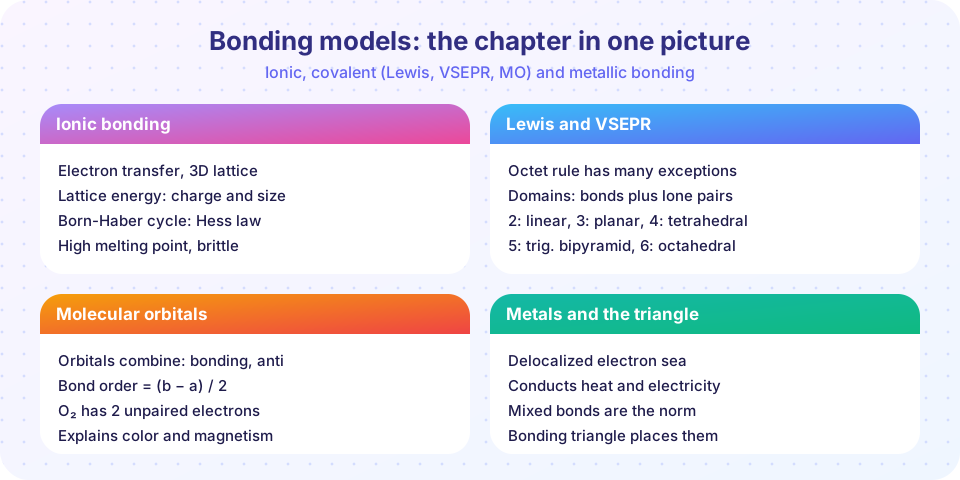
The chapter in a table
| Model | Best for | Key quantities |
|---|---|---|
| Ionic lattice | Salts, melting points, solubility | Lattice energy (∝ q₁q₂/d), Born-Haber cycle |
| Lewis structures | Counting electron pairs, formal charge | Valence electrons, octet, resonance |
| VSEPR | Shapes of molecules | Electron domains, lone-pair repulsion |
| Molecular orbitals | Magnetism, bond order, color | Bonding and antibonding MOs |
| Metallic bonding | Conductivity, malleability | Delocalized electrons |
| Bonding triangle | Placing a substance between types | Δχ and average χ |
Shortcuts worth remembering:
- NaCl lattice energy −787 kJ/mol; MgO about −3800 kJ/mol.
- Domains 2, 3, 4, 5, 6 give linear, trigonal planar, tetrahedral, trigonal bipyramidal, octahedral.
- Bond order = (bonding − antibonding)/2: N₂ 3, O₂ 2, F₂ 1, Ne₂ 0.
Try it
Extend the MO calculator to ions. Removing electrons takes them from the highest occupied MO; adding electrons puts them in the next one up. Change the species and see the effect on bond order and magnetism.
Press Run (or Ctrl + Enter) to see the result here.
Program input · what you'd type while the program runs
Type the answers before you press Run, one per line. Each time the program reads a line (with input()), it gets the next line from this box.
Check your understanding
Quick check · 10 questions
of 10 answered You scored / 10 · perfect!
-
1. Which compound has the largest lattice energy magnitude?
Higher charges (2+ and 2−) and small ions make MgO far more strongly bound. -
2. What is the shape of SF₄?
Sulfur has four bonds and one lone pair: five domains, trigonal bipyramidal, with the lone pair equatorial. -
3. Which species has the highest bond order?
N₂ has bond order 3; O₂ has 2, F₂ has 1 and O₂⁻ has 1.5. -
4. Why is CO₂ nonpolar even though its C=O bonds are polar?
Opposite bond dipoles in a linear molecule cancel out. -
5. How is a Born-Haber cycle used?
The lattice energy can't be measured directly, so it is found by subtracting the other measured steps from the enthalpy of formation. -
6. What is the bond order of O₂⁺?
O₂⁺ has 11 valence electrons: 8 bonding and 3 antibonding, so (8 − 3)/2 = 2.5. -
7. Which statement about the octet rule is correct?
BF₃ has an incomplete octet, SF₆ has an expanded one, and NO has an odd electron. -
8. In the bonding triangle, a substance with a large Δχ and low average electronegativity lies near:
A large electronegativity difference puts a compound near the ionic corner; CsF is an example. -
9. Which statement about molecular orbitals is true?
Out-of-phase combination produces a node between the nuclei and a higher-energy orbital. -
10. Which bond angle is correct for NH₃?
The lone pair compresses the H–N–H angle slightly below 109.5°.
Summary
- Choose the model to fit the question: lattice energy for salts, VSEPR for shapes, MO theory for magnetism and bond order.
- Lattice energy grows with charge and shrinks with distance; bond order tracks bond strength.
- Real bonds sit on a continuum between ionic, covalent and metallic.
Track your progress
Create a free account to tick off lessons and pick up where you left off on any device.
of Inorganic Chemistry lessons completed