


















Lesson 28 of 45 · Transition Metals
d-Block Properties: Electrons, Oxidation States and Color
Count d electrons, explain trends across the 3d row, see why oxidation states vary, and connect d-electron counts to color, magnetism and catalysis.
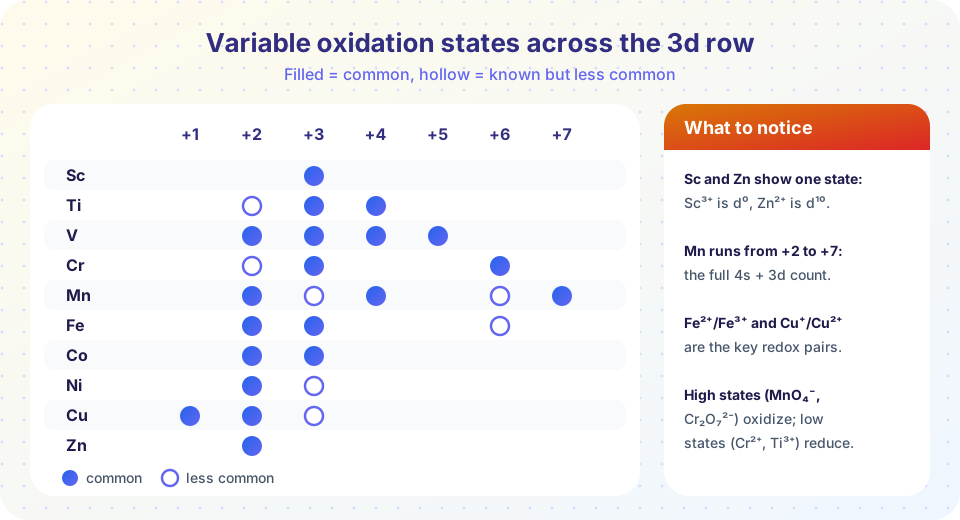
If you remember one skill from this chapter, make it counting d electrons. Once you know that an ion is d⁵ or d⁸, you can say whether it is likely to be colored, whether it is magnetic and how stable its oxidation state is. This lesson builds that skill and applies it to the common 3d metals, using a chart of oxidation states that you can read like a map.
What you will learn
- Compute the d-electron count of any 3d ion from its oxidation state.
- Explain why first ionization energies change so little across the 3d row.
- Explain why the highest oxidation states are oxidizing and the lowest are reducing.
- Link d⁰ and d¹⁰ ions to being colorless, and unpaired electrons to paramagnetism.
- Give examples of d-block catalysts.
Key terms
dⁿ count: the number of d electrons in an ion; for a 3d metal in oxidation state +m it equals (group number − m).
Oxoanion: an anion containing oxygen bonded to a central metal, such as MnO₄⁻ or CrO₄²⁻.
Paramagnetic / diamagnetic: attracted into / slightly repelled from a magnetic field; the first requires unpaired electrons.
Spin-only moment: the magnetic moment predicted from n unpaired electrons, μ = √(n(n+2)) Bohr magnetons.
Counting d electrons
A neutral 3d atom has group number valence electrons in total (Sc 3, Ti 4, ..., Zn 12). Removing electrons to reach oxidation state +m leaves group − m of them, all in the d subshell for ions. This gives a quick formula:
d count = group number − oxidation state
| Ion | Group | d count |
|---|---|---|
| Ti⁴⁺ | 4 | d⁰ |
| Cr³⁺ | 6 | d³ |
| Mn²⁺ | 7 | d⁵ |
| Fe³⁺ | 8 | d⁵ |
| Cu²⁺ | 11 | d⁹ |
| Zn²⁺ | 12 | d¹⁰ |
| Mn⁷⁺ in MnO₄⁻ | 7 | d⁰ |
Trends across the 3d row
The first ionization energies hardly change across Sc to Cu: about 630 kJ/mol for Sc up to 745 for Cu, with Mn and Zn slightly higher (Mn 717, Zn 906) because of their half-filled and filled subshells. That is a striking contrast to the s and p blocks. The extra protons added along the row are almost balanced by extra 3d electrons, which are poor at shielding one another from the nucleus, so atoms shrink only slightly and then stay nearly the same size.
Physical properties show the pattern of metallic bonding: melting points and densities peak in the middle of the row, where the most d electrons contribute to bonding, and fall toward zinc, which is volatile and low-melting.
Why so many oxidation states?
Because the 4s and 3d levels are close, successive ionization energies increase slowly, as the oxidation state chart shows. The patterns repeat:
- Highest states reach the group number up to Mn (+7). They occur as oxoanions, such as
MnO₄⁻,CrO₄²⁻andCr₂O₇²⁻, and are strong oxidizers. - Beyond Mn the highest state falls: Fe reaches +6 only in rare ferrates, and Co, Ni, Cu, Zn are mostly +2 (Cu also +1).
- Lowest states (Ti³⁺, V²⁺, Cr²⁺) are reducing agents: they hold electrons loosely.
- Across the row, +2 gets more stable relative to +3. Fe²⁺ is easily oxidized to Fe³⁺, but Co³⁺ and Ni³⁺ are strong oxidizers, which is why Co²⁺ and Ni²⁺ dominate their chemistry.
The special stability of d⁵ and d¹⁰ explains that Mn²⁺ (d⁵) is hard to oxidize and Fe³⁺ (d⁵) is a more comfortable state than Fe²⁺ in many ligand environments.
Color and magnetism: a first look
Most aqueous 3d ions are colored. Here are some common aqua ions:
| Ion | d count | Color of aqueous ion |
|---|---|---|
| Sc³⁺ | d⁰ | colorless |
| Ti³⁺ | d¹ | violet |
| V³⁺ | d² | green |
| Cr³⁺ | d³ | violet-grey (appears green with some ligands) |
| Mn²⁺ | d⁵ | very pale pink |
| Fe²⁺ | d⁶ | pale green |
| Fe³⁺ | d⁵ | yellow to brown (from hydrolysis) |
| Co²⁺ | d⁷ | pink |
| Ni²⁺ | d⁸ | green |
| Cu²⁺ | d⁹ | blue |
| Zn²⁺ | d¹⁰ | colorless |
The rule is simple: d⁰ and d¹⁰ ions have no d–d transitions and are colorless in compounds with colorless ligands. Chapter 7 explains the others using crystal field theory. One famous exception to "d⁰ is colorless" is permanganate: MnO₄⁻ is d⁰ yet deep purple, because its color comes from charge transfer from oxygen to manganese, not from d–d transitions. Chromate CrO₄²⁻ (yellow) and dichromate Cr₂O₇²⁻ (orange) work the same way.
Magnetism follows unpaired electrons. Ions with unpaired d electrons are paramagnetic; the spin-only formula μ = √(n(n+2)) predicts the moment in Bohr magnetons.
Catalysts
Partly filled d orbitals let metals bind and activate molecules: Fe in the Haber process, V₂O₅ in the contact process, Pt, Pd and Rh in catalytic converters, Ni in hydrogenation of fats and Ti compounds in polymerization (Ziegler–Natta). Variable oxidation states let a metal shuttle electrons in a catalytic cycle.
Common misconceptions
"d⁰ ions are always colorless." Not when charge-transfer bands occur (MnO₄⁻).
"Colored means paramagnetic." Colored d⁶ low-spin complexes can be diamagnetic; you need to count unpaired electrons.
"The oxidation number is the real charge." Mn in MnO₄⁻ is not literally 7+; it is a counting convention.
Try it
Compute d counts and the spin-only magnetic moment for common M²⁺ aqua ions in their high-spin octahedral configurations. The unpaired-electron counts are entered by hand, and the magnetic-moment plot uses the spin-only formula; real values differ a little.
Press Run (or Ctrl + Enter) to see the result here.
Program input · what you'd type while the program runs
Type the answers before you press Run, one per line. Each time the program reads a line (with input()), it gets the next line from this box.
Now a d-count calculator for oxidation states. It uses d = group − oxidation state, so it applies only to the 3d metals listed.
Press Run (or Ctrl + Enter) to see the console output here.
No output.
Check your understanding
Quick check · 5 questions
of 5 answered You scored / 5 · perfect!
-
1. What is the d count of Mn in MnO₄⁻?
Mn is +7 in MnO₄⁻, and group 7 − 7 = 0. -
2. Why are first ionization energies almost constant across the 3d row?
The nuclear charge increases, but so does electron repulsion among d electrons, so the effective pull changes little. -
3. Which ion is paramagnetic with five unpaired electrons?
Mn²⁺ is d⁵; all five d electrons are unpaired in high-spin octahedral geometry. -
4. Which statement about permanganate is correct?
MnO₄⁻ has no d electrons, so d–d transitions are impossible; its intense color comes from charge transfer. -
5. Which is likely a strong oxidizing agent?
High oxidation states such as Mn(VII) are strongly oxidizing; low states (Cr²⁺, V²⁺, Ti³⁺) are reducing.
Summary
- d count = group number − oxidation state; use it to predict color and magnetism.
- First ionization energies are nearly constant across the 3d row; melting points and densities peak in the middle.
- Highest states appear as oxoanions and oxidize; lowest states reduce; +2 grows more stable to the right.
- d⁰ and d¹⁰ ions lack d–d transitions; unpaired electrons give paramagnetism with μ ≈ √(n(n+2)).
Next: Redox and Frost Diagrams
Track your progress
Create a free account to tick off lessons and pick up where you left off on any device.
of Inorganic Chemistry lessons completed