


















Lesson 21 of 45 · Main Group Chemistry
Chapter 5 Overview: The Main Groups
A map of main-group chemistry: the s and p blocks, the trends that organize them, and a preview of the five lessons in this chapter.
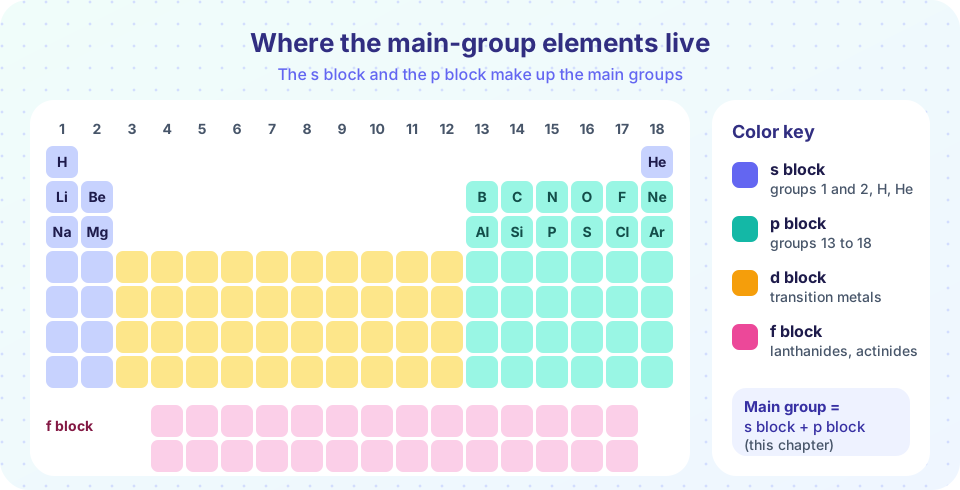
Most of the elements you meet in daily life sit in the main groups: the sodium in salt, the carbon in your pencil, the nitrogen and oxygen in the air, the chlorine in swimming pools. These are the s-block and p-block elements, the tall columns at the left and right of the periodic table. In this chapter you will stop treating the table as a poster and start using it as a prediction machine: given an element's position, you will be able to say what it looks like, what compounds it forms and how it reacts.
What you will learn
- Which elements are "main group" and why the label matters.
- The two periodic trends that explain most main-group behavior.
- Three recurring surprises: the first-row anomaly, the inert pair effect and diagonal relationships.
- What each lesson in this chapter covers.
Key terms
Main-group element: an element in the s block or p block, whose valence electrons sit in the outermost s and p orbitals.
Valence electrons: the outer electrons that take part in bonding; for main-group elements this equals the group number (units digit for groups 13 to 18).
Oxidation state: the charge an atom would have if every bond were fully ionic; a bookkeeping tool for tracking electrons.
Catenation: the ability of an element to form chains and rings of its own atoms, strongest for carbon.
The big picture
Every main-group element is fixed by its valence configuration: ns¹ for group 1, ns² for group 2, and ns² np¹ through ns² np⁶ for groups 13 to 18. That one fact predicts the common ion charge or number of bonds. Sodium (3s¹) loses one electron and forms Na⁺. Chlorine (3s² 3p⁵) needs one electron and forms Cl⁻ or one covalent bond. Carbon (2s² 2p²) shares four electrons and forms four bonds.
Five regions, five personalities
Two trends do most of the work
Three surprises
What comes next
Trend 1: moving down a group
Going down a column adds a shell of electrons. Atoms get larger, the outer electrons feel less pull and are easier to remove. That is why the metals get more reactive down group 1 (lithium is calm in water; caesium is explosive) and why nonmetals become more metallic: carbon is a nonmetal, silicon a semiconductor, tin and lead metals.
Trend 2: moving across a period
Across a period the nuclear charge grows while the new electrons enter the same shell, so atoms shrink and hold on to their electrons more tightly. Ionization energy and electronegativity both rise from left to right. Here are the first ionization energies for periods 2 and 3, in kJ/mol.
| Element | Li | Be | B | C | N | O | F | Ne |
|---|---|---|---|---|---|---|---|---|
| IE₁ | 520 | 900 | 801 | 1086 | 1402 | 1314 | 1681 | 2081 |
| Element | Na | Mg | Al | Si | P | S | Cl | Ar |
| IE₁ | 496 | 738 | 578 | 786 | 1012 | 1000 | 1251 | 1521 |
The rise is not perfectly smooth. Boron dips below beryllium because its outer electron is in a higher-energy 2p orbital; oxygen dips below nitrogen because one 2p orbital now holds a repelling pair. Explaining these small dips is a classic exam question, and the plot below makes them easy to see.
Three recurring surprises
- The first-row anomaly. Period 2 elements (Li to F) are small and have no
dorbitals. They obey the octet rule strictly and form strong π bonds (N≡N, O=O, C=C). Heavier members prefer single bonds and can exceed the octet (PF₅, SF₆). This is why N₂ is a gas but phosphorus forms P₄ and polymers. - The inert pair effect. In heavy p-block elements, the
ns²pair is reluctant to take part in bonding. Tl⁺, Pb²⁺ and Bi³⁺ are more stable than Tl³⁺, Pb⁴⁺ and Bi⁵⁺. You will meet it again in the group 13 and 14 lesson. - Diagonal relationships. Moving one step right and one step down often cancels the trends, so Li resembles Mg, Be resembles Al and B resembles Si.
What is in this chapter
| Lesson | Focus |
|---|---|
| s-Block Metals | Groups 1 and 2: ionic bonding, reactivity, flame colors, hydrogen |
| Groups 13 and 14 | Boron hydrides, aluminum, carbon allotropes, silicon and silicates |
| Groups 15 and 16 | Nitrogen ladder, phosphorus, oxygen, sulfur, oxoacids |
| Halogens and Noble Gases | Oxidizing power, interhalogens, xenon compounds |
| Chapter Review | One-picture summary and a ten-question check |
Common misconceptions
"Group number always equals charge." It does for groups 1 and 2, but p-block elements usually show several oxidation states, and the heavy ones often prefer the state two lower than the group maximum.
"Ionization energy rises steadily across a period." The overall trend rises, but dips occur at group 13 and group 16 for the orbital reasons above.
Try it
First, plot the first ionization energies of periods 2 and 3 and spot the dips. The data are textbook values; the code only draws them.
Press Run (or Ctrl + Enter) to see the result here.
Program input · what you'd type while the program runs
Type the answers before you press Run, one per line. Each time the program reads a line (with input()), it gets the next line from this box.
Second, a small calculator that applies a rule of thumb: the electronegativity difference between two bonded atoms suggests whether the bond is nonpolar covalent, polar covalent or ionic. It is a simplified model, not a law.
Press Run (or Ctrl + Enter) to see the console output here.
No output.
Check your understanding
Quick check · 5 questions
of 5 answered You scored / 5 · perfect!
-
1. Which elements are called main-group elements?
Main-group elements are the s-block and p-block elements: groups 1 and 2 and groups 13 to 18. -
2. Why does ionization energy generally rise across a period?
More protons pull the same shell harder, so atoms shrink and electrons are harder to remove. -
3. Why is the first ionization energy of oxygen lower than that of nitrogen?
In nitrogen each 2p orbital has one electron. In oxygen one orbital is doubly occupied, and pair repulsion makes that electron easier to remove. -
4. The inert pair effect means that...
Tl⁺, Pb²⁺ and Bi³⁺ illustrate it: the ns² pair stays on the atom. -
5. Which pair shows a diagonal relationship?
Li and Mg are neighbors on a diagonal. Na and K, C and Si, and F and Cl are vertical neighbors in the same group.
Summary
- Main-group elements are the s-block and p-block elements; valence configuration predicts their typical charges and bond counts.
- Atoms grow down a group and shrink across a period; ionization energy and electronegativity do the opposite.
- Three surprises recur: the first-row anomaly, the inert pair effect and diagonal relationships.
- The chapter visits the s block, groups 13 and 14, groups 15 and 16, and the halogens and noble gases.
Next: s-Block Metals
Track your progress
Create a free account to tick off lessons and pick up where you left off on any device.
of Inorganic Chemistry lessons completed