


















Lesson 14 of 45 · Bonding Models
Molecular orbital theory
Learn how atomic orbitals combine into bonding and antibonding molecular orbitals, build the MO diagram of O2, and use bond order to predict bond strength and magnetism.
A Lewis structure for oxygen, O=O, puts every electron in a pair. Yet liquid oxygen is drawn into the field of a strong magnet and will hang between its poles, which means O₂ has unpaired electrons. Lewis and VSEPR cannot explain this. Molecular orbital (MO) theory can, and it does it with one clean idea: when atoms come together, their atomic orbitals combine into new orbitals that belong to the whole molecule.
What you will learn
- How atomic orbitals combine into bonding and antibonding MOs
- How to fill an MO diagram for a homonuclear diatomic molecule
- How to calculate bond order and predict magnetism
- Why the energy order of σ and π orbitals changes across period 2
Key terms
- Molecular orbital (MO): a wave function for an electron spread over the whole molecule.
- Bonding MO: lower in energy than the atomic orbitals, with electron density between the nuclei.
- *Antibonding MO (marked ): higher in energy, with a node between the nuclei.
- Bond order:
(bonding electrons − antibonding electrons) / 2. - σ and π: σ orbitals are symmetric around the bond axis; π orbitals have a nodal plane containing the axis.
Adding and subtracting waves
Think of two atomic orbitals as two waves. They can combine in two ways:
- In phase (add). Electron density builds up between the nuclei. The result is a bonding MO with lower energy than either atomic orbital.
- Out of phase (subtract). A node appears between the nuclei. The result is an antibonding MO with higher energy.
The number of MOs always equals the number of atomic orbitals you start with. Two atoms contribute two 1s orbitals to make σ1s and σ*1s. Each MO holds two electrons, filled by the same rules as atoms: lowest energy first, Pauli, and Hund for degenerate MOs.
Bond order
Electrons in bonding MOs help hold the atoms together; electrons in antibonding MOs push them apart. So:
bond order = (number in bonding MOs − number in antibonding MOs) / 2
- H₂: two electrons in σ1s, bond order 1.
- He₂: two in σ1s and two in σ*1s, bond order 0. There is no stable He₂ molecule.
- Higher bond order means a shorter, stronger bond.
The period 2 diatomics
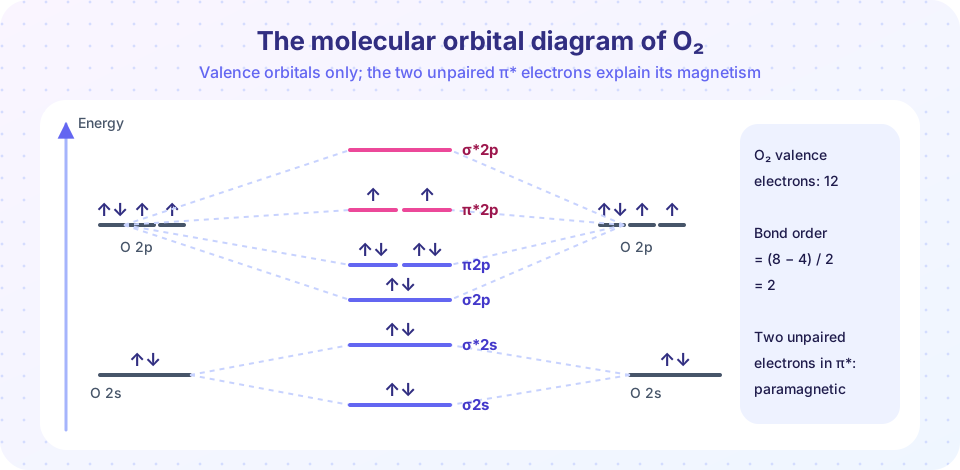
For the molecules from Li₂ to Ne₂ the valence MOs come from the 2s and 2p orbitals: eight MOs in all. In order of energy for O₂, F₂ and Ne₂:
σ2s < σ*2s < σ2p < π2p (two) < π*2p (two) < σ*2p
For Li₂ through N₂, 2s and 2p are close in energy and mix, which pushes σ2p above π2p:
σ2s < σ*2s < π2p (two) < σ2p < π*2p (two) < σ*2p
The order changes at O₂ because the 2s–2p gap grows across the period. Experiments (photoelectron spectra and the magnetism of B₂) confirm this switch.
Oxygen
O₂ has 12 valence electrons. They fill σ2s², σ2s², σ2p², π2p⁴ and π2p² with one electron in each π* orbital (Hund's rule). Bonding electrons: 8; antibonding: 4. Bond order = (8 − 4)/2 = 2, matching O=O. The two unpaired electrons make O₂ paramagnetic.
Nitrogen
N₂ has 10 valence electrons: σ2s², σ*2s², π2p⁴, σ2p². Bond order = (8 − 2)/2 = 3. All electrons are paired (diamagnetic), and the very strong triple bond (945 kJ/mol) explains why N₂ is so unreactive.
Ions
MO theory predicts the effect of adding or removing electrons. Removing an electron from O₂ takes it from an antibonding π* orbital, so O₂⁺ has bond order 2.5 and a stronger, shorter bond than O₂. Adding an electron gives O₂⁻ (superoxide) with bond order 1.5 and a weaker bond.
MO theory versus Lewis and VSEPR
MO theory handles things that Lewis structures cannot: unpaired electrons in O₂ and B₂, fractional bond orders, colors (light promotes electrons between MOs), and spectroscopy. The price is complexity, so for bond shapes of polyatomic molecules VSEPR remains the fast tool. For molecules with different atoms (heteronuclear, like CO or HF) the MO diagram becomes lopsided: the MOs lie closer to the more electronegative atom's orbitals, which links neatly to bond polarity. You will meet the same ideas for metal complexes in chapter 7.
Common misconceptions
- "Antibonding electrons cancel bonding electrons one for one." The net effect is the difference, but antibonding orbitals are usually raised more than bonding orbitals are lowered, so the cancellation is slightly worse than it looks.
- "Bond order must be a whole number." O₂⁺ is 2.5 and O₂⁻ is 1.5.
- "MOs are just a fancier way to draw Lewis structures." They give different, testable predictions, such as the magnetism of O₂.
Try it
The program fills the valence MOs of the homonuclear diatomics from Li₂ to Ne₂, using the correct orbital order for each, and prints bond order and magnetism.
Press Run (or Ctrl + Enter) to see the result here.
Program input · what you'd type while the program runs
Type the answers before you press Run, one per line. Each time the program reads a line (with input()), it gets the next line from this box.
Bond order should track bond strength. The plot compares approximate dissociation energies of some diatomics with their bond orders.
Press Run (or Ctrl + Enter) to see the result here.
Program input · what you'd type while the program runs
Type the answers before you press Run, one per line. Each time the program reads a line (with input()), it gets the next line from this box.
Check your understanding
Quick check · 5 questions
of 5 answered You scored / 5 · perfect!
-
1. What is the bond order of N₂?
N₂ has 8 bonding and 2 antibonding valence electrons: (8 − 2)/2 = 3. -
2. Why is O₂ paramagnetic?
By Hund's rule the last two electrons occupy the two π* orbitals separately with parallel spins. -
3. Which has the strongest oxygen-oxygen bond?
Removing an electron from an antibonding π* orbital raises the bond order to 2.5. -
4. What is the bond order of He₂?
Two bonding and two antibonding electrons give (2 − 2)/2 = 0, so He₂ is not stable. -
5. How many molecular orbitals form from the combination of two atomic orbitals?
The number of MOs equals the number of atomic orbitals combined: one bonding and one antibonding.
Summary
- Atomic orbitals combine into bonding (lower) and antibonding (higher) molecular orbitals; the number of MOs equals the number of AOs.
- Bond order is (bonding − antibonding electrons)/2 and tracks bond strength and length.
- O₂ has two unpaired electrons in π* orbitals, explaining its paramagnetism; N₂ has a triple bond.
- For Li₂ to N₂ the σ2p MO lies above π2p because of 2s-2p mixing; for O₂ and beyond the order flips.
Next: Chapter 3 review
Track your progress
Create a free account to tick off lessons and pick up where you left off on any device.
of Inorganic Chemistry lessons completed