


















Lesson 26 of 45 · Main Group Chemistry
Chapter 5 Review: Main Group Chemistry
A one-page recap of s-block, p-block, nitrogen, oxygen and halogen chemistry with a recap table and a ten-question mixed quiz.
You have now toured the whole s and p blocks. This review pulls the chapter into one picture and one table, then tests you with ten mixed questions. If you can explain each row of the table in your own words, you are ready for the transition metals.
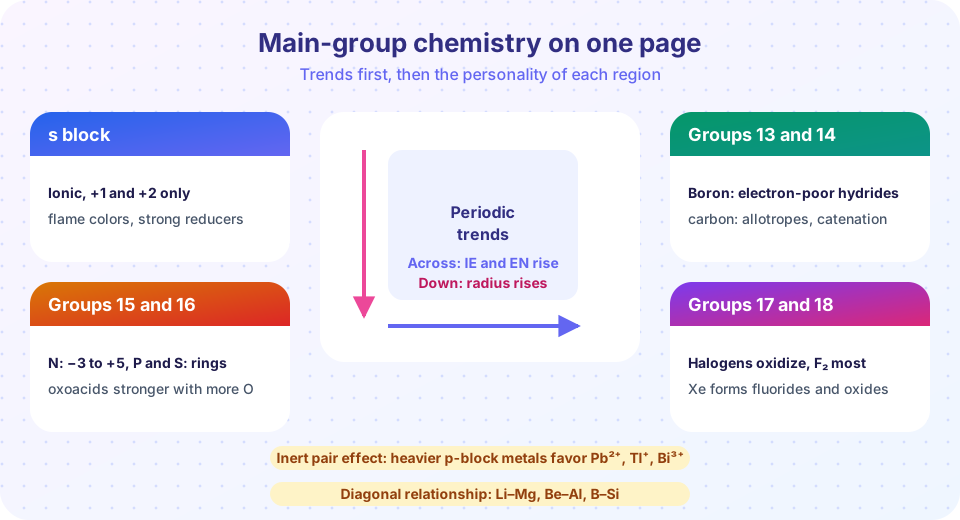
What you will learn
- Connect each region of the s and p blocks to its signature chemistry.
- Practice choosing the right explanation (size, charge, bond strength, shielding) for a trend.
- Check yourself against ten mixed questions.
The chapter in a table
| Region | Signature | Key example |
|---|---|---|
| Group 1 | Ionic M⁺, reactivity rises down the group; Li has the most negative E° because of hydration | Flame colors, NaOH from brine |
| Group 2 | M²⁺; hydroxides more soluble and carbonates more stable down the group; Be is covalent | BaSO₄ insoluble, MgCO₃ decomposes easily |
| Boron | Electron-deficient, Lewis acidic | BF₃, B₂H₆ |
| Aluminum | Passivating oxide, amphoteric | Al₂O₃, Hall–Héroult cell |
| Carbon and silicon | Allotropes and catenation; SiO₂ is a network, CO₂ a molecule | Diamond, graphite, silicates |
| Tl, Sn, Pb | Inert pair effect | Tl⁺, Pb²⁺ |
| Nitrogen | −3 to +5; triple bond makes N₂ inert | Haber, Ostwald |
| Phosphorus and sulfur | Rings and hypervalence; strong E–O bonds | P₄, PCl₅, contact process |
| Oxoacids | pKa ≈ 8 − 5n | HClO to HClO₄ |
| Halogens | Oxidizers, F₂ strongest; disproportionation in base | Bleach, displacement |
| Noble gases | Xe, Kr fluorides and oxides | XeF₂, XeF₄ |
Key terms
Inert pair effect: reluctance of the heavy p-block ns² electrons to participate in bonding.
Amphoteric: reacts with both acids and bases.
Hypervalent: apparently more than eight electrons at a main-group atom.
Disproportionation: one species both oxidized and reduced.
Common misconceptions
"Trends have no exceptions." The dips at B and O in ionization energy and the strange fluorine bond energies are the interesting exceptions. Always check them against orbital and electron-repulsion reasons.
"Memorize each compound separately." Most facts follow from a handful of ideas: size, charge density, bond strength, shielding and electron count.
Try it
Electronegativity rises across a period. Plot both periods and see how the metal-to-nonmetal change appears as a steady climb. The Pauling values are textbook numbers.
Press Run (or Ctrl + Enter) to see the result here.
Program input · what you'd type while the program runs
Type the answers before you press Run, one per line. Each time the program reads a line (with input()), it gets the next line from this box.
Use this small flashcard deck to test yourself. Read the question, answer aloud, then compare.
Press Run (or Ctrl + Enter) to see the console output here.
No output.
Check your understanding
Quick check · 10 questions
of 10 answered You scored / 10 · perfect!
-
1. Ionization energy generally rises across a period. Which pair explains the dips at group 13 and group 16?
Boron's outer electron is in a 2p orbital, and oxygen has a doubly occupied 2p orbital. -
2. Which group 2 carbonate decomposes on heating at the lowest temperature?
The small, highly polarizing Mg²⁺ ion destabilizes the carbonate most. -
3. Which is an electron-deficient compound?
Diborane has too few electrons for ordinary two-center bonds and uses three-center bonds. -
4. The amphoteric oxide among these is...
Al₂O₃ dissolves in both acid and base. -
5. Diamond differs from graphite because diamond...
Diamond's tetrahedral network has no delocalized electrons. -
6. Which oxidation state of nitrogen is found in NH₄⁺?
Four hydrogens give +4 and the charge is +1, so nitrogen is −3. -
7. Pauling's rule predicts pKa ≈ 8 − 5n. For HClO₃ (n = 2) the estimate is...
8 − 5 × 2 = −2. -
8. Which reaction occurs?
A more powerful oxidizer (higher E°) displaces the halide of a weaker one. -
9. The inert pair effect explains why...
The heavy element keeps its ns² pair. -
10. XeF₂ is linear because xenon has...
Five electron pairs form a trigonal bipyramid; three lone pairs sit in the equatorial plane, leaving the two F atoms on the axis.
Summary
- Position in the s or p block predicts ions, bond counts and oxidation states; trends in size, ionization energy and electronegativity explain most behavior.
- Period 2 is special (strict octet, π bonds); heavier atoms can be hypervalent and show the inert pair effect.
- Oxides move from basic to acidic across a period; oxoacid strength follows Pauling's rule.
- Halogens oxidize and disproportionate; xenon forms compounds with F and O.
Track your progress
Create a free account to tick off lessons and pick up where you left off on any device.
of Inorganic Chemistry lessons completed