


















Lesson 40 of 45 · Solid State and Bioinorganic Chemistry
Chapter 8 Review: Solids and Bioinorganic Chemistry
Recap unit cells, ionic structures, lattice energy, band theory and bioinorganic metals with a summary picture, a table and a ten-question quiz.
This chapter moved from the geometry of crystals to the energy that holds them together, then to the electrons that flow through them, and finally to the metals that make life work. The thread connecting all four topics is the same: structure sets properties. Review the picture and the table, then try the ten questions.
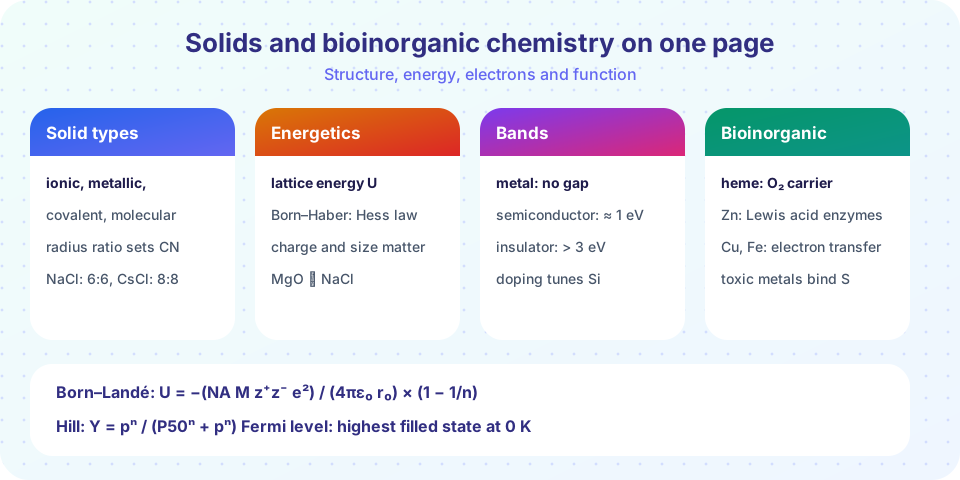
What you will learn
- Connect unit cells, lattice energy, bands and biological metal sites in one story.
- Practice numerical problems on density, lattice energy and band gaps.
- Check yourself with ten mixed questions.
Chapter in a table
| Topic | Key facts | Example |
|---|---|---|
| Unit cells | sc 1, bcc 2, fcc 4 atoms; packing 52%, 68%, 74% | Cu is fcc, Fe is bcc |
| Density | ρ = Z M / (N_A a³) | Cu: 8.9 g/cm³ |
| Ionic structures | rock salt 6:6, CsCl 8:8, zinc blende 4:4, fluorite 8:4 | NaCl, CsCl, ZnS, CaF₂ |
| Radius ratio | 0.225–0.414 CN 4; 0.414–0.732 CN 6; 0.732–1 CN 8 | NaCl 0.56 |
| Lattice energy | grows with charge, falls with size; Born–Haber via Hess | NaCl −787 kJ/mol |
| Bands | metal: partly filled; semiconductor: small gap; insulator: large gap | Si 1.12 eV |
| Doping | P gives n-type, B gives p-type | LEDs, solar cells |
| Heme | Fe²⁺ in porphyrin; Hill n ≈ 2.8 | Hb P50 ≈ 26 mmHg |
| Zinc enzymes | redox-inactive Lewis acid | carbonic anhydrase |
| Toxic metals | bind S groups; chelators remove them | EDTA, cisplatin's Pt |
Key terms
Packing efficiency: fraction of volume filled by atoms.
Lattice energy: energy released forming one mole of ionic solid from gaseous ions.
Band gap: energy between valence and conduction bands.
Cooperativity: binding at one site alters affinity at others.
Common misconceptions
"Higher coordination number always means a more stable structure." Stability depends on lattice energy and ion sizes; the radius ratio only suggests which arrangement lets ions touch.
"The unit cell is the whole crystal." It is the smallest repeating unit; a crystal contains enormous numbers of them.
Try it
Compare lattice energies. The values are rounded textbook Born–Haber results in kJ/mol (as magnitudes).
Press Run (or Ctrl + Enter) to see the result here.
Program input · what you'd type while the program runs
Type the answers before you press Run, one per line. Each time the program reads a line (with input()), it gets the next line from this box.
Use these flashcards to revise.
Press Run (or Ctrl + Enter) to see the console output here.
No output.
Check your understanding
Quick check · 10 questions
of 10 answered You scored / 10 · perfect!
-
1. How many atoms does a body-centered cubic cell contain?
8 corners × 1/8 + 1 center = 2. -
2. A metal is fcc with a = 400 pm and M = 27 g/mol. What is its density?
ρ = 4 × 27 / (6.022×10²³ × (4.00×10⁻⁸ cm)³) = 108 / 38.5 ≈ 2.8 g/cm³. -
3. Which ion pair has the largest lattice energy magnitude?
Higher charges and small ions give the largest lattice energy. -
4. A radius ratio of 0.92 suggests which coordination number?
0.732 to 1.0 corresponds to CN 8, as in CsCl. -
5. Which describes the band structure of an insulator?
A large band gap keeps electrons from the conduction band. -
6. Boron-doped silicon is...
Boron has three valence electrons, creating holes. -
7. Hemoglobin's Hill coefficient is about 2.8. This indicates...
n greater than 1 means binding is cooperative. -
8. An LED has Eg = 1.8 eV. Its approximate wavelength is...
1239.84 / 1.8 ≈ 689 nm, red. -
9. Which enzyme metal is d¹⁰ and redox-inactive?
Zn²⁺ is d¹⁰. -
10. Carbon monoxide is dangerous mainly because it...
CO competes with O₂ for the heme site and wins at low partial pressures.
Summary
- Unit-cell counts give density and radius; fcc and hcp are the most efficient packings.
- Ionic structures follow radius ratios loosely; lattice energy grows with charge and shrinks with size.
- Band gaps classify metals, semiconductors and insulators; doping and junctions underlie electronics.
- Metals in biology work through tuned coordination spheres: heme for O₂, zinc for Lewis acid catalysis, copper for electron transfer.
Next: Practice Calculations
Track your progress
Create a free account to tick off lessons and pick up where you left off on any device.
of Inorganic Chemistry lessons completed