


















Lesson 6 of 45 · Atomic Structure and Periodicity
Chapter 2 overview: atomic structure and periodicity
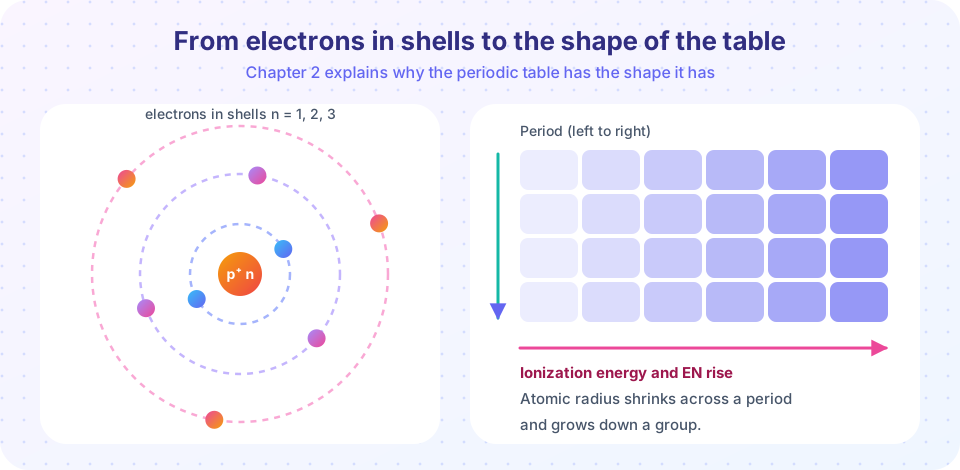
See the big picture of chapter 2: how the quantum model of the atom explains orbitals, electron configurations and the trends that give the periodic table its shape.
Why does sodium give up one electron while chlorine grabs one? Why are the noble gases so aloof, and why does the table break into blocks? Every one of these questions has the same answer: the arrangement of electrons around the nucleus. This chapter builds that picture in four steps and then uses it to explain the periodic trends you will rely on for the rest of the course.
What you will learn
- The story from Bohr's shells to the quantum-mechanical orbital
- What each lesson in this chapter covers
- How to link an electron arrangement to a periodic trend
From shells to orbitals
In 1913 Niels Bohr proposed that the electron in hydrogen occupies fixed circular orbits with fixed energies, and that light is emitted when it jumps between them. The model matched the hydrogen spectrum with great accuracy, including the wavelengths you can compute below, but it failed for every atom with more than one electron.
The fix came in the 1920s with wave mechanics (Schrödinger, Heisenberg, Born). An electron has no path. It has a wave function whose square gives the probability of finding it at each point. The regions of space where that probability is high are called orbitals. They come in different shapes (s, p, d, f), each with a characteristic energy. Filling these orbitals in order of increasing energy, subject to two simple rules, produces the electron configuration of every element.
What each lesson covers
| Lesson | Question it answers |
|---|---|
| Orbitals and quantum numbers | What are s, p, d and f orbitals, and how are they labeled? |
| Electron configurations | In what order do electrons fill orbitals, and what are the exceptions? |
| Periodic trends | Why do radius, ionization energy and electronegativity change as they do? |
| Chapter 2 review | Do I have the whole picture? |
Four steps to the periodic table
- Wave model
- Quantum numbers
- Filling rules
- Trends
Three forces behind every trend
Try it
Bohr's model got one thing very right: the spectrum of hydrogen. When the electron drops from level n down to level 2, the atom emits visible light. The wavelength follows the Rydberg formula 1/λ = R (1/2² − 1/n²). The program below computes the first Balmer lines and draws them as a spectrum.
Press Run (or Ctrl + Enter) to see the result here.
Program input · what you'd type while the program runs
Type the answers before you press Run, one per line. Each time the program reads a line (with input()), it gets the next line from this box.
Check your understanding
Quick check · 3 questions
of 3 answered You scored / 3 · perfect!
-
1. What does an orbital represent in the quantum model?
An orbital is described by a wave function, and the square of the wave function gives the probability of finding the electron. -
2. Why did Bohr's model fail for atoms with more than one electron?
Bohr's model treated a single electron in a fixed circular orbit; multi-electron atoms need the full quantum treatment. -
3. Which three factors explain most periodic trends?
How strongly the nucleus pulls on an electron depends on charge, how much inner electrons shield it, and how far away it is.
Summary
- The quantum model replaces circular orbits with orbitals: probability regions with definite energies.
- Filling orbitals from lowest energy upward gives each element's configuration.
- Nuclear charge, shielding and distance explain periodic trends.
Track your progress
Create a free account to tick off lessons and pick up where you left off on any device.
of Inorganic Chemistry lessons completed