


















Lesson 24 of 45 · Main Group Chemistry
Groups 15 and 16: Nitrogen, Phosphorus, Oxygen and Sulfur
Oxidation states of nitrogen, phosphorus allotropes, oxides and oxoacids, ozone and peroxide, and the sulfur chemistry behind sulfuric acid.
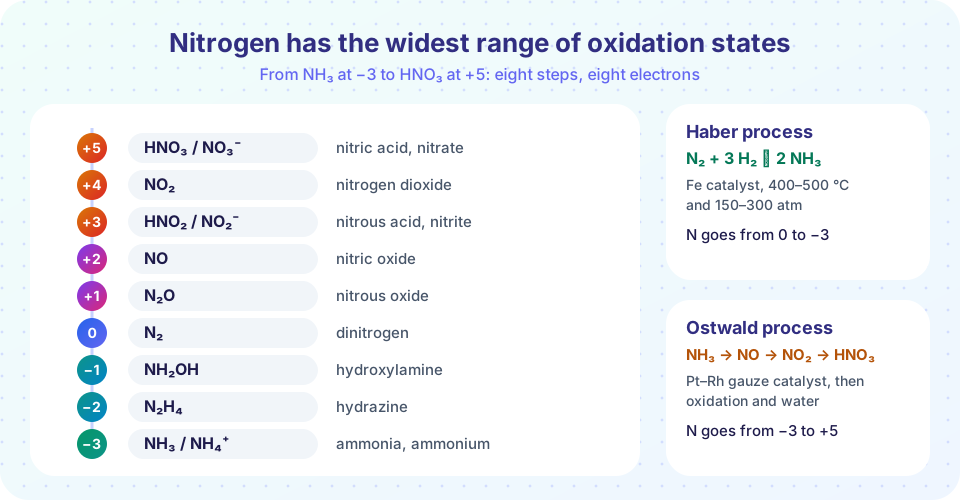
Groups 15 and 16 are where main-group chemistry becomes a story about redox. Nitrogen runs through every oxidation state from −3 to +5. Oxygen is the element that defines "oxide" and "oxidation." Phosphorus and sulfur are their heavier cousins and, thanks to larger size, build rings, chains and acids that their lighter neighbors cannot. In this lesson you will use a single ladder diagram for nitrogen and one simple rule for the strength of oxoacids to make sense of dozens of compounds.
What you will learn
- Place the common nitrogen compounds on the oxidation-state ladder and explain N₂ inertness.
- Compare the allotropes and chloride chemistry of nitrogen and phosphorus.
- Describe the allotropes of oxygen and sulfur and the contact process.
- Rank oxoacid strength with Pauling's rule.
- Classify oxides as acidic, basic or amphoteric.
Key terms
Oxoacid: an acid in which the acidic hydrogens are attached to oxygen atoms that are bonded to a central atom, such as H₂SO₄.
Disproportionation: a reaction where one species is both oxidized and reduced, for example 2 H₂O₂ → 2 H₂O + O₂.
Hypervalent: describing a main-group atom that appears to have more than eight electrons around it, such as P in PCl₅.
Acidic oxide: an oxide that reacts with water or base to form an acid or salt; typically a nonmetal oxide such as SO₃.
Nitrogen: strong triple bond, many states
N₂ is nearly inert at room temperature because of the N≡N triple bond, 945 kJ/mol. That is why air, 78% nitrogen, does not burn and why fixing nitrogen into ammonia needs a catalyst and high pressure: the Haber process, N₂ + 3 H₂ ⇌ 2 NH₃, over an iron catalyst at roughly 400–500 °C and 150–300 atm. About half of the nitrogen atoms in your body have passed through that process in fertilizer.
Ammonia (−3) is a base and a ligand with a lone pair on nitrogen. Going up the ladder: hydrazine N₂H₄ (−2) is a rocket fuel and a reductant, N₂O (+1) is "laughing gas," NO (+2) is a radical and a biological messenger, NO₂ (+4) is a brown gas that dimerizes to colorless N₂O₄, and nitric acid HNO₃ (+5) is a strong acid and oxidizer made by the Ostwald process (NH₃ → NO → NO₂ → HNO₃). Because the middle states often disproportionate, 3 NO₂ + H₂O → 2 HNO₃ + NO is a standard step.
Phosphorus: the first-row anomaly in action
Nitrogen forms N₂; phosphorus forms P₄, a tetrahedron of white phosphorus whose 60° bond angles are strained, making it so reactive that it ignites in air and is stored under water. On heating it gives red phosphorus (a polymeric chain network) and under pressure black phosphorus (layered, like graphite). Single P–P bonds are weak, but P–O bonds are strong: this is why phosphorus loves oxygen. Burning P₄ gives P₄O₁₀, which hydrates to phosphoric acid: P₄O₁₀ + 6 H₂O → 4 H₃PO₄.
Phosphorus also forms PCl₅ (trigonal bipyramidal) where nitrogen cannot form NCl₅: N is too small. The old explanation that P uses 3d orbitals has been replaced by models using multi-center bonding, but the practical rule stays: period 3 and below can be hypervalent.
Oxygen: two allotropes and many oxides
Dioxygen O₂ has two unpaired electrons and is paramagnetic, something molecular orbital theory explains but Lewis structures miss. Ozone O₃ is bent (about 117°) and absorbs ultraviolet light high in the stratosphere. Hydrogen peroxide H₂O₂ disproportionates, and catalysts such as MnO₂ speed this up.
Oxides show the periodic trend in one row: Na₂O and MgO are basic, Al₂O₃ is amphoteric, SiO₂ is weakly acidic and P₄O₁₀, SO₃ and Cl₂O₇ are strongly acidic. The more electronegative the element, the more acidic its oxide.
Sulfur: rings and sulfuric acid
Sulfur's stable form at room temperature is the yellow α-S₈, a crown-shaped ring. It forms SO₂ (bent, a reductant and a pollutant behind acid rain) and SO₃ (trigonal planar). Sulfuric acid is the world's most-produced industrial chemical and is made by the contact process: S + O₂ → SO₂, then 2 SO₂ + O₂ ⇌ 2 SO₃ over V₂O₅ catalyst near 450 °C, and finally absorption of SO₃ in concentrated H₂SO₄ to give oleum, which is diluted to the acid you want.
Pauling's rule for oxoacids
Write an oxoacid as (HO)ₘXOₙ, where n counts the oxygens with no hydrogen. Pauling's rule says the first pKa is roughly 8 − 5n. More non-hydroxyl oxygens pull electron density from the O–H bond and stabilize the conjugate base by delocalization.
| n | Example | Approximate pKa |
|---|---|---|
| 0 | HOCl, H₃BO₃ | 7.5, 9.2 |
| 1 | H₃PO₄, HNO₂, H₂SO₃ | 2.1, 3.3, 1.9 |
| 2 | HNO₃, H₂SO₄ | about −1.4, about −3 |
| 3 | HClO₄ | about −10 |
The rule is an approximation, but it ranks acids correctly: HClO < HClO₂ < HClO₃ < HClO₄.
Common misconceptions
"Nitrogen is unreactive." Only N₂ is, kinetically. Ammonia, nitrogen oxides and nitric acid are very reactive.
"Phosphorus forms P₂ like nitrogen forms N₂." At normal conditions the stable gas-phase and liquid forms are P₄; P≡P is much weaker than N≡N.
"The oxidation number is the real charge on the atom." It is a bookkeeping device. The real charge on N in HNO₃ is nowhere near +5.
Try it
The scatter plot compares Pauling's estimate with measured values. Experimental values are approximate and taken as textbook numbers.
Press Run (or Ctrl + Enter) to see the result here.
Program input · what you'd type while the program runs
Type the answers before you press Run, one per line. Each time the program reads a line (with input()), it gets the next line from this box.
Next, an oxidation-number calculator for nitrogen compounds. It applies the rules H = +1 and O = −2 and solves for nitrogen; it does not work for peroxides or compounds that contain N–N bonds with other elements.
Press Run (or Ctrl + Enter) to see the console output here.
No output.
Check your understanding
Quick check · 5 questions
of 5 answered You scored / 5 · perfect!
-
1. Why is N₂ so unreactive?
The 945 kJ/mol triple bond must be broken, which is why the Haber process needs a catalyst and high pressure. -
2. What is the oxidation state of N in HNO₃?
H is +1, three O are −6, so N = +5. -
3. Why is white phosphorus so reactive?
The tetrahedral P₄ molecule has bond angles of 60°, much less than the ideal, which strains the P–P bonds. -
4. According to Pauling's rule, which acid is strongest?
HClO₄ has the most non-hydroxyl oxygens (n = 3), so the lowest pKa. -
5. Which catalyst is used in the contact process?
Vanadium(V) oxide catalyzes the oxidation of SO₂ to SO₃. Iron is for Haber, Pt–Rh for Ostwald.
Summary
- N₂ is inert because of its triple bond; nitrogen spans −3 to +5 and is linked industrially by the Haber and Ostwald processes.
- Phosphorus forms P₄ and can be hypervalent (PCl₅); period 2 cannot.
- Oxides go from basic to acidic across a period; oxygen has the allotropes O₂ and O₃.
- Sulfuric acid comes from the contact process using a V₂O₅ catalyst.
- Pauling's rule (pKa ≈ 8 − 5n) ranks oxoacid strength.
Next: Halogens and Noble Gases
Track your progress
Create a free account to tick off lessons and pick up where you left off on any device.
of Inorganic Chemistry lessons completed