


















Lesson 23 of 45 · Main Group Chemistry
Groups 13 and 14: Boron, Aluminum, Carbon and Silicon
Electron-deficient boron, amphoteric aluminum, the allotropes of carbon, silicates and the inert pair effect in thallium, tin and lead.
Groups 13 and 14 hold some of the most useful and most different elements in the table. Boron is a hard, brittle semimetal whose compounds break the octet rule by having too few electrons. Aluminum is the most abundant metal in Earth's crust. Carbon builds the molecules of life; silicon builds rocks and computer chips. Why do carbon and silicon, one column apart, behave so differently? The answer will reuse everything from the overview: size, π bonding and the first-row anomaly.
What you will learn
- Explain why boron compounds are electron-deficient and act as Lewis acids.
- Describe aluminum's amphoteric oxide and how aluminum metal is made.
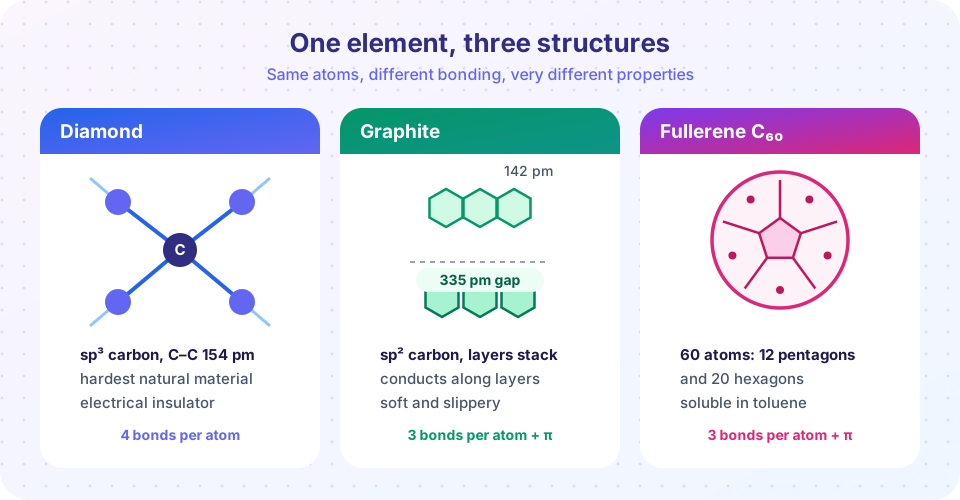
- Relate the properties of diamond, graphite and fullerenes to their bonding.
- Contrast CO₂ with SiO₂ and describe the silicate families.
- Apply the inert pair effect to Tl, Sn and Pb.
Key terms
Electron-deficient: having fewer valence electron pairs than bonds, as in boranes.
Lewis acid: an electron-pair acceptor, such as BF₃.
Amphoteric: reacting as both an acid and a base, as Al₂O₃ does.
Allotropes: different structural forms of the same element in the same physical state.
Catenation: bonding of an element to itself in chains and rings.
Boron: not enough electrons
Boron has three valence electrons (2s² 2p¹), so it forms three bonds and ends with only six electrons around it: an empty p orbital remains. This makes BF₃ a planar molecule and a strong Lewis acid; it grabs an electron pair from ammonia to form the adduct F₃B←NH₃, where boron finally has an octet.
The simplest hydride, diborane B₂H₆, has only 12 valence electrons, but eight B–H bonds drawn as ordinary pairs would need 16, so it cannot be written with two-electron bonds alone. The bonding uses two three-center two-electron bonds, in which one pair of electrons holds two borons and a bridging hydrogen together. Boric acid, B(OH)₃, is also a Lewis acid: it accepts OH⁻ from water to give [B(OH)₄]⁻ and is only a weak acid (pKa about 9.2). Boron nitride, BN, is isoelectronic with carbon and exists as a graphite-like and a diamond-like form.
Aluminum: the amphoteric metal
Aluminum is reactive, but a thin, tough layer of Al₂O₃ passivates it and stops further corrosion. Al₂O₃ dissolves in both acid and base, which defines an amphoteric oxide:
Al₂O₃ + 6 HCl → 2 AlCl₃ + 3 H₂O
Al₂O₃ + 2 NaOH + 3 H₂O → 2 Na[Al(OH)₄]
Anhydrous AlCl₃ is a Lewis acid too: in the gas phase and non-polar solvents it forms dimers Al₂Cl₆ with chloride bridges, so each Al reaches an octet. Aluminum metal is made by the Hall–Héroult process, electrolysis of Al₂O₃ dissolved in molten cryolite (Na₃AlF₆) at about 950 °C between carbon electrodes. The process is energy-hungry, which is why recycling aluminum saves most of the cost.
The inert pair effect in group 13
Going down group 13, +1 becomes more stable relative to +3. Thallium prefers Tl⁺, and Tl³⁺ is a strong oxidizer. The usual story is that the 6s² pair is held tightly by relativistic stabilization and poor shielding by the filled d and f subshells. The plot at the end of this lesson shows the energy cost of removing the ns² pair from each element: it is not smooth, because Ga and Tl follow the 3d and the 4f/5d fillings.
Group 14: from nonmetal to metal
Carbon is a nonmetal, silicon and germanium are semiconductors, tin and lead are metals: the textbook metallic-character trend in one column.
Carbon
Diamond has every carbon bonded to four others in a tetrahedral network (sp³, C–C 154 pm): it is hard and an electrical insulator. Graphite has flat sheets of fused hexagons (sp², C–C 142 pm) with delocalized π electrons that conduct along the sheets. Layers are 335 pm apart and bound by weak dispersion forces, so they slide: graphite is a lubricant and pencil "lead." Fullerenes such as C₆₀ (12 pentagons, 20 hexagons) and nanotubes and graphene (a single graphite sheet) are further forms. Carbon's ability to form long chains (catenation) comes from the strong C–C bond (about 346 kJ/mol) and the kinetic stability of C–H and C–C bonds toward air and water.
Oxides: CO is a poisonous ligand that binds iron in hemoglobin, and CO₂ is a linear molecule with two C=O π bonds.
Silicon and the silicates
SiO₂ is a giant network, not a molecule like CO₂. Silicon is too large for strong 3p–2p π overlap, so it prefers four Si–O single bonds to two Si=O double bonds. Quartz is a network of corner-sharing SiO₄ tetrahedra. Silicate minerals are classified by how many oxygen atoms each tetrahedron shares:
| Structure | O:Si ratio | Example |
|---|---|---|
| Isolated SiO₄ units | 4 | olivine, Mg₂SiO₄ |
| Pairs, Si₂O₇ | 3.5 | thortveitite |
| Single chains or rings | 3 | pyroxene, MgSiO₃ |
| Sheets | 2.5 | talc, mica |
| 3D framework | 2 | quartz, SiO₂ |
Replacing some Si by Al gives aluminosilicates such as feldspars and zeolites. Silicones have a Si–O backbone with organic groups, e.g. [(CH₃)₂SiO]ₙ, valued for stability and flexibility. Silicon is also the semiconductor of microelectronics; you will see why in the band theory lesson.
Tin and lead
Here the inert pair effect shows: Sn²⁺ is a reducing agent (SnCl₂ reduces Fe³⁺), and Pb⁴⁺ is an oxidizing agent. PbO₂ oxidizes hydrochloric acid to chlorine, and lead(II) is the stable form in solution.
Common misconceptions
"CO₂ and SiO₂ are similar because carbon and silicon are in the same group." One is a gas of molecules, the other a hard network. Bonding preferences change down the group.
"Diamond conducts heat and electricity." Diamond is an outstanding heat conductor but an electrical insulator, because it has no delocalized electrons.
"Boron compounds always follow the octet rule." BF₃ and B₂H₆ do not; they are electron-deficient.
Try it
Plot the energy needed to remove the ns² pair (IE₂ + IE₃, kJ/mol) for group 13. The values are textbook data.
Press Run (or Ctrl + Enter) to see the result here.
Program input · what you'd type while the program runs
Type the answers before you press Run, one per line. Each time the program reads a line (with input()), it gets the next line from this box.
Next, classify silicate structures by their O:Si ratio. This is a calculator that applies the table above, not a structure solver.
Press Run (or Ctrl + Enter) to see the console output here.
No output.
Check your understanding
Quick check · 5 questions
of 5 answered You scored / 5 · perfect!
-
1. Why is BF₃ a Lewis acid?
The empty p orbital on boron can accept an electron pair from a Lewis base. -
2. Which reaction shows that Al₂O₃ is amphoteric?
Amphoteric oxides react with both acids and bases. -
3. Why does graphite conduct electricity along its layers?
Each carbon is sp² and contributes one electron to a delocalized π system. -
4. SiO₂ is a hard solid while CO₂ is a gas mainly because...
Poor 3p–2p overlap makes Si=O weak, so silicon builds a network of single bonds. -
5. Which is a strong oxidizing agent because of the inert pair effect?
Pb⁴⁺ would require using the 6s² pair, which is reluctant, so PbO₂ readily gains electrons to become Pb²⁺.
Summary
- Boron compounds are electron-deficient: BF₃ is a Lewis acid and B₂H₆ has three-center bonds.
- Al₂O₃ is amphoteric; aluminum metal is made by electrolysis in molten cryolite.
- Diamond (
sp³), graphite (sp²) and C₆₀ are allotropes with very different properties. - SiO₂ and silicates are networks of SiO₄ tetrahedra; the O:Si ratio classifies them.
- The inert pair effect favors Tl⁺, Sn²⁺ and Pb²⁺ over their higher states.
Next: Groups 15 and 16
Track your progress
Create a free account to tick off lessons and pick up where you left off on any device.
of Inorganic Chemistry lessons completed