


















Lesson 1 of 45 · Getting Started
Course map
Start here: who this inorganic chemistry course is for, what you need first, how to study it, and a map of all nine chapters from atoms to bioinorganic chemistry.
Inorganic chemistry is the chemistry of everything on the periodic table, and of the compounds those elements form, except the great family of carbon compounds that organic chemistry owns. That still leaves a vast territory: table salt and ceramics, rust and steel, fertilizers and fuel cells, the silicon in chips, the iron in your blood, and the catalysts that make plastics and medicines.
This course gives you the ideas that organize that territory. You will learn why the periodic table has its shape, how atoms bond, how acids, bases and metal ions behave, how the main-group and transition elements differ, and how solids and living systems use metals.
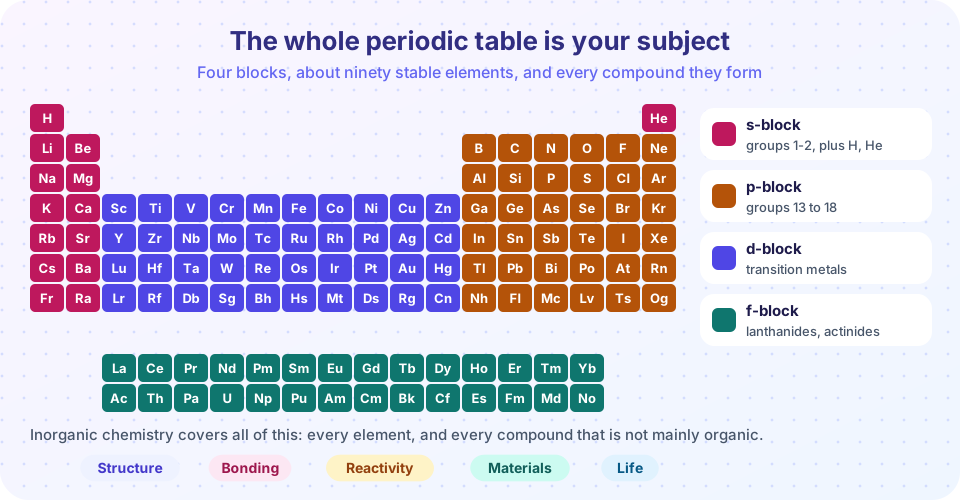
What you will learn
- Who this course is for and what you should know before you start
- How the nine chapters fit together
- A study routine that works for chemistry
- How to read the periodic table as four blocks
Who this course is for
The course suits learners of about 16 and up: final-year school students (IGCSE, A Level, IB, AP) and first-year university students, plus adults who want to understand materials, minerals or biochemistry. It follows an international approach: SI units, IUPAC names, and US spelling.
You do not need advanced mathematics. You do need to be comfortable with:
- Basic algebra and powers of ten (writing
1.0 × 10⁻¹⁴). - The mole, balanced equations and simple molar-mass calculations.
- The idea that atoms contain protons, neutrons and electrons.
If any of these feels shaky, spend an hour with a general chemistry refresher first. Everything else is built from scratch, and every new term is defined the first time it appears.
The nine chapters at a glance
Part 1: the foundations
- Getting started
- Atoms and periodicity
- Bonding models
Part 2: reactivity
- Acids, bases, solvents
- Main group
Part 3: the d block
- Transition metals
- Coordination
Part 4: applications
- Solids and bio
- Projects and practice
Chapters 1 to 4 (this part of the course) lay the groundwork: the vocabulary, the structure of the atom, the models of bonding, and the chemistry of acids, bases and solvents. Later chapters apply these to families of elements and to materials.
How to study this course
Chemistry rewards a steady routine more than a long cram.
- Read actively. After each section, close the page and say the main idea aloud in one sentence.
- Run the examples. Every lesson has live code or widgets. Change a number, predict what will happen, then check.
- Write your own summary table. For each chapter, keep one page: key terms, a diagram you can redraw from memory, and two worked examples.
- Test yourself. The quizzes after each lesson, and the longer review quiz at the end of each chapter, are practice for recall. Wrong answers are the most useful ones: read the explanation.
- Revisit. Come back to chapter 2 when you reach transition metals. The same ideas reappear.
Draw the periodic table from memory once a week. Even a rough sketch with blocks and a few families forces your brain to build the structure rather than just recognize it.
Common misconceptions
- "Inorganic means no carbon." Not quite. Carbon dioxide, carbonates, cyanides, carbides and metal carbonyls are all inorganic chemistry. The dividing line is a convention, not a law.
- "Inorganic chemistry is just memorizing facts." Most of it follows from a few ideas: electron configuration, effective nuclear charge and electronegativity. This course builds those ideas first so that facts become predictions.
Try it
The periodic table has 118 elements, and the blocks are very unequal in size. This short program counts them, then draws a bar chart in the colors of the illustration above.
Press Run (or Ctrl + Enter) to see the result here.
Program input · what you'd type while the program runs
Type the answers before you press Run, one per line. Each time the program reads a line (with input()), it gets the next line from this box.
Check your understanding
Quick check · 4 questions
of 4 answered You scored / 4 · perfect!
-
1. Which statement best describes the scope of inorganic chemistry?
Inorganic chemistry covers the whole periodic table. Some carbon compounds, such as CO2, carbonates and metal carbonyls, are inorganic. -
2. Which block contains the transition metals?
The transition metals fill d orbitals, so they form the d-block in the middle of the table. -
3. How many elements are in the d-block as drawn in this course (with Lu and Lr in group 3)?
Four periods (4 to 7) each add ten d-block elements, giving 40. -
4. What is the best way to use the live examples in each lesson?
Predicting before running turns a demonstration into practice and shows you where your mental model is wrong.
Summary
- Inorganic chemistry covers every element and the compounds they form, other than the bulk of organic chemistry.
- The course moves from foundations (chapters 1 to 4) through main-group, transition-metal and coordination chemistry to solids, bioinorganic chemistry and projects.
- The periodic table is organized in four blocks (s, p, d, f), and each block has a characteristic chemistry.
- Study actively: predict, run, summarize, test, revisit.
Track your progress
Create a free account to tick off lessons and pick up where you left off on any device.
of Inorganic Chemistry lessons completed