


















Lesson 16 of 45 · Acids, Bases and Solvents
Chapter 4 overview: acids, bases and solvents
See how three definitions of acids and bases fit together, how pH measures acidity, and why the solvent matters, with a map of chapter 4 of inorganic chemistry.
Acid-base chemistry is the first great organizing theme of inorganic reactivity. Salts dissolve, oxides turn into hydroxides, metal ions grab water molecules, and minerals weather, all because of the transfer of protons or the sharing of electron pairs. This chapter shows how the definition of "acid" widens from a substance that makes H⁺ in water to any electron-pair acceptor, and how the solvent changes what counts as strong or weak.
What you will learn
- The three definitions of acids and bases and how they relate
- What pH measures and how it connects to concentration
- What each lesson of the chapter covers
Three definitions, each wider than the last
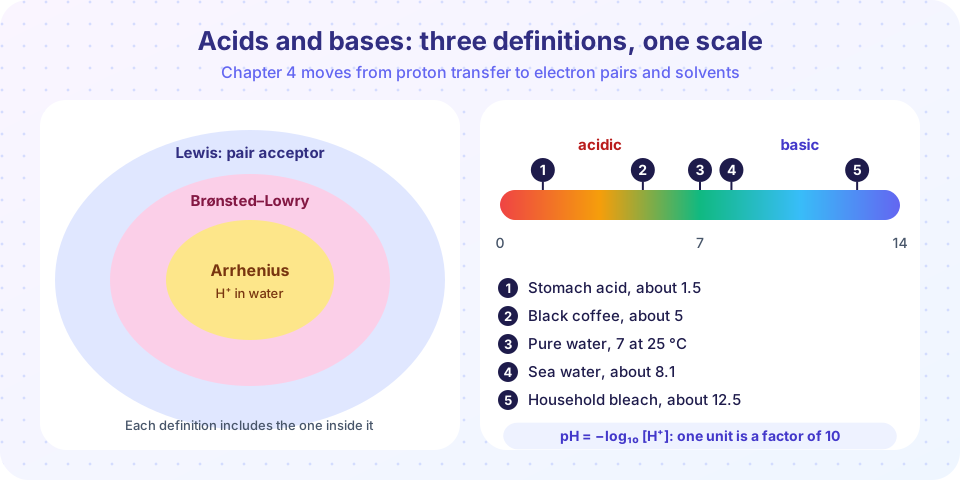
- Arrhenius (1884): an acid produces H⁺ in water, a base produces OH⁻. It is simple, but it only works in water and cannot explain ammonia (NH₃ has no OH⁻ to give).
- Brønsted-Lowry (1923): an acid is a proton donor and a base is a proton acceptor. Acids and bases come in conjugate pairs: HA and A⁻. It works in any solvent that can exchange protons.
- Lewis (1923): an acid is an electron-pair acceptor, a base an electron-pair donor. It includes reactions with no protons at all, such as BF₃ + NH₃, and the binding of ligands to metal ions.
Each definition includes the previous one. Every Arrhenius acid is a Brønsted acid and every Brønsted acid is a Lewis acid, because a proton is itself an electron-pair acceptor.
The pH scale
In water at 25 °C, Kw = [H⁺][OH⁻] = 1.0 × 10⁻¹⁴, and pH = −log₁₀[H⁺]. Pure water has pH 7. Each pH unit is a factor of ten in hydrogen ion concentration, so lemon juice at pH 2 has a hundred thousand times more H⁺ than pure water. The scale of 0 to 14 is a convenience, not a limit: concentrated strong acids can have negative pH.
Acid-base ideas in order
Chapter 4 lessons
What each lesson covers
| Lesson | Focus |
|---|---|
| Brønsted acids and pKa | Ka and pKa, conjugate pairs, buffers, the leveling effect |
| Lewis acids and HSAB | Electron-pair acceptors, adducts, hard and soft acids and bases |
| Nonaqueous solvents | Why the solvent matters, self-ionization, liquid ammonia and sulfuric acid |
| Chapter 4 review | Recap and a mixed quiz |
Common misconceptions
- "Strong acid means concentrated acid." Strength is about how completely an acid ionizes; concentration is how much you have. Dilute HCl is a strong acid, and concentrated acetic acid is still a weak one.
- "A pH of 0 is the most acidic possible." It is just 1 M H⁺. Strong acids can go below zero.
- "Bases must contain OH⁻." Ammonia, carbonate and fluoride are bases without any hydroxide in their formulas.
Try it
This calculator finds the pH of a strong acid, a weak acid and a weak base of the same concentration, 0.10 M. Weak species are solved with the quadratic formula, not the rough approximation.
Press Run (or Ctrl + Enter) to see the result here.
Program input · what you'd type while the program runs
Type the answers before you press Run, one per line. Each time the program reads a line (with input()), it gets the next line from this box.
Check your understanding
Quick check · 3 questions
of 3 answered You scored / 3 · perfect!
-
1. Which definition of acids includes reactions with no proton transfer, such as BF₃ + NH₃?
BF₃ accepts an electron pair from NH₃, so it is a Lewis acid even though no proton moves. -
2. A solution has [H⁺] = 1.0 × 10⁻³ M. What is its pH?
pH = −log₁₀(10⁻³) = 3. -
3. Which statement is correct?
Strength is about the extent of ionization. Pure water has 10⁻⁷ M H⁺, and ammonia is a base with no OH⁻ in its formula.
Summary
- Arrhenius, Brønsted-Lowry and Lewis definitions are nested: each is wider than the one before.
- pH is −log₁₀[H⁺]; each unit is a factor of ten.
- Strength (extent of ionization) differs from concentration.
- The rest of the chapter explores pKa, Lewis acids and the effect of the solvent.
Next: Brønsted acids and pKa
Track your progress
Create a free account to tick off lessons and pick up where you left off on any device.
of Inorganic Chemistry lessons completed