


















Lesson 22 of 45 · Main Group Chemistry
s-Block Metals and Hydrogen
Why group 1 and 2 metals are so reactive, how their compounds trend down the group, why flames change color, and where hydrogen fits in.
The s-block metals are the most "textbook" of all the elements: each wants to lose its outer s electrons and become a noble-gas-like cation, so their chemistry is mostly ionic and highly predictable. Yet inside that simplicity are some lovely puzzles, such as why lithium is the strongest reducing agent of the group in water but reacts the most gently. In this lesson you will explain the trends rather than memorize them.
What you will learn
- Explain why reactivity rises down group 1 and group 2.
- Predict trends in solubility and thermal stability of s-block salts.
- Use flame colors to identify ions and say where the colors come from.
- Describe the three kinds of hydride and the isotopes of hydrogen.
Key terms
Alkali metal: a group 1 metal (Li, Na, K, Rb, Cs, Fr); reacts with water to give an alkaline solution.
Alkaline earth metal: a group 2 metal (Be, Mg, Ca, Sr, Ba, Ra).
Ionic potential: ion charge divided by ion radius; a measure of how strongly a cation polarizes nearby anions.
Hydration enthalpy: the energy released when a gaseous ion is surrounded by water molecules.
Hydride: a compound of hydrogen with a less electronegative element, containing H⁻ or a bond to H.
Group 1: one electron to lose
Every alkali metal has the configuration [noble gas] ns¹. The single outer electron is far from the nucleus and shielded by all the inner electrons, so ionization energy falls down the group. In kJ/mol: Li 520, Na 496, K 419, Rb 403, Cs 376.
That drop makes the metals softer, lower-melting and more reactive down the group. Lithium melts at 181 °C, caesium at 28.5 °C, only a little above room temperature. All have a single common oxidation state, +1. Their compounds are colorless unless the anion has color, and nearly all alkali salts dissolve in water.
The reaction with water is 2 M + 2 H₂O → 2 MOH + H₂. Lithium fizzes steadily, sodium melts into a ball and skates around, potassium ignites the hydrogen with a lilac flame, and caesium reacts violently. The products are strong bases: NaOH and KOH are made at industrial scale by the chlor-alkali process, the electrolysis of brine. Another key product is sodium carbonate, made by the Solvay process from salt, ammonia and limestone.
The lithium puzzle
If reactivity is about ease of losing an electron, lithium should be the least reactive reductant. Look at the standard reduction potentials instead: Li⁺/Li is −3.04 V, Na⁺/Na is −2.71 V, K⁺/K is −2.93 V. Lithium is thermodynamically the strongest reducing agent in water, yet kinetically the calmest. The reason is hydration: the tiny Li⁺ ion (76 pm) has a high charge density and binds water very strongly, releasing a lot of energy that offsets its high ionization energy. Its reaction is slow because lithium melts at a higher temperature and the product hydroxide is less soluble, not because it holds electrons tightly. Thermodynamics (how far) and kinetics (how fast) are different questions.
Group 2: two electrons to lose
The alkaline earths have ns² and form M²⁺. They are harder, denser and higher melting than group 1 neighbors because two electrons join the metallic bonding. Beryllium is an outlier: Be²⁺ is so small (about 45 pm) and so polarizing that its compounds are largely covalent and its oxide is amphoteric, a diagonal link to aluminum.
Three trends are worth knowing well:
- Hydroxide solubility rises down the group. Mg(OH)₂ is barely soluble (milk of magnesia), Ba(OH)₂ is quite soluble.
- Sulfate solubility falls down the group. MgSO₄ dissolves freely (Epsom salt), BaSO₄ is insoluble, which is why a barium sulfate "meal" is safe for X-ray imaging while soluble barium salts are poisonous.
- Carbonate thermal stability rises down the group.
MCO₃ → MO + CO₂needs a lower temperature for MgCO₃ than for BaCO₃.
The third trend is explained by polarizing power. A small, highly charged cation distorts the electron cloud of the carbonate ion and weakens one C–O bond, so the carbonate breaks down more easily. A bigger cation distorts less. Ionic potential (charge over radius) gives you the ranking at a glance, as the second Try it will show.
Flame colors
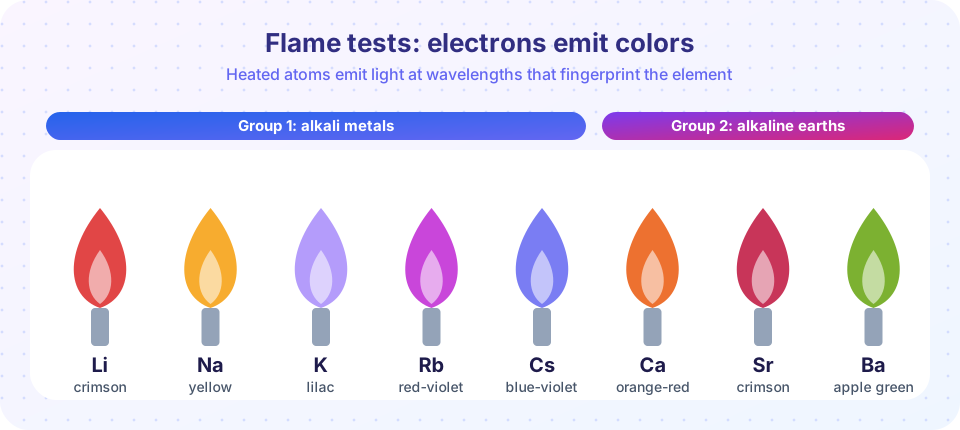
A flame test excites outer electrons into higher levels; when they fall back they release visible light of a particular wavelength: Li crimson, Na intense yellow, K lilac, Rb red-violet, Cs blue-violet, Ca orange-red, Sr crimson, Ba pale green. Be and Mg give no characteristic color. Sodium's yellow is so strong that it hides weaker colors, which is why potassium is viewed through cobalt-blue glass that blocks it. This is atomic emission, the same process behind street lamps and fireworks.
Hydrogen: the odd one out
Hydrogen sits above group 1 because it has 1s¹, but it is not an alkali metal. It is a gas of H₂ molecules, usually bonds covalently, and forms H⁺ (a bare proton, found only attached to something) or hydride H⁻. It has three isotopes: protium (¹H), deuterium (²H or D, one neutron) and radioactive tritium (³H). Heavy water, D₂O, is used as a neutron moderator and in isotope labeling.
Hydrides come in three families:
- Ionic (saline) hydrides such as NaH and CaH₂ contain H⁻; they react with water to release H₂ and are powerful bases.
- Covalent hydrides such as CH₄, NH₃, H₂O, HF and the boranes are molecules.
- Metallic (interstitial) hydrides such as PdH₀.₆ soak hydrogen into a metal lattice and are studied for storage.
Common misconceptions
"The more reactive the metal, the more negative its E°." Not for the alkalis: lithium has the most negative E° but the mildest reaction with water. E° measures driving force, not speed.
"Hydrogen is just another alkali metal." Hydrogen's chemistry is dominated by covalent bonds and the H⁻ ion; only its electron configuration matches group 1.
"All group 2 salts follow the same solubility trend." Hydroxides become more soluble down the group; sulfates become less soluble.
Try it
Plot the first ionization energies against the standard reduction potentials for group 1. The data are textbook values for the plot only. Notice that lithium breaks the pattern.
Press Run (or Ctrl + Enter) to see the result here.
Program input · what you'd type while the program runs
Type the answers before you press Run, one per line. Each time the program reads a line (with input()), it gets the next line from this box.
The second tool computes ionic potential (charge divided by radius) for the group 2 cations and ranks their polarizing power. A higher value predicts a less stable carbonate.
Press Run (or Ctrl + Enter) to see the result here.
Program input · what you'd type while the program runs
Type the answers before you press Run, one per line. Each time the program reads a line (with input()), it gets the next line from this box.
Check your understanding
Quick check · 5 questions
of 5 answered You scored / 5 · perfect!
-
1. Why does first ionization energy fall down group 1?
Each new shell puts the outer s electron farther away, so it is easier to remove. -
2. Which group 2 sulfate is the least soluble in water?
Sulfate solubility falls down group 2, so BaSO₄ is the least soluble, which is why it is used in X-ray 'barium meals'. -
3. Which statement about lithium is correct?
High hydration energy of the small Li⁺ ion makes E° very negative, but the reaction with water is gentle for kinetic reasons. -
4. A sample gives a lilac flame, visible through cobalt-blue glass. The metal is likely...
Potassium gives a lilac flame; the cobalt glass filters out any sodium yellow that would hide it. -
5. Which type of hydride contains the H⁻ ion?
Saline hydrides are ionic solids containing H⁻.
Summary
- Group 1 loses one electron and group 2 loses two, forming M⁺ and M²⁺; reactivity rises down both groups.
- Li⁺ has the most negative E° in group 1 because of hydration, even though lithium reacts most gently.
- Hydroxide solubility rises and sulfate solubility falls down group 2; carbonate stability rises with cation size.
- Flame colors are atomic emission and identify the ion.
- Hydrogen forms ionic, covalent and metallic hydrides and has three isotopes.
Next: Groups 13 and 14
Track your progress
Create a free account to tick off lessons and pick up where you left off on any device.
of Inorganic Chemistry lessons completed