


















Lesson 3 of 45 · Getting Started
Formulas and naming
Learn to write formulas from charges and name ionic and molecular inorganic compounds with IUPAC rules: Stock numerals, polyatomic ions, acids and prefixes.
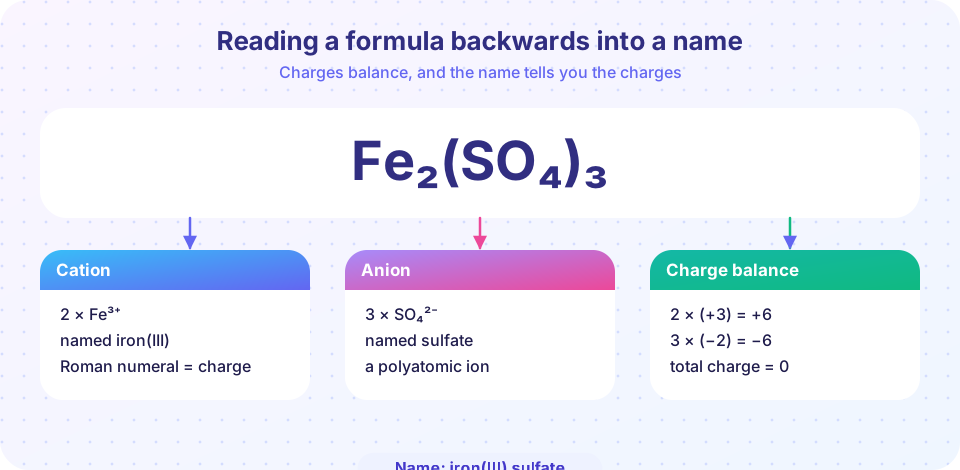
A formula such as Fe₂(SO₄)₃ is a compact sentence. It says which elements are present, in what ratio, and, if you know the rules, what charges they carry. Chemists need a shared language so that a name written in Lagos can be read in Lima. That language is IUPAC nomenclature, and for ionic compounds it is wonderfully mechanical: if you know the ions, you know the formula and the name.
What you will learn
- How to write an ionic formula by balancing charges
- How to name cations, anions and polyatomic ions
- When to use Roman numerals (the Stock system)
- How to name binary molecular compounds and common acids
Key terms
- Cation: a positively charged ion, such as Na⁺ or Fe³⁺.
- Anion: a negatively charged ion, such as Cl⁻ or SO₄²⁻.
- Polyatomic ion: a charged group of atoms that stays together, such as OH⁻ or NH₄⁺.
- Stock system: naming a metal's charge with a Roman numeral, as in copper(II) oxide.
- Formula unit: the smallest whole-number ratio of ions in an ionic compound.
Ions you should know by heart
Main-group ions follow the group number. Group 1 forms 1+, group 2 forms 2+, aluminum forms 3+; group 17 forms 1−, group 16 forms 2−, and nitrogen forms 3−. Transition metals can form several ions, so their charge must be stated.
| Ion | Name | Ion | Name |
|---|---|---|---|
| Na⁺ | sodium | OH⁻ | hydroxide |
| Mg²⁺ | magnesium | NO₃⁻ | nitrate |
| Al³⁺ | aluminum | SO₄²⁻ | sulfate |
| Fe²⁺ | iron(II) | CO₃²⁻ | carbonate |
| Fe³⁺ | iron(III) | PO₄³⁻ | phosphate |
| Cu²⁺ | copper(II) | NH₄⁺ | ammonium |
| Zn²⁺ | zinc | ClO₄⁻ | perchlorate |
The suffixes tell you about oxygen content. -ate means more oxygen, -ite one fewer (sulfate SO₄²⁻, sulfite SO₃²⁻; nitrate NO₃⁻, nitrite NO₂⁻). Prefixes extend the series for chlorine oxyanions: hypochlorite ClO⁻, chlorite ClO₂⁻, chlorate ClO₃⁻, perchlorate ClO₄⁻.
Writing a formula: balance the charges
An ionic compound is electrically neutral, so the total positive charge must equal the total negative charge. The procedure:
- Write the cation first, then the anion, each with its charge.
- Find the smallest numbers of each ion that make the charges add to zero. The least common multiple of the charges does it.
- Write those numbers as subscripts, omitting 1.
- Put parentheses around a polyatomic ion if its subscript is greater than 1.
Worked example: aluminum sulfate. The ions are Al³⁺ and SO₄²⁻. The least common multiple of 3 and 2 is 6, so we need two Al³⁺ (+6) and three SO₄²⁻ (−6). The formula is Al₂(SO₄)₃.
Another: calcium hydroxide. Ca²⁺ and OH⁻ need one Ca²⁺ and two OH⁻, giving Ca(OH)₂. A shortcut sometimes called "crisscross" (swap the numbers) works but fails when the ratio simplifies, as for Mg²⁺ with O²⁻, where it would give Mg₂O₂ instead of MgO. Always reduce to the lowest ratio.
Naming ionic compounds
Name the cation, then the anion. For a metal that forms more than one ion, give the charge in Roman numerals. To find that charge in a formula, work backwards from the anion.
FeCl₂has two Cl⁻, so Fe is 2+: iron(II) chloride.FeCl₃has three Cl⁻, so Fe is 3+: iron(III) chloride.Cu₂Ohas one O²⁻ (−2) shared among two Cu, so each is 1+: copper(I) oxide.(NH₄)₂SO₄is ammonium sulfate. No numeral is needed because ammonium is always 1+.
Main-group metals such as sodium and calcium form a single ion, so no numeral is used: NaCl is sodium chloride, not sodium(I) chloride. Single-atom anions end in -ide: chloride, oxide, sulfide, nitride.
Naming molecular (covalent) compounds
For compounds of two nonmetals, use Greek prefixes for the numbers of atoms: mono-, di-, tri-, tetra-, penta-, hexa-, hepta-, octa-, nona-, deca-. Drop "mono" on the first element.
| Formula | Name |
|---|---|
| CO | carbon monoxide |
| CO₂ | carbon dioxide |
| N₂O₄ | dinitrogen tetroxide |
| PCl₅ | phosphorus pentachloride |
| SF₆ | sulfur hexafluoride |
Water (H₂O) and ammonia (NH₃) keep their common names, which IUPAC accepts.
Naming acids
Binary acids are hydrogen compounds dissolved in water: HCl(aq) is hydrochloric acid. Oxoacids take the name from the oxyanion: -ate becomes -ic acid and -ite becomes -ous acid. So H₂SO₄ is sulfuric acid, H₂SO₃ is sulfurous acid, HNO₃ is nitric acid, and H₃PO₄ is phosphoric acid.
Common misconceptions
- "Fe₂O₃ is iron(II) oxide because there are two iron atoms." The numeral is the charge on each ion, not the count. Three O²⁻ give −6, so each of two Fe is 3+: iron(III) oxide.
- "Always use Roman numerals." Only when the metal can form more than one ion. Calcium chloride never carries a numeral.
- "Subscripts and charges are the same thing." A subscript counts atoms; a superscript gives charge. The crisscross trick only looks like it swaps them.
Try it
First, a script that builds formulas from ion charges using the least-common-multiple method. It also adds parentheses for polyatomic ions.
Press Run (or Ctrl + Enter) to see the result here.
Program input · what you'd type while the program runs
Type the answers before you press Run, one per line. Each time the program reads a line (with input()), it gets the next line from this box.
Now build and name compounds interactively. Choose a cation and an anion and watch the formula and name appear.
Check your understanding
Quick check · 5 questions
of 5 answered You scored / 5 · perfect!
-
1. What is the formula of magnesium nitrate?
Mg²⁺ needs two NO₃⁻ to balance, and the polyatomic ion needs parentheses when its subscript is greater than 1. -
2. What is the name of Cu₂O?
One O²⁻ (charge −2) is balanced by two Cu, so each copper is 1+: copper(I) oxide. -
3. What is the name of SF₆?
Binary molecular compounds use Greek prefixes. The prefix mono- is dropped on the first element. -
4. Which formula is correct for aluminum oxide?
Two Al³⁺ give +6, and three O²⁻ give −6. -
5. H₂SO₃ is named:
The sulfite ion (-ite) gives the -ous acid, and sulfate gives sulfuric acid.
Summary
- Ionic compounds are neutral: use the least common multiple of the charges to find the formula.
- Name the cation first, then the anion; use Roman numerals only for metals with more than one common ion.
- -ate and -ite mark more and fewer oxygens; -ide marks a single-atom anion.
- Covalent compounds use Greek prefixes; acids derive from their anions (-ate gives -ic, -ite gives -ous).
Next: Oxidation states
Track your progress
Create a free account to tick off lessons and pick up where you left off on any device.
of Inorganic Chemistry lessons completed