


















Lesson 37 of 45 · Solid State and Bioinorganic Chemistry
Ionic Solids and Lattice Energy
Learn rock salt, cesium chloride, zinc blende and fluorite structures, predict them with radius ratios, and calculate lattice energy with Born-Haber and Born-Lande.
Table salt is not made of NaCl molecules. It is a giant lattice in which every Na⁺ sits among six Cl⁻ and every Cl⁻ among six Na⁺, repeated billions of times in every direction. Why does salt form that lattice rather than one with four neighbors or eight? And why does magnesium oxide melt near 2850 °C while sodium chloride melts at 801 °C? The answers combine geometry (radius ratio) and energy (lattice energy), and both are calculable.
What you will learn
- Describe the rock salt, cesium chloride, zinc blende and fluorite structures.
- Use radius ratio to predict coordination number.
- Build and solve a Born–Haber cycle for NaCl.
- Estimate lattice energy with the Born–Landé equation and explain trends in charge and radius.
Key terms
Lattice energy (U): the energy released when gaseous ions form one mole of solid ionic compound (here written as a negative number).
Radius ratio: r(cation) / r(anion), used to predict coordination number.
Madelung constant (M): a geometric factor for the total electrostatic attraction in a lattice; 1.7476 for rock salt.
Born–Haber cycle: a Hess's law cycle that obtains lattice energy from measurable quantities.
Electron affinity (EA): energy change when a gaseous atom gains an electron.
Four classic structures
| Structure | Formula type | Coordination (cation:anion) | Example |
|---|---|---|---|
| Rock salt | MX | 6:6 | NaCl, MgO, KBr |
| Cesium chloride | MX | 8:8 | CsCl, CsBr |
| Zinc blende (sphalerite) | MX | 4:4 | ZnS, CuCl |
| Fluorite | MX₂ | 8:4 | CaF₂, ZrO₂ |
In rock salt the anions form a face-centered cubic array and the cations fill all the octahedral holes: 4 NaCl per unit cell. CsCl is a simple cubic array of Cl⁻ with Cs⁺ in the central hole: one formula unit per cell (not bcc, since the two ions differ). Zinc blende has S²⁻ in an fcc array with Zn²⁺ in half the tetrahedral holes. Fluorite has Ca²⁺ in an fcc array with F⁻ in all the tetrahedral holes; the reverse arrangement (anions in the fcc array, cations in the holes) is called antifluorite, e.g. Li₂O.
Predicting structure: radius ratio
Anions touch the cation only if the cation is large enough. The cation-to-anion radius ratio gives the borderline values:
| r⁺/r⁻ | Predicted CN | Geometry |
|---|---|---|
| 0.225 – 0.414 | 4 | tetrahedral |
| 0.414 – 0.732 | 6 | octahedral |
| 0.732 – 1.0 | 8 | cubic |
Take NaCl with Na⁺ 102 pm and Cl⁻ 181 pm: the ratio is 0.56, so CN 6. CsCl: 167/181 = 0.92, so CN 8. ZnS: 74/184 = 0.40, CN 4. The rule works for many simple salts, but it is only a guide; exceptions arise from covalency and polarization (for instance, AgI and CuCl prefer tetrahedral coordination).
Lattice energy
The attraction between oppositely charged ions follows Coulomb's law: energy ∝ z⁺z⁻ / r. Summing over the lattice gives the Born–Landé equation:
U = −(N_A · M · z⁺ · z⁻ · e²) / (4π ε₀ r₀) × (1 − 1/n)
Here r₀ is the cation–anion distance, M the Madelung constant, and n the Born exponent (about 8 for NaCl; the repulsive term) that corrects for electron-cloud repulsion at close range. For NaCl, with r₀ = 282 pm, the formula gives about −753 kJ/mol. The first TryIt computes it.
The equation explains the trends. Charge matters most: MgO (2+, 2−) has U ≈ −3791 kJ/mol while NaCl (1+, 1−) has about −787 kJ/mol, a factor near four. Size matters next: the lattice energy falls from LiF (−1037) to NaF (−923) as the cation grows, and from NaF to NaCl (−787), NaBr (−747) and NaI (−704) as the anion grows. A large lattice energy means a high melting point and a hard, brittle crystal.
The Born–Haber cycle
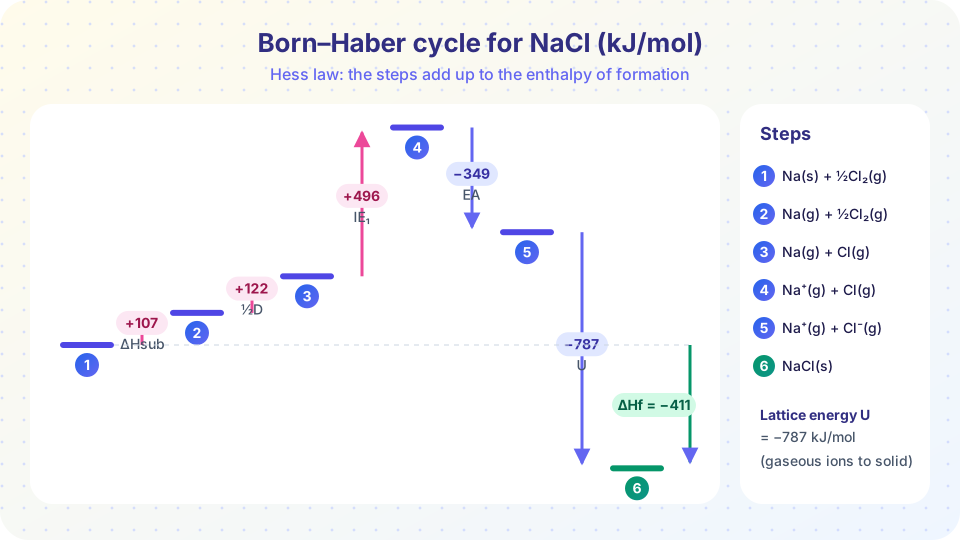
Lattice energy cannot be measured directly (we cannot easily make gaseous ions in a calorimeter), so we use Hess's law. For NaCl (kJ/mol):
- Sublimation of sodium: Na(s) → Na(g): +107
- Half the Cl–Cl bond dissociation: ½Cl₂(g) → Cl(g): +122
- Ionization energy of Na: Na(g) → Na⁺(g) + e⁻: +496
- Electron affinity of Cl: Cl(g) + e⁻ → Cl⁻(g): −349
- Lattice energy: Na⁺(g) + Cl⁻(g) → NaCl(s): U
- Overall, enthalpy of formation: ΔHf(NaCl) = −411
So ΔHf = 107 + 122 + 496 − 349 + U, giving U = −411 − 376 = −787 kJ/mol. The Born–Landé value (−753) is within about 4%, with the difference caused by covalent character and van der Waals terms.
Why this matters
Lattice energy competes with hydration energy when an ionic solid dissolves: it dissolves if the hydration of the ions pays for the lattice. Highly charged small ions give very high lattice energies, so MgO and Al₂O₃ are insoluble and refractory. Lattice energy also pays for ions that are costly to make. Forming O²⁻ from O takes energy overall (the second electron affinity of oxygen is positive, about +744 kJ/mol), yet oxides are stable because their lattice energies are so large. And NaCl₂ (containing Na²⁺) does not form, because the second ionization energy of sodium (4562 kJ/mol) is far more than the extra lattice energy could repay.
Common misconceptions
"NaCl exists as molecules." The formula unit is the simplest ratio in a giant lattice.
"CsCl is body-centered cubic." It is a simple cubic lattice with a two-ion basis; bcc would need identical atoms at the corners and the center.
"Lattice energy is the energy needed to form the compound from its elements." That is the enthalpy of formation; lattice energy starts from gaseous ions.
Try it
Compute the Born–Landé lattice energy for NaCl and check the Born–Haber sum in code. Constants are in SI and results in kJ/mol.
Press Run (or Ctrl + Enter) to see the result here.
Program input · what you'd type while the program runs
Type the answers before you press Run, one per line. Each time the program reads a line (with input()), it gets the next line from this box.
Next, a radius-ratio predictor for the coordination number. It applies the borderline values above and prints a likely structure type. Real crystals can break the rule.
Press Run (or Ctrl + Enter) to see the console output here.
No output.
Check your understanding
Quick check · 5 questions
of 5 answered You scored / 5 · perfect!
-
1. What is the coordination number of Na⁺ in rock salt?
Each Na⁺ is surrounded by six Cl⁻ in an octahedron. -
2. Which has the highest lattice energy magnitude?
MgO has 2+ and 2− charges and small ions, so its lattice energy is about four times that of NaCl. -
3. In the Born–Haber cycle for NaCl, which step is exothermic?
Cl gains an electron and releases −349 kJ/mol; the other listed steps absorb energy. -
4. A radius ratio of 0.30 predicts which coordination number?
0.225 – 0.414 corresponds to tetrahedral holes (CN 4). -
5. Which is the correct formula for the Born–Haber lattice energy of NaCl?
ΔHf equals the sum of the steps plus U, so U = −411 − 376 = −787 kJ/mol.
Summary
- Common AX structures are rock salt (6:6), CsCl (8:8), zinc blende (4:4) and fluorite (8:4).
- Radius ratio predicts coordination number as a rough guide.
- Lattice energy rises with ion charge and falls with ion size; Born–Landé gives an estimate.
- A Born–Haber cycle gives lattice energy via Hess's law: −787 kJ/mol for NaCl.
Next: Band Theory
Track your progress
Create a free account to tick off lessons and pick up where you left off on any device.
of Inorganic Chemistry lessons completed