


















Lesson 25 of 45 · Main Group Chemistry
Halogens and Noble Gases
Why fluorine is the strongest oxidizer, how halogens displace each other, why HF is a weak acid, and how xenon compounds broke the noble gas rule.
Group 17 sits one electron short of a noble-gas configuration, so the halogens are hungry for electrons: they are the most electronegative family and the most reliable oxidizing agents on the table. Group 18 sits at the opposite extreme, with full shells and for decades the reputation of being completely inert. In 1962 that reputation cracked, and the story of why is a perfect test of everything in this chapter.
What you will learn
- Describe how color, physical state and oxidizing power change down group 17.
- Predict displacement reactions from standard reduction potentials.
- Explain why HF is weak and why fluorine's F–F bond is unusually weak.
- Write halogen disproportionation reactions and name the oxoanions of chlorine.
- Describe some xenon compounds and explain why they exist.
Key terms
Halogen: a group 17 element (F, Cl, Br, I, At), existing as diatomic molecules X₂.
Displacement reaction: a more powerful oxidizer takes electrons from the halide ion of a weaker one.
Interhalogen: a compound of two different halogens, such as ClF₃.
Noble gas: a group 18 element with a closed valence shell.
Trends in group 17
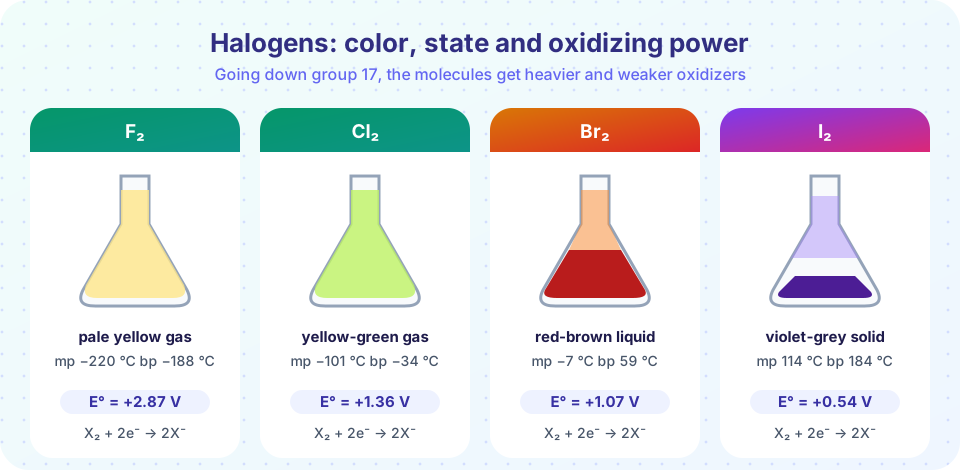
Look at the flasks above. Fluorine and chlorine are gases, bromine is a volatile liquid and iodine a solid that sublimes to a violet vapor. The molecules are all nonpolar X₂, and heavier ones have stronger dispersion forces, so boiling points rise: −188 °C, −34 °C, 59 °C and 184 °C. Color deepens because the energy gap between occupied and empty molecular orbitals shrinks.
Oxidizing power falls steadily: the standard reduction potentials for X₂ + 2e⁻ → 2X⁻ are +2.87 V (F₂), +1.36 V (Cl₂), +1.07 V (Br₂) and +0.54 V (I₂). A halogen therefore oxidizes the halide ions below it. Add chlorine water to potassium bromide solution and it turns orange-brown as Br₂ forms: Cl₂ + 2 Br⁻ → 2 Cl⁻ + Br₂. Bromine does not oxidize chloride.
Two fluorine oddities
- Weak F–F bond. The F–F bond energy is only 159 kJ/mol, weaker than Cl–Cl (243). Fluorine atoms are so small that lone pairs on neighboring atoms repel each other strongly. A weak bond makes F₂ easy to split, one reason for its reactivity. Fluorine's bonds to other elements are exceptionally strong (H–F is 567 kJ/mol), so its reactions are extremely exothermic.
- HF is a weak acid (pKa about 3.2) while HCl, HBr and HI are strong. The H–F bond is strong, and the small F⁻ ion is tightly hydrated, but the main factor is the bond strength. HF is also special in that it etches glass, and aqueous HF is dangerous because it penetrates the skin and binds calcium.
Oxidation states and oxoanions
Halogens (except fluorine) show positive oxidation states in oxo compounds. Chlorine's oxoacids and anions are named in a family:
| Oxidation state | Acid | Anion | Name |
|---|---|---|---|
| +1 | HOCl | ClO⁻ | hypochlorite |
| +3 | HClO₂ | ClO₂⁻ | chlorite |
| +5 | HClO₃ | ClO₃⁻ | chlorate |
| +7 | HClO₄ | ClO₄⁻ | perchlorate |
Chlorine disproportionates in cold base, Cl₂ + 2 OH⁻ → Cl⁻ + ClO⁻ + H₂O, which is how household bleach is made. In hot base it goes further to chlorate: 3 Cl₂ + 6 OH⁻ → 5 Cl⁻ + ClO₃⁻ + 3 H₂O.
Interhalogens and polyhalides
Halogens bond to each other, giving molecules such as ClF, BrF₃, ClF₃ (T-shaped), BrF₅ (square pyramidal) and IF₇ (pentagonal bipyramidal). The pattern is simple: the larger halogen sits in the middle and the number of fluorines grows with the central atom's size. Iodine dissolves in water poorly, but in aqueous iodide it forms triiodide: I₂ + I⁻ ⇌ I₃⁻, a linear ion that gives the deep color in the iodine-starch test.
Group 18: how inert are the noble gases?
Helium (boiling point 4.2 K, the lowest of any substance at atmospheric pressure) is used to cool superconducting magnets; argon fills welding shields and light bulbs; neon glows red-orange in a tube. For decades they were thought to form no compounds because of their closed shells and very high ionization energies.
In 1962, Neil Bartlett reasoned that xenon's first ionization energy (about 1170 kJ/mol) is close to that of O₂ (1165 kJ/mol), which PtF₆ could oxidize. He mixed Xe with PtF₆ and obtained a red-orange solid, the first noble gas compound. Within months, XeF₂ (linear), XeF₄ (square planar) and XeF₆ were made. Xenon's compounds all involve the most electronegative partners, fluorine and oxygen, and include XeO₃ (explosive) and the xenates. Krypton forms KrF₂; radon compounds are expected but hard to study because of radioactivity.
VSEPR explains the shapes: XeF₂ has three lone pairs on Xe (linear), XeF₄ has two (square planar).
Common misconceptions
"Noble gases never form compounds." Xenon and krypton do, with fluorine and oxygen. They are just very reluctant.
"The most electronegative halogen has the strongest X–X bond." Fluorine has a weaker F–F bond than chlorine.
"HF is a strong acid because fluorine is the most electronegative." It is weak because the H–F bond is strong; electronegativity alone does not decide.
Try it
Compare bond energies, which explain the oddities of fluorine. Values are textbook averages in kJ/mol.
Press Run (or Ctrl + Enter) to see the result here.
Program input · what you'd type while the program runs
Type the answers before you press Run, one per line. Each time the program reads a line (with input()), it gets the next line from this box.
This predictor uses reduction potentials to decide which halogen can oxidize which halide. It models only the thermodynamics of the reaction, not its speed.
Press Run (or Ctrl + Enter) to see the console output here.
No output.
Check your understanding
Quick check · 5 questions
of 5 answered You scored / 5 · perfect!
-
1. Which halogen is the strongest oxidizing agent?
F₂ has the most positive reduction potential, +2.87 V. -
2. What happens when chlorine water is added to potassium iodide solution?
Cl₂ is a stronger oxidizer than I₂, so Cl₂ + 2 I⁻ → 2 Cl⁻ + I₂. -
3. Why is HF a weak acid while HCl is strong?
The strong H–F bond (567 kJ/mol) makes ionization less favorable. -
4. What is the oxidation state of chlorine in ClO₃⁻?
Three oxygens contribute −6 and the ion is −1, so Cl is +5. -
5. Which xenon compound is square planar?
XeF₄ has four bonded pairs and two lone pairs, giving a square planar shape.
Summary
- Down group 17 the elements go gas to solid, darken, and become weaker oxidizers (E° from +2.87 V to +0.54 V).
- Fluorine is unusual: weak F–F, strong bonds to others, and a weak acid HF.
- Chlorine disproportionates in base; its oxoanions run from hypochlorite (+1) to perchlorate (+7).
- Xenon forms compounds with fluorine and oxygen; VSEPR predicts their shapes.
Next: Chapter Review
Track your progress
Create a free account to tick off lessons and pick up where you left off on any device.
of Inorganic Chemistry lessons completed