


















Lesson 12 of 45 · Bonding Models
Ionic bonding and lattice energy
Understand why ionic compounds form, how lattice energy depends on charge and ion size, how to use the Born-Haber cycle, and how it explains melting points.
Sodium and chlorine react violently to make table salt. Yet if you count the energy bill for one pair of atoms, the reaction looks like a bad deal: removing sodium's outer electron costs energy, and chlorine gives back less than it costs. The bill is paid by something that only exists in the solid: the enormous attraction between a huge number of oppositely charged ions packed into a lattice. That energy is the lattice energy, and it is the reason ionic compounds exist.
What you will learn
- What lattice energy is and how it depends on ion charge and size
- How to read and complete a Born-Haber cycle
- How the ionic model explains melting points, hardness and brittleness
- Where the ionic model breaks down
Key terms
- Lattice energy (U): the energy released when gaseous ions form one mole of an ionic solid. Here it is quoted as a negative number, for example −787 kJ/mol for NaCl.
- Ionization energy (IE): energy to remove an electron from a gaseous atom.
- Electron affinity (EA): energy change when a gaseous atom gains an electron.
- Enthalpy of formation (ΔHf): the enthalpy change of forming one mole of a compound from its elements.
- Coordination number: the number of nearest neighbors of opposite charge around an ion.
The structure of an ionic solid
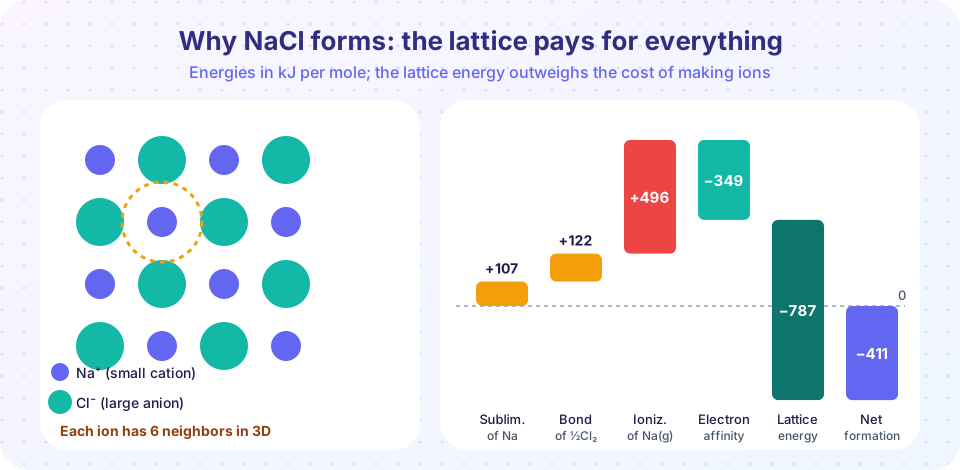
In the sodium chloride structure each Na⁺ is surrounded by six Cl⁻, and each Cl⁻ by six Na⁺: both have coordination number 6. The arrangement alternates in all three directions, so no ion has a partner. There are no NaCl "molecules", only a lattice, and NaCl is a formula unit giving the ratio of ions.
A cation is smaller than its parent atom, and an anion is larger. In NaCl the ionic radii are about 102 pm for Na⁺ and 181 pm for Cl⁻, so the distance between neighboring centers is about 283 pm.
The Born-Haber cycle
A lattice energy cannot be measured directly. Instead, Max Born and Fritz Haber used Hess's law: the enthalpy of forming a compound from its elements is the same whether you go in one step or via a series of steps. For NaCl:
| Step | Process | ΔH (kJ/mol) |
|---|---|---|
| 1 | Sublimation: Na(s) → Na(g) | +107 |
| 2 | Bond dissociation: ½Cl₂(g) → Cl(g) | +122 |
| 3 | Ionization: Na(g) → Na⁺(g) + e⁻ | +496 |
| 4 | Electron affinity: Cl(g) + e⁻ → Cl⁻(g) | −349 |
| 5 | Lattice formation: Na⁺(g) + Cl⁻(g) → NaCl(s) | U |
| Net | Na(s) + ½Cl₂(g) → NaCl(s) | −411 (formation) |
Hess's law gives −411 = 107 + 122 + 496 − 349 + U. The first four steps total +376, so U = −411 − 376 = −787 kJ/mol. The lattice step is large enough to pay for everything else and leave a net release of 411 kJ.
What controls lattice energy
The energy of attraction between two ions is roughly proportional to q₁ q₂ / d, the product of the charges divided by the distance between them. Therefore lattice energy grows with:
- Charge. MgO (2+ and 2−) has a lattice energy of about −3800 kJ/mol, roughly four to five times that of NaCl.
- Smaller ions. LiF is bound more tightly than CsF because the ions are closer.
The Born-Landé equation gives a quantitative estimate from the lattice geometry: U = −(N_A M z⁺ z⁻ e²) / (4π ε₀ r₀) × (1 − 1/n), where M is the Madelung constant of the structure (1.7476 for rock salt), r₀ is the distance between nearest ions and n is the Born exponent (about 8 for NaCl). The run below shows how well it agrees with the Born-Haber value.
What the ionic model explains
- High melting points: breaking the lattice means overcoming strong electrostatic forces in every direction. NaCl melts at 801 °C; MgO at about 2850 °C.
- Brittleness: hitting a crystal can shift a layer by one ion, bringing like charges face to face, and the crystal splits.
- Conductivity: solids do not conduct (ions are fixed), but molten salts and solutions do.
- Solubility: dissolving requires the solvent to overcome lattice energy. Water does this by solvating ions, so that hydration energy compensates.
Where the ionic model fails
No bond is 100 percent ionic. Small, highly charged cations polarize large anions and pull electron density between them, giving partial covalent character (Fajans' rules). That is why AgI, with a large polarizable anion and a polarizing cation, is much less ionic than NaCl, and why aluminum chloride is a molecular compound that sublimes at about 180 °C.
Common misconceptions
- "Ionic bonds form because atoms want full shells." Making an ion costs energy. Ionic compounds form because the lattice energy releases more than the ionization costs.
- "Each Na⁺ is bonded to one Cl⁻." Each ion interacts with all of its neighbors equally.
- "A formula like NaCl describes a molecule." It describes a ratio in an extended lattice.
Try it
First, recover the lattice energy of NaCl in two ways: the Born-Haber cycle, and the Born-Landé equation using the geometry of the lattice.
Press Run (or Ctrl + Enter) to see the result here.
Program input · what you'd type while the program runs
Type the answers before you press Run, one per line. Each time the program reads a line (with input()), it gets the next line from this box.
Next, test the charge-and-distance rule against real data. The x-axis is q₁ q₂ / d using Shannon ionic radii (pm); the y-axis is the melting point.
Press Run (or Ctrl + Enter) to see the result here.
Program input · what you'd type while the program runs
Type the answers before you press Run, one per line. Each time the program reads a line (with input()), it gets the next line from this box.
Check your understanding
Quick check · 5 questions
of 5 answered You scored / 5 · perfect!
-
1. Why is formation of NaCl from its elements exothermic even though ionization of sodium costs energy?
The lattice energy (−787 kJ/mol) outweighs the net cost of making the gaseous ions (+376 kJ/mol), leaving about −411 kJ/mol. -
2. Which has the larger lattice energy magnitude?
MgO has 2+ and 2− ions and a small interionic distance, so q₁q₂/d is far larger. -
3. What is the coordination number of each ion in the NaCl structure?
In rock salt each ion is surrounded by six of the opposite charge. -
4. Why are ionic crystals brittle?
A shift of one ion position puts like-charged ions adjacent, and the repulsion breaks the crystal along that plane. -
5. Which is NOT a step of a Born-Haber cycle for NaCl?
The steps are sublimation, bond dissociation, ionization, electron affinity and lattice formation.
Summary
- Ionic compounds are stable because the lattice energy outweighs the cost of making the ions.
- The Born-Haber cycle applies Hess's law to find a lattice energy that cannot be measured directly.
- Lattice energy increases with ion charge and decreases with ion size; it explains melting points and brittleness.
- Polarization adds covalent character, especially for small, highly charged cations and large anions.
Track your progress
Create a free account to tick off lessons and pick up where you left off on any device.
of Inorganic Chemistry lessons completed