


















Lesson 10 of 45 · Atomic Structure and Periodicity
Chapter 2 review: atomic structure and periodicity
Review chapter 2 of inorganic chemistry: quantum numbers, orbital shapes, electron configurations and periodic trends, with a recap table and a ten-question quiz.
Chapter 2 gave you the machinery that explains the periodic table. Use this page to consolidate it: look at the one-page picture, skim the table of key facts, try the ranking tool, and then test yourself with a mixed quiz.
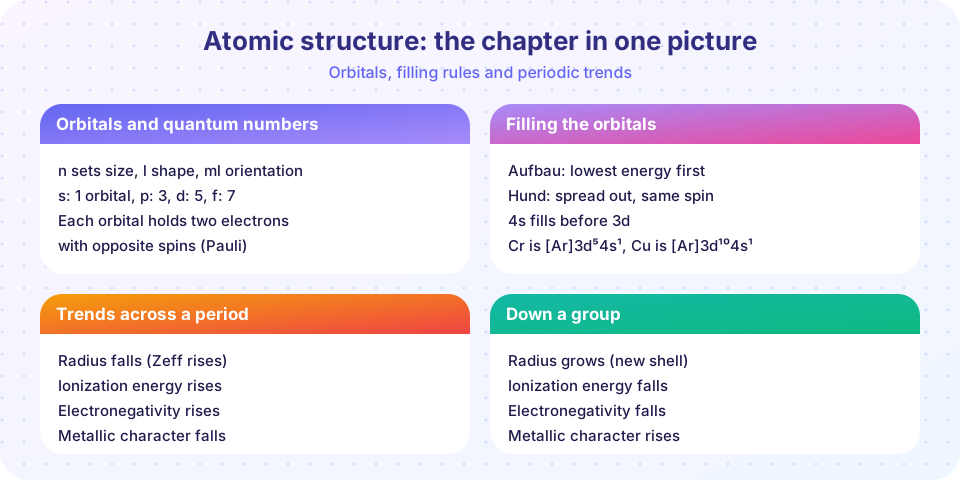
The chapter in a table
| Idea | Key fact |
|---|---|
| Quantum numbers | n (shell), l (shape), ml (orientation), ms (spin) |
| Orbital counts | s: 1, p: 3, d: 5, f: 7; shell n holds 2n² electrons |
| Nodes | Total n − 1; radial nodes n − l − 1; angular nodes l |
| Filling rules | Aufbau (lowest first), Pauli (max two, opposite spins), Hund (singly first) |
| Order | 1s 2s 2p 3s 3p 4s 3d 4p 5s 4d 5p 6s 4f ... |
| Exceptions | Cr [Ar] 3d⁵4s¹, Cu [Ar] 3d¹⁰4s¹ |
| Cations | Lose highest n first, so 4s before 3d |
| Across a period | Zeff up, radius down, IE and χ up |
| Down a group | Radius up, IE and χ down |
| Exceptions to IE | B below Be, O below N |
Try it
Rank elements by a chosen property from a small data table, then check your intuition against the numbers. Change the prop and the element list.
Press Run (or Ctrl + Enter) to see the result here.
Program input · what you'd type while the program runs
Type the answers before you press Run, one per line. Each time the program reads a line (with input()), it gets the next line from this box.
Check your understanding
Quick check · 10 questions
of 10 answered You scored / 10 · perfect!
-
1. Which set of quantum numbers describes a 3p orbital?
p orbitals have l = 1. With n = 3 this is the 3p subshell. -
2. How many electrons can a 4f subshell hold?
An f subshell has seven orbitals, each holding two electrons. -
3. Which is the ground-state configuration of vanadium (Z = 23)?
Vanadium follows the Madelung order: 4s fills before 3d, giving 3d³ 4s². -
4. Which ion has the same configuration as neon?
Mg²⁺ has 10 electrons, like Ne. K⁺ and Ca²⁺ are [Ar] and Br⁻ is [Kr]. -
5. Which has the highest first ionization energy?
Neon, the noble gas at the end of period 2, holds its electrons most tightly. IE rises across a period and falls on moving to the next period. -
6. Why do transition metals lose 4s electrons before 3d electrons?
With 3d occupied, the 3d orbitals lie below 4s, and cations form by removing electrons from the highest principal shell first. -
7. Which statement about atomic radius is true?
Added electrons repel each other, so anions are larger than the neutral atoms. -
8. What is the effective nuclear charge Zeff?
Zeff = Z − S measures the net attraction an outer electron feels. -
9. In a multi-electron atom, which orbital is lower in energy?
A 2s electron penetrates closer to the nucleus and feels a higher effective nuclear charge, so 2s lies below 2p. (In hydrogen alone they are equal.) -
10. Which is the correct trend in electronegativity?
Fluorine, at the upper right, has the highest value.
Summary
- Quantum numbers label orbitals; shells hold 2n² electrons.
- Aufbau, Pauli and Hund plus the Madelung order give configurations, with Cr and Cu as famous exceptions.
- Zeff explains radius, ionization energy, electron affinity and electronegativity trends and their exceptions.
Next: Bonding models overview
Track your progress
Create a free account to tick off lessons and pick up where you left off on any device.
of Inorganic Chemistry lessons completed