


















Lesson 34 of 45 · Coordination Chemistry
Color and Magnetism of Complexes
Connect d-orbital splitting to the colors and magnetic moments of complexes: the spectrochemical series, d-d and charge-transfer bands, and spin-only moments.
Why is [Cu(H₂O)₆]²⁺ pale blue and [Cu(NH₃)₄(H₂O)₂]²⁺ deep blue? Why is [Cr(NH₃)₆]³⁺ yellow and [Cr(H₂O)₆]³⁺ violet? Crystal field theory gives a direct, quantitative answer: the color is the energy gap Δo seen through your eyes. This lesson turns the d-orbital diagram into a color predictor and a magnet predictor.
What you will learn
- Explain color as absorption of a photon with energy equal to a d–d gap.
- Convert between wavenumber, wavelength and energy.
- Place ligands on the spectrochemical series and predict color shifts.
- Distinguish d–d, charge-transfer and spin-forbidden absorptions by intensity.
- Calculate spin-only magnetic moments and interpret them.
Key terms
d–d transition: promotion of an electron from the t₂g set to the eg set by absorbing a photon of energy Δo.
Complementary color: the color seen when a certain color is removed from white light.
Charge-transfer (CT) transition: an electron moves between ligand and metal orbitals; very intense.
Wavenumber (cm⁻¹): 1/wavelength, proportional to energy; a standard unit in spectroscopy.
Bohr magneton (BM): the unit of magnetic moment for electrons.
From splitting to color
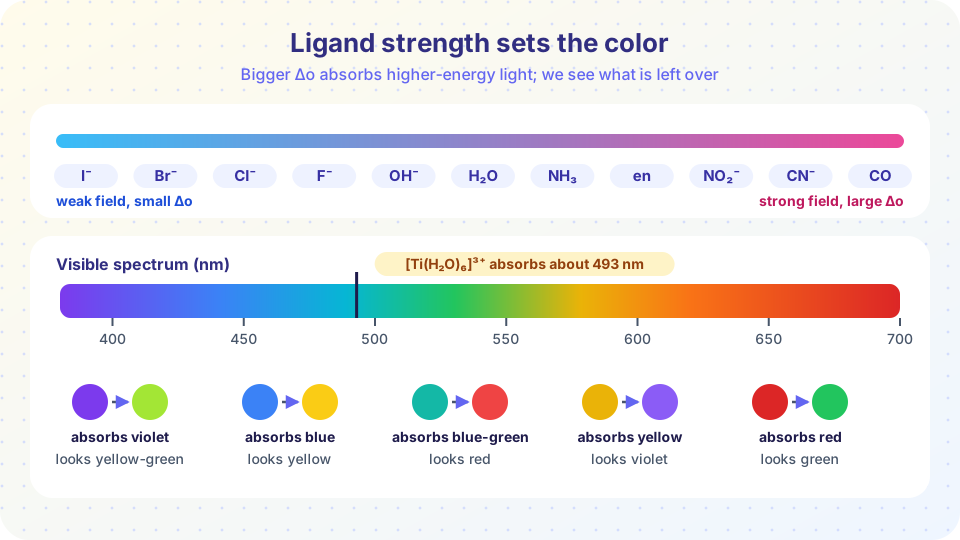
An octahedral d¹ ion has its electron in a t₂g orbital. If a photon with energy equal to Δo arrives, the electron can jump into eg. White light loses that wavelength, and your eye sees what is left. For [Ti(H₂O)₆]³⁺, Δo ≈ 20,300 cm⁻¹, so
λ = 10⁷ / 20,300 ≈ 493 nm
That is blue-green light being absorbed; the transmitted light is the red and violet end, giving the violet color. The energy per mole is E = 0.01196 kJ/mol × 20,300 ≈ 243 kJ/mol, the same order as chemical bond energies, which is why such complexes can react photochemically.
The same logic works for d³ ions such as Cr³⁺, where the lowest-energy absorption equals Δo: [Cr(H₂O)₆]³⁺ (Δo ≈ 17,400 cm⁻¹, 575 nm yellow absorbed) is violet, [Cr(NH₃)₆]³⁺ (21,550 cm⁻¹, 464 nm, blue absorbed) is yellow, and the change is exactly what the spectrochemical series predicts: ammonia is a stronger-field ligand than water, so Δo is larger and the absorption shifts to shorter wavelengths. For ions with more complicated electron arrangements (d², d⁴ to d⁸) the absorptions are not simply Δo, and more advanced theory (Tanabe–Sugano diagrams) is needed.
Other colors and their intensities
- Tetrahedral complexes have smaller splitting (Δt ≈ 4/9 Δo) and no center of symmetry, which relaxes the selection rule and makes their bands much more intense.
[CoCl₄]²⁻is a deep blue, whereas octahedral[Co(H₂O)₆]²⁺is pale pink. The change from pink to blue when concentrated HCl is added to cobalt chloride solution is a classic demonstration. - Charge transfer. MnO₄⁻ is d⁰, yet deep purple; CrO₄²⁻ is d⁰ and yellow. Electrons move from oxygen to metal (LMCT). These bands are 100 to 1000 times stronger than d–d bands. Prussian blue's color arises from metal-to-metal CT between Fe(II) and Fe(III).
- Spin-forbidden transitions.
[Mn(H₂O)₆]²⁺is high-spin d⁵ and every d–d transition would require a spin flip, which is forbidden; hence a very pale pink. - d⁰ and d¹⁰ with colorless ligands (Zn²⁺, Sc³⁺) show no d–d bands and are colorless.
The Laporte rule captures this: in a molecule with a center of symmetry (octahedral), transitions between orbitals of the same parity (d to d) are forbidden and only weak because vibrations break the symmetry briefly. Molar absorptivity ε is about 1 to 100 L mol⁻¹ cm⁻¹ for octahedral d–d, around 100 to 1000 for tetrahedral d–d, and often above 10,000 for charge transfer.
Magnetism
A complex with unpaired electrons is paramagnetic: it is pulled into a magnetic field. One with all electrons paired is diamagnetic and slightly repelled. If orbital angular momentum is quenched, the magnetic moment depends only on spin:
μ(spin-only) = √(n(n + 2)) Bohr magnetons, where n is the number of unpaired electrons.
| Complex | d count | Spin | n | μ (spin-only) |
|---|---|---|---|---|
| [Cr(H₂O)₆]³⁺ | d³ | — | 3 | 3.87 |
| [Mn(H₂O)₆]²⁺ | d⁵ | high | 5 | 5.92 |
| [Fe(H₂O)₆]²⁺ | d⁶ | high | 4 | 4.90 |
| [Fe(CN)₆]⁴⁻ | d⁶ | low | 0 | 0 |
| [Ni(H₂O)₆]²⁺ | d⁸ | — | 2 | 2.83 |
| [Cu(H₂O)₆]²⁺ | d⁹ | — | 1 | 1.73 |
Measured moments are usually close, and are a way to tell high-spin from low-spin: a Co³⁺ complex with μ ≈ 4.9 BM is high spin (4 unpaired), but μ ≈ 0 means low spin. For some ions, such as high-spin Fe²⁺ or Co²⁺, orbital contributions push the measured value above the spin-only prediction. Magnetic moments are measured with a Gouy balance, a Faraday balance or, in solution, by the shift of an NMR signal (the Evans method).
Common misconceptions
"The color of a complex is the color it absorbs." You see the transmitted color, the complement of what is absorbed.
"Strong-field ligands make complexes absorb at longer wavelengths." Larger Δo means higher energy, hence shorter wavelength.
"Every colored complex is paramagnetic." Low-spin d⁶ complexes are colored but diamagnetic.
Try it
Convert Δo values to absorbed wavelengths and plot schematic absorption bands. The wavelength comes from the numbers; the bands are drawn as simple Gaussian curves for illustration and are not measured spectra. Observed colors are experimental facts, listed by hand.
Press Run (or Ctrl + Enter) to see the result here.
Program input · what you'd type while the program runs
Type the answers before you press Run, one per line. Each time the program reads a line (with input()), it gets the next line from this box.
Next, compute the spin-only moment and the likely number of unpaired electrons for octahedral complexes of any d count, choosing high or low spin.
Press Run (or Ctrl + Enter) to see the console output here.
No output.
Check your understanding
Quick check · 5 questions
of 5 answered You scored / 5 · perfect!
-
1. A complex has Δo = 25,000 cm⁻¹. At about what wavelength does its d–d absorption occur?
λ = 10⁷ / 25,000 = 400 nm. -
2. Replacing water with ammonia in [Cr(H₂O)₆]³⁺ shifts the absorption...
NH₃ is a stronger-field ligand, so Δo increases and the wavelength decreases. -
3. What is the spin-only moment of a complex with 3 unpaired electrons?
√(3 × 5) = √15 ≈ 3.87. -
4. Why is MnO₄⁻ intensely colored even though it is d⁰?
With no d electrons there are no d–d bands; the color comes from charge transfer. -
5. [Fe(CN)₆]⁴⁻ is diamagnetic because it is...
CN⁻ is a strong-field ligand, so all six d electrons pair in t₂g.
Summary
- Color comes from d–d absorption at energy Δo (λ = 10⁷ / Δo in cm⁻¹); you see the complement.
- Stronger-field ligands give larger Δo and shorter-wavelength absorption.
- Tetrahedral complexes and charge-transfer bands are much more intense than octahedral d–d bands.
- μ(spin-only) = √(n(n+2)) BM separates high-spin from low-spin complexes.
Next: Chapter Review
Track your progress
Create a free account to tick off lessons and pick up where you left off on any device.
of Inorganic Chemistry lessons completed