


















Lesson 13 of 45 · Bonding Models
Lewis structures and VSEPR
Draw Lewis structures, handle expanded octets and formal charge, and predict molecular shapes from electron domains with VSEPR, including lone-pair shapes such as SF4 and XeF4.
In 1916 Gilbert N. Lewis proposed that atoms bond by sharing pairs of electrons to reach a stable octet. Fifty years later Ronald Gillespie and Ronald Nyholm turned that idea into a rule for shape: the electron pairs around a central atom repel each other, so they arrange themselves as far apart as possible. Together the two ideas let you go from a formula to a three-dimensional picture in a minute, and they work surprisingly well, even for the unusual compounds of the heavy main-group elements.
What you will learn
- How to draw Lewis structures with formal charge and resonance
- When the octet rule fails and what to do about it
- How to count electron domains and predict molecular shape
- How lone pairs distort bond angles
Key terms
- Lone pair: a pair of valence electrons not involved in bonding.
- Electron domain: a region of electron density around the central atom: a bond (single, double or triple counts as one) or a lone pair.
- Formal charge:
valence electrons − nonbonding electrons − ½ bonding electronsfor each atom. - Hypervalent: a central atom with more than eight electrons in its valence shell, such as S in SF₆.
- Resonance: several valid Lewis structures for one species, whose average is the true structure.
Drawing a Lewis structure
- Add up the valence electrons of all atoms, adjusting for charge (add one per negative charge, subtract one per positive).
- Put the least electronegative atom (not hydrogen) in the center and join it to the others with single bonds.
- Give each outer atom a full octet (hydrogen gets two) with lone pairs.
- Place remaining electrons on the central atom.
- If the central atom has fewer than eight, turn lone pairs on outer atoms into double or triple bonds.
- Check formal charges. The best structure has charges close to zero, with any negative charge on the more electronegative atom.
Example: CO₂. 4 + 2 × 6 = 16 electrons. A skeleton O–C–O uses 4; after octets on the oxygens, carbon has only four electrons. Two double bonds fix this: O=C=O, with two lone pairs on each oxygen and zero formal charges.
Resonance arises in species such as nitrate NO₃⁻ and ozone O₃. Nitrate has three equivalent structures, each with one N=O double bond. In reality all three N–O bonds are identical, with bond order 1⅓. The Lewis structures are our way of describing a single delocalized electron distribution.
When the octet rule fails
- Fewer than eight (electron deficient). BF₃ has six electrons around boron, and BeCl₂ has four around beryllium. These compounds are strong Lewis acids (chapter 4).
- Odd electron count. NO and NO₂ have an unpaired electron, so one atom cannot have an octet.
- More than eight (expanded octet). SF₆, PCl₅, XeF₂ and ClF₃ have central atoms with 10 to 12 electrons. Elements from period 3 down can do this. Modern calculations show the d orbitals contribute little: the bonding in SF₆ is better described by delocalized three-center, four-electron bonds with strong ionic character. The Lewis structure with six S–F bonds is still a good bookkeeping device, and the shape predictions are correct.
VSEPR: from electron domains to shape
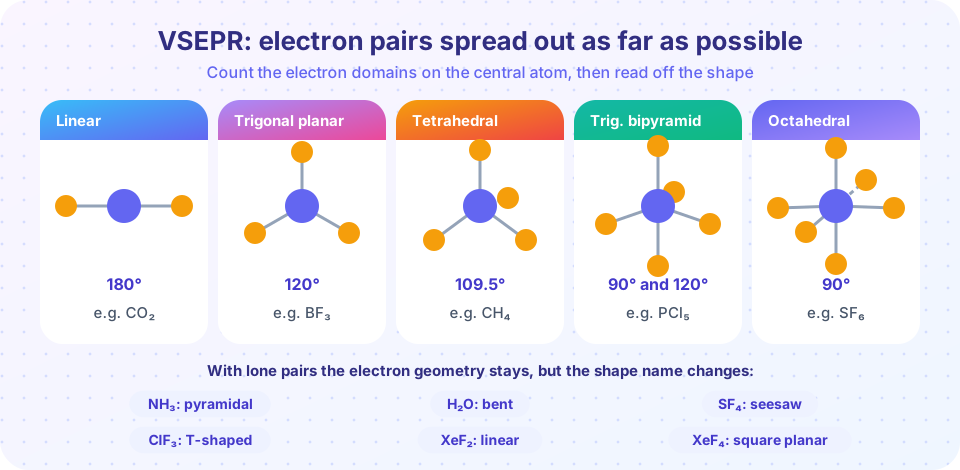
Count the electron domains (bonding domains plus lone pairs) around the central atom. They point to the corners of a geometry that keeps them as far apart as possible:
| Domains | Electron geometry | Ideal angles |
|---|---|---|
| 2 | linear | 180° |
| 3 | trigonal planar | 120° |
| 4 | tetrahedral | 109.5° |
| 5 | trigonal bipyramidal | 90° and 120° |
| 6 | octahedral | 90° |
The molecular shape names only the positions of the atoms. Lone pairs occupy space but are invisible in the shape:
| Bonds + lone pairs | Shape | Example |
|---|---|---|
| 3 + 0 | trigonal planar | BF₃ |
| 2 + 1 | bent | SO₂ |
| 4 + 0 | tetrahedral | CH₄ |
| 3 + 1 | trigonal pyramidal | NH₃ |
| 2 + 2 | bent | H₂O |
| 5 + 0 | trigonal bipyramidal | PCl₅ |
| 4 + 1 | seesaw | SF₄ |
| 3 + 2 | T-shaped | ClF₃ |
| 2 + 3 | linear | XeF₂ |
| 6 + 0 | octahedral | SF₆ |
| 5 + 1 | square pyramidal | BrF₅ |
| 4 + 2 | square planar | XeF₄ |
Two refinements make predictions sharper. First, lone pairs repel more than bonding pairs, because they are held by one nucleus and spread out. So angles shrink as lone pairs are added: CH₄ 109.5°, NH₃ about 107°, H₂O about 104.5°. Second, in a trigonal bipyramid the lone pairs go in the equatorial positions, where they have fewer close neighbors at 90°. Thus SF₄, ClF₃ and XeF₂ look as the table says. In an octahedron, two lone pairs sit opposite each other, which is why XeF₄ is square planar.
A double or triple bond counts as one domain, but it takes up a little more room than a single bond.
Common misconceptions
- "Water is bent because oxygen has two bonds." It is bent because oxygen also has two lone pairs: four domains, tetrahedral arrangement, two corners empty of atoms.
- "A molecule with polar bonds is polar." CO₂ has two polar C=O bonds, but the molecule is linear, so the dipoles cancel and it is nonpolar. Shape decides.
- "The octet rule is a law." It is a good rule for the second period and a weak one for heavier elements and electron-deficient compounds.
Try it
This program counts lone pairs from valence electrons for molecules of the type AXn (central atom with single-bonded terminal atoms), then looks up the shape.
Press Run (or Ctrl + Enter) to see the result here.
Program input · what you'd type while the program runs
Type the answers before you press Run, one per line. Each time the program reads a line (with input()), it gets the next line from this box.
Now build shapes yourself. Choose how many bonded atoms and lone pairs the central atom has. Lone pairs are drawn in pink.
Check your understanding
Quick check · 5 questions
of 5 answered You scored / 5 · perfect!
-
1. What is the shape of the ammonia molecule, NH₃?
Nitrogen has three bonds and one lone pair: four domains in a tetrahedral arrangement, with only three positions occupied by atoms. -
2. Why is XeF₄ square planar?
Xenon has four bonds and two lone pairs: six domains, octahedral. The lone pairs sit trans, which leaves the four fluorines in a plane. -
3. Which molecule violates the octet rule by having an incomplete octet?
Boron in BF₃ has only six electrons, which makes BF₃ a strong Lewis acid. -
4. The H–O–H angle in water is smaller than the ideal 109.5° because:
The two lone pairs push the bonding pairs closer together, reducing the angle to about 104.5°. -
5. In SF₄, where is the lone pair?
Lone pairs prefer the equatorial positions of a trigonal bipyramid, giving the seesaw shape.
Summary
- A Lewis structure counts valence electrons and distributes them as bonds and lone pairs, checked with formal charge and resonance.
- The octet rule fails for electron-deficient, odd-electron and hypervalent species.
- VSEPR counts electron domains, chooses the geometry, and names the shape by the atoms only.
- Lone pairs repel more than bonding pairs and sit equatorially in trigonal bipyramids.
Next: Molecular orbital theory
Track your progress
Create a free account to tick off lessons and pick up where you left off on any device.
of Inorganic Chemistry lessons completed