


















Lesson 11 of 45 · Bonding Models
Chapter 3 overview: bonding models
Get the map of chapter 3: ionic, covalent and metallic bonding, the Van Arkel-Ketelaar triangle, and how Lewis, VSEPR and molecular orbital models fit together.
Chemical bonds are not objects. Nobody has ever seen a bond, and there is no single equation that describes every one. What we have instead are models: simplified pictures, each good at predicting certain things. Ionic models predict lattice energies. Lewis structures count electron pairs. VSEPR predicts shapes. Molecular orbital theory explains color, magnetism and bond order. A good inorganic chemist knows which model to use, and when each one breaks down.
What you will learn
- The three limiting types of bond and what each explains
- How to place a substance on the bonding triangle using electronegativity
- Which model to reach for, and what each lesson of the chapter covers
Three ends of one spectrum
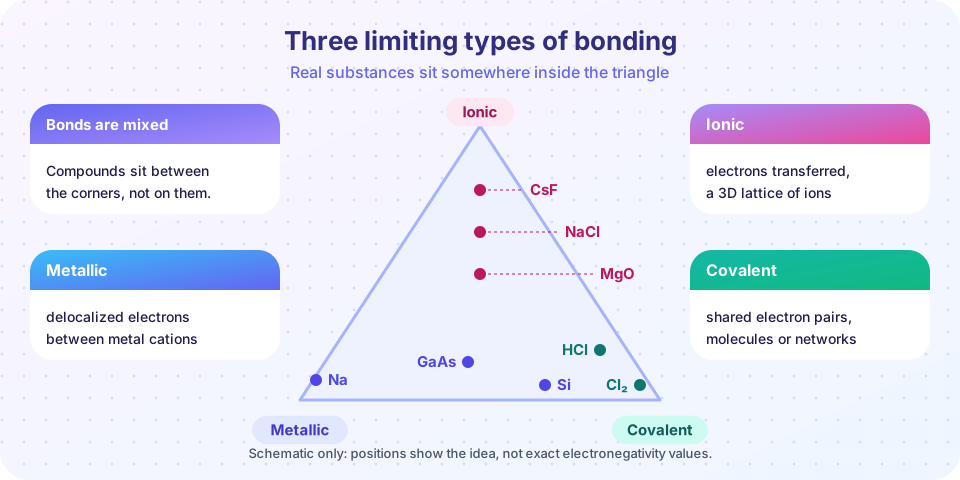
- Ionic bonding: one atom gives electrons to another, and the resulting ions are held together by electrostatic attraction in a 3D lattice (NaCl, MgO). The model works best when the electronegativity difference is large.
- Covalent bonding: atoms share electron pairs (H₂, H₂O, CH₄, SF₆). The substance can be a small molecule or a giant network (diamond, SiO₂).
- Metallic bonding: metal atoms release their valence electrons into a shared, delocalized "sea" around a lattice of cations (Na, Cu, Fe).
The Van Arkel-Ketelaar triangle arranges them as corners. The vertical axis is the electronegativity difference Δχ between the two atoms, and the horizontal axis is their average electronegativity. Large Δχ places a compound near the ionic corner; small Δχ and low average electronegativity puts it near the metallic corner; small Δχ and high average electronegativity puts it near the covalent corner. Semiconductors such as silicon and gallium arsenide fall between the metallic and covalent corners.
Which model for which question?
| Question | Best model | Lesson |
|---|---|---|
| Why does NaCl melt at 801 °C? | Ionic lattice and lattice energy | Ionic bonding and lattice energy |
| What shape is SF₄? | Lewis structures and VSEPR | Lewis structures and VSEPR |
| Why is O₂ magnetic? | Molecular orbital theory | Molecular orbital theory |
| How strong is a bond? | Bond order, bond energy (MO) | Molecular orbital theory |
Three ways to bond
Three tools to describe them
Common misconceptions
- "Bonds are either ionic or covalent." The truth is a continuum. Even NaCl has some covalent character, and even H₂ is purely covalent only because both atoms are identical.
- "A bond is a physical stick." A bond is a description of electron density that lowers the energy of two or more nuclei relative to separated atoms.
- "One model is right and the others are wrong." Each model is accurate for some questions and useless for others.
Try it
Place compounds on the triangle by computing Δχ and the average electronegativity from Pauling values. The classification rule here is a rough guide, not a law.
Press Run (or Ctrl + Enter) to see the result here.
Program input · what you'd type while the program runs
Type the answers before you press Run, one per line. Each time the program reads a line (with input()), it gets the next line from this box.
Check your understanding
Quick check · 3 questions
of 3 answered You scored / 3 · perfect!
-
1. In the bonding triangle, where does elemental sodium sit?
Sodium has low electronegativity and no electronegativity difference between its atoms, so it sits at the metallic corner. -
2. Which axis of the Van Arkel-Ketelaar triangle shows how ionic a compound is?
A large difference in electronegativity means the compound is near the ionic corner. -
3. Which model is best for explaining why O₂ is attracted to a magnet?
MO theory predicts two unpaired electrons in O₂, which a simple Lewis structure with all electrons paired does not.
Summary
- Ionic, covalent and metallic bonding are limiting cases on a triangle; real compounds are in between.
- Electronegativity difference and average electronegativity place a substance on the triangle.
- Different models answer different questions: lattice energy for ionic solids, Lewis and VSEPR for shapes, MO theory for magnetism and bond order.
Track your progress
Create a free account to tick off lessons and pick up where you left off on any device.
of Inorganic Chemistry lessons completed