


















Lesson 42 of 45 · Projects and Practice
Project: Build a Complex Analyzer
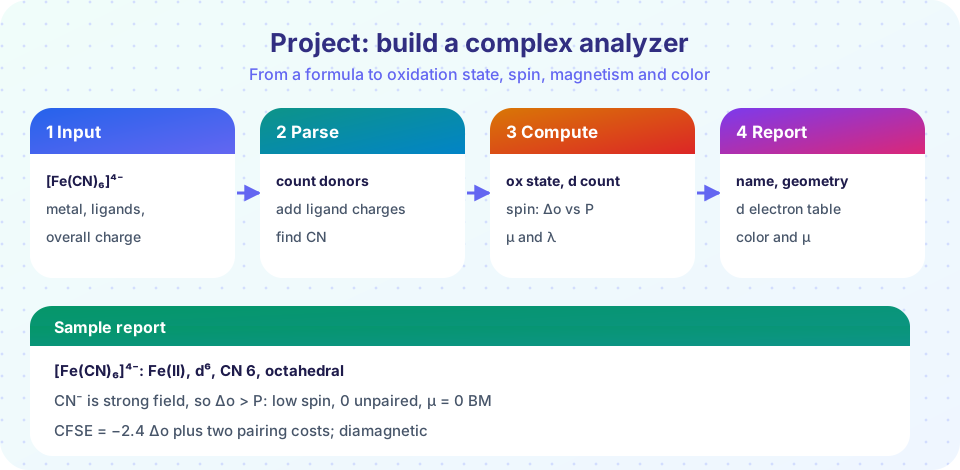
Write a small program that parses a complex formula and reports oxidation state, d count, spin state, magnetic moment and color, then plot spin states.
In this project you will combine nearly everything from chapters 6 and 7 into one working tool. You give it a formula such as [Fe(CN)6]4-, and it tells you the oxidation state of the metal, the d-electron count, the geometry, whether the complex is high spin or low spin, the number of unpaired electrons, the spin-only magnetic moment and the wavelength equivalent of the splitting. Building it forces you to state each rule precisely enough for a computer to follow, which is one of the best ways to find out whether you really understand it.
What you will learn
- Break a chemistry procedure into parse, compute and report stages.
- Encode the d-count, spin-state and magnetism rules as code.
- Use experimental Δo and pairing-energy tables instead of guessing.
- Visualize the high-spin and low-spin boundary.
Key terms
Homoleptic complex: one in which all ligands are the same, such as [Fe(CN)₆]⁴⁻.
Pairing energy (P): the energy cost of putting two electrons in the same orbital.
Lookup table: a stored set of measured values the program reads rather than computes.
Edge case: an input the rules do not cover, such as a complex with no data for Δo.
Design
The program is limited by design: it handles homoleptic octahedral or four-coordinate complexes with one kind of ligand, written as [M(L)n]charge. Ligand names are CN, CO, NH3, H2O, F, Cl and en. The charge and ligand count give the oxidation state, the metal's group number gives the d count, and measured Δo and P values (from the TryIt's table) decide the spin state when d is 4 to 7. Anything outside the table is reported as "unknown" rather than guessed, which is an important habit in scientific code.
The rules the code implements:
oxidation state = overall charge − (ligand count × ligand charge)d count = group number − oxidation statecoordination number = ligand count × denticity(en counts 2)- For d⁴ to d⁷ with CN 6: low spin if Δo > P, else high spin; other d counts have no choice.
- Unpaired electrons from the filling rules;
μ = √(n(n+2)). - The wavelength equivalent of Δo,
λ = 10⁷ / Δo, which equals the lowest absorption band only for d¹ and d³ ions.
The code
Run it, change the formulas in the last lines and see how the report changes. The Δo and P values are rounded textbook numbers in cm⁻¹.
Press Run (or Ctrl + Enter) to see the console output here.
No output.
Notice what the program does for [Mn(CN)6]4-: Δo is missing from the table, so it says so rather than guessing. That is a sound design rule for scientific software.
Visualize the spin boundary
The decisive comparison is Δo against P. Plot each complex in the table as a point; those above the diagonal are low spin, those below are high spin.
Press Run (or Ctrl + Enter) to see the result here.
Program input · what you'd type while the program runs
Type the answers before you press Run, one per line. Each time the program reads a line (with input()), it gets the next line from this box.
Extension ideas
- Add more ligands (
I,Br,OH,ox) and more measured Δo values. - Support mixed complexes such as
[Co(NH3)5Cl]2+by accepting a list of ligands. - Add the square planar rule: CN 4 with d⁸ and a 4d or 5d metal.
- Print the IUPAC name by reusing the naming tool from the ligands lesson.
- Compute CFSE in kJ/mol using
0.011963 × Δo.
Common misconceptions
"The program proves the answer." It applies simplified rules to rounded data; it is a model, not an experiment.
"Missing data can be filled with a typical value." Doing so hides uncertainty. Report unknowns as unknown.
Check your understanding
Quick check · 4 questions
of 4 answered You scored / 4 · perfect!
-
1. Which complex in the analyzer table is low spin?
Δo (23,000) exceeds P (21,000) for Co³⁺ with ammonia. -
2. Why does the program report unknown for [Mn(CN)6]4-?
The lookup table has no entry, and the program avoids guessing. -
3. What is the oxidation state of Fe in [Fe(CN)6]3-?
Six CN⁻ give −6; the overall charge is −3, so Fe is +3. -
4. For which d counts does the program need Δo and P?
Only d⁴ to d⁷ have a choice between high and low spin.
Summary
- A useful chemistry tool is a pipeline: parse, compute, report.
- The analyzer encodes oxidation state, d count, spin state, μ and λ in a few rules and tables.
- Measured Δo and P values decide spin states; missing data should be reported, not invented.
- Plotting Δo against P shows the high-spin and low-spin regions at a glance.
Next: Glossary
Track your progress
Create a free account to tick off lessons and pick up where you left off on any device.
of Inorganic Chemistry lessons completed