


















Lesson 8 of 45 · Atomic Structure and Periodicity
Electron configurations
Write electron configurations for atoms and ions using the Aufbau principle, Hund's rule and the Pauli principle, and see why chromium and copper break the pattern.
An electron configuration lists which orbitals an atom's electrons occupy. It is the single most useful fact about an atom. From it you can read the valence electrons, the likely ions, the number of unpaired electrons (and so the magnetism) and the position in the periodic table. This lesson shows how to build a configuration step by step and why a few elements break the rules.
What you will learn
- The three rules for filling orbitals
- How to write full and noble-gas-core configurations
- How to write configurations for ions, especially transition-metal cations
- Why Cr and Cu are exceptions
Key terms
- Aufbau principle: electrons fill the lowest-energy orbitals first ("building up").
- Hund's rule: within a set of equal-energy orbitals, electrons occupy separate orbitals with parallel spins before any pairing.
- Valence electrons: the electrons in the outermost shell (plus incompletely filled d and f subshells that take part in bonding).
- Core electrons: the filled inner shells, often abbreviated by the preceding noble gas, such as [Ar].
- Paramagnetic / diamagnetic: having unpaired electrons (attracted to a magnet) / having none (weakly repelled).
The three rules
- Aufbau. Fill orbitals from lowest to highest energy.
- Pauli. At most two electrons per orbital, with opposite spins.
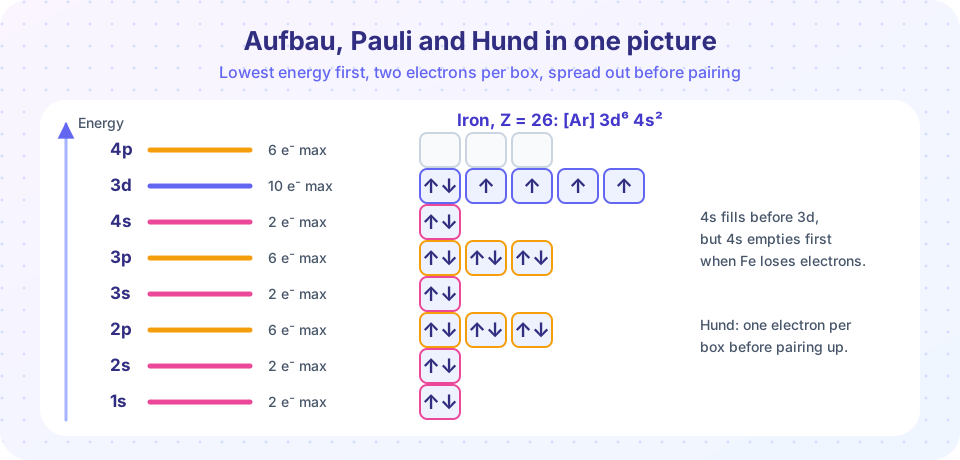
- Hund. Equal-energy orbitals are filled singly first, all with the same spin direction, then paired.
The filling order
For most elements the energy order is given by the Madelung (n + l) rule: orbitals fill in order of increasing n + l, and for equal n + l, the lower n first. That gives the familiar sequence:
1s, 2s, 2p, 3s, 3p, 4s, 3d, 4p, 5s, 4d, 5p, 6s, 4f, 5d, 6p, 7s, 5f, 6d, 7p
Why does 4s fill before 3d? Because of penetration (see the previous lesson). A 4s electron spends some time very close to the nucleus, so it feels a high effective nuclear charge and is more stable than a 3d electron in a neutral atom with an empty d subshell. Once 3d is occupied it is pulled down in energy, and the 3d orbitals lie below 4s. That is why transition metals lose their 4s electrons first when they form cations.
Writing configurations
Carbon (Z = 6): 1s² 2s² 2p². The two 2p electrons go in separate p orbitals with parallel spins (Hund), so carbon has two unpaired electrons.
Chlorine (Z = 17): 1s² 2s² 2p⁶ 3s² 3p⁵, or [Ne] 3s² 3p⁵. Seven valence electrons and one unpaired electron.
Iron (Z = 26): [Ar] 3d⁶ 4s². The six 3d electrons occupy five boxes: one pair and four unpaired electrons, so atomic iron has four unpaired electrons. (The 3d is written before 4s because it has the lower n.)
Ions
Anions simply add electrons to the next available orbital: Cl⁻ is [Ar], isoelectronic with argon.
Cations remove electrons from the highest principal quantum number first, and among equal n, from the highest l. So for transition metals the s electrons leave first:
- Fe²⁺: [Ar] 3d⁶ (the two 4s electrons go)
- Fe³⁺: [Ar] 3d⁵ (one more, from 3d), with five unpaired electrons: a half-filled, stable arrangement
- Cu⁺: [Ar] 3d¹⁰
- Zn²⁺: [Ar] 3d¹⁰
This explains why Fe³⁺ is relatively stable and why zinc, with a full d shell, is only ever 2+.
The exceptions
Two electron arrangements are especially stable: half-filled (d⁵) and filled (d¹⁰) subshells, because 3d and 4s are very close in energy and electron exchange energy favors parallel spins. So:
- Chromium (Z = 24) is [Ar] 3d⁵ 4s¹, not 3d⁴ 4s².
- Copper (Z = 29) is [Ar] 3d¹⁰ 4s¹, not 3d⁹ 4s².
Further down, the same effect gives molybdenum [Kr] 4d⁵ 5s¹, silver [Kr] 4d¹⁰ 5s¹ and palladium [Kr] 4d¹⁰. The rules of thumb are a good guide, not a law of nature: the real configuration is whatever minimizes total energy, and in heavy elements the competition is subtle. Experiment and calculation settle the exceptions, and they are listed in data tables for every element.
Common misconceptions
- "4s is higher in energy than 3d, so 3d fills first." The reverse is true for neutral atoms; and transition metals lose 4s electrons before 3d.
- "Half-filled subshells are stable because of a magic rule." They are favored by exchange energy, but the effect is modest, and it is only one factor.
- "Electrons pair up as early as possible to save space." Hund's rule says the opposite: parallel spins in separate orbitals minimize repulsion.
Try it
The program below builds electron configurations with the Madelung rule and the known exceptions up to xenon. It writes noble-gas-core notation, counts unpaired electrons, and removes electrons correctly for cations.
Press Run (or Ctrl + Enter) to see the result here.
Program input · what you'd type while the program runs
Type the answers before you press Run, one per line. Each time the program reads a line (with input()), it gets the next line from this box.
Magnetism follows from unpaired electrons. This chart counts the unpaired electrons of each neutral first-row transition metal, using the same rules. Chromium's exception makes it the champion with six.
Press Run (or Ctrl + Enter) to see the result here.
Program input · what you'd type while the program runs
Type the answers before you press Run, one per line. Each time the program reads a line (with input()), it gets the next line from this box.
Check your understanding
Quick check · 6 questions
of 6 answered You scored / 6 · perfect!
-
1. What is the electron configuration of Fe²⁺?
Neutral Fe is [Ar] 3d⁶ 4s². Cations lose the 4s electrons first, leaving [Ar] 3d⁶. -
2. Why is the configuration of chromium [Ar] 3d⁵ 4s¹ instead of [Ar] 3d⁴ 4s²?
3d and 4s are close in energy, and exchange energy favors a half-filled d subshell, so one electron moves from 4s to 3d. -
3. How many unpaired electrons does a carbon atom have in its ground state?
The two 2p electrons occupy different p orbitals with parallel spins (Hund's rule). -
4. Which ion has the configuration [Ar]?
Cl has 17 electrons, so Cl⁻ has 18, the same as argon. Na⁺ and Mg²⁺ are [Ne] and Li⁺ is [He]. -
5. Which orbital is filled first?
By the n + l rule the order is 3p, 4s, 3d, 4p, 5s. -
6. Zn²⁺ has the configuration [Ar] 3d¹⁰. Is it paramagnetic?
A completely filled d subshell has all electrons paired, so Zn²⁺ is diamagnetic and its compounds are colorless.
Summary
- Fill orbitals by the Aufbau, Pauli and Hund rules, following the Madelung n + l order.
- Cations lose electrons from the highest n first, so transition metals lose 4s before 3d.
- Half-filled and filled d subshells explain exceptions such as Cr and Cu.
- Unpaired electrons make atoms and ions paramagnetic, and filled d shells make them diamagnetic and often colorless.
Next: Periodic trends
Track your progress
Create a free account to tick off lessons and pick up where you left off on any device.
of Inorganic Chemistry lessons completed