


















Lesson 27 of 45 · Transition Metals
Chapter 6 Overview: The Transition Metals
A map of d-block chemistry: the 3d row, why transition metals have many oxidation states, colors and catalysis, and what each lesson in this chapter covers.
Iron in a bridge, copper in a wire, titanium in a hip implant, platinum in a car's catalytic converter, zinc coating a nail: the transition metals built the modern world. They are also the elements that give rubies, emeralds and sapphires their colors, make hemoglobin red and drive industrial catalysts. Their chemistry is richer than the s block's because they have a partly filled d subshell that can lose different numbers of electrons, and that single feature explains nearly everything in the next three chapters.
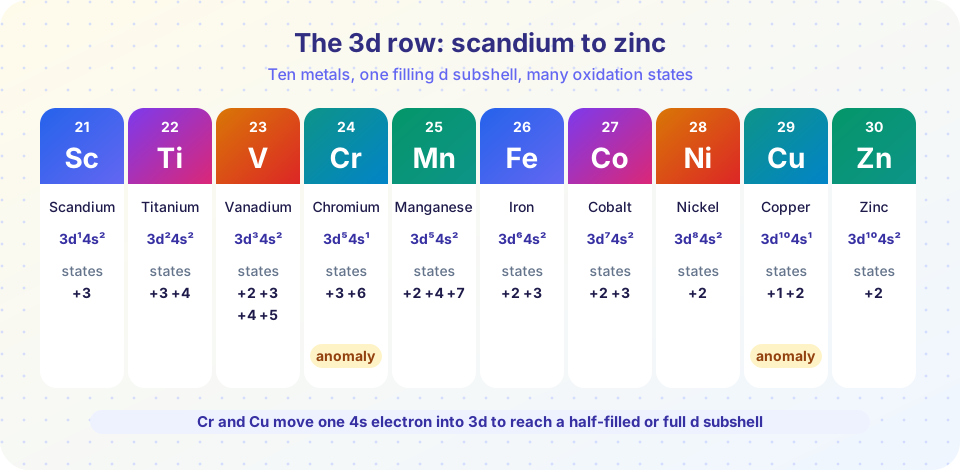
What you will learn
- What qualifies an element as a transition metal and why the 3d row is the one we study first.
- How to write configurations for neutral atoms and ions, including Cr and Cu.
- Why transition metals show many oxidation states, colors and catalytic activity.
- What each lesson in this chapter covers.
Key terms
Transition metal: an element whose atom has a partly filled d subshell, or can form cations with a partly filled d subshell (IUPAC definition).
d-block: groups 3 to 12; the 3d, 4d and 5d series.
Variable oxidation state: an element that forms stable ions with different charges, such as Fe²⁺ and Fe³⁺.
Paramagnetic: attracted into a magnetic field because of unpaired electrons.
What makes a metal a transition metal?
By the IUPAC definition, a transition metal has an incomplete d subshell, or can form a cation with one. That includes Ti to Cu but, strictly, excludes zinc (Zn²⁺ is 3d¹⁰) and scandium (Sc³⁺ is 3d⁰). Most chemists still study them together because their physical properties are similar and Zn and Sc occupy the same rows. Moving across, the 3d row is followed by the 4d row (Y to Cd) and the 5d row (La/Hf to Hg).
The valence shell order is odd but regular: the neutral atom fills 4s before 3d (Ar 4s² first), yet in ions the 4s electrons leave first. A neutral Fe atom is [Ar] 3d⁶ 4s², and Fe³⁺ is [Ar] 3d⁵, not [Ar] 3d³ 4s². The reason is that once 3d electrons are present, 3d drops below 4s in energy. The first TryIt below builds configurations for any 3d atom or ion.
Why transition metals are special
Four big ideas in this chapter
Remember
Why so many oxidation states?
In the s block, removing the second electron is much harder than the first, so +1 or +2 is the end of the story. In the 3d row, the 4s and 3d electrons have similar energies, so successive ionization energies rise gently and several states are within reach. Manganese runs from +2 to +7: Mn²⁺ is a pale pink aqua ion, MnO₂ a brown solid and MnO₄⁻ the deep purple permanganate. Two rules of thumb will be formalized later: the maximum oxidation state equals the group number up to manganese, and the highest states appear as oxoanions that act as oxidizers.
Chemistry beyond the s and p blocks
The partly filled d subshell does three things at once. It gives many oxidation states (this lesson and the next two), it makes compounds colored and often magnetic because the d electrons can jump between split d levels (chapter 7), and it lets metals bind molecules to their surface or as ligands, which is the basis of catalysis. Iron catalyzes ammonia synthesis, vanadium(V) oxide catalyzes the contact process and platinum, palladium and rhodium clean exhaust gas.
What is in this chapter
| Lesson | Focus |
|---|---|
| d-Block Properties | Electron counts, trends, oxidation states, colors and uses |
| Redox and Frost Diagrams | Latimer diagrams, Frost diagrams, Nernst equation, disproportionation |
| Chapter Review | One-picture summary and a ten-question mixed quiz |
Common misconceptions
"4s fills first so 4s electrons are lost last." They are lost first because 3d is lower in energy once it is occupied.
"All d-block elements are transition metals." By the strict definition, Zn, Cd, Hg and sometimes Sc are not.
"Transition metals are all hard, dense and high-melting." Most are, but mercury is a liquid and zinc melts at only 420 °C.
Try it
Build the configuration of any 3d atom or ion. The table of neutral configurations is hard-coded (including the Cr and Cu exceptions) and ions lose 4s electrons first.
Press Run (or Ctrl + Enter) to see the console output here.
No output.
Second, plot how melting point and density vary along the 3d row. They peak near the middle of the row, where bonding is strongest.
Press Run (or Ctrl + Enter) to see the result here.
Program input · what you'd type while the program runs
Type the answers before you press Run, one per line. Each time the program reads a line (with input()), it gets the next line from this box.
Check your understanding
Quick check · 5 questions
of 5 answered You scored / 5 · perfect!
-
1. What is the electron configuration of Fe³⁺?
Fe is [Ar] 3d⁶ 4s². Both 4s electrons go first, then one 3d electron, leaving 3d⁵. -
2. Which 3d element is NOT a transition metal by the strict IUPAC definition?
Zn²⁺ is 3d¹⁰, a full subshell, so zinc has no ion with a partly filled d subshell. -
3. Why does chromium have the configuration [Ar] 3d⁵ 4s¹?
Moving one 4s electron into 3d gives a half-filled 3d subshell with extra exchange stabilization. -
4. Which ion is expected to be colorless?
Zn²⁺ is d¹⁰, so no d–d transitions are possible. -
5. Variable oxidation states arise mainly because...
Successive ionization energies rise gently, so several states are accessible.
Summary
- Transition metals have partly filled d subshells; the 3d row runs Sc to Zn, with Cr and Cu as configuration anomalies.
- Neutral atoms fill 4s first, but ions lose 4s first.
- Variable oxidation states, colors, magnetism and catalysis all come from the partly filled d subshell.
- The chapter covers properties, then redox, then a review.
Next: d-Block Properties
Track your progress
Create a free account to tick off lessons and pick up where you left off on any device.
of Inorganic Chemistry lessons completed