


















Lesson 41 of 45 · Projects and Practice
Practice Calculations: Chapters 5 to 8
Eight worked problems that mix redox, d-electron counting, crystal field theory, unit cells, lattice energy and oxygen binding, plus a practice generator.
Reading about chemistry is not the same as doing chemistry. This lesson gives you eight problems that cut across the last four chapters. Try each one on paper before opening the solution, then run the code that checks it. Every problem uses a tool you have already met, so the real skill being practiced is choosing the right tool and setting it up.
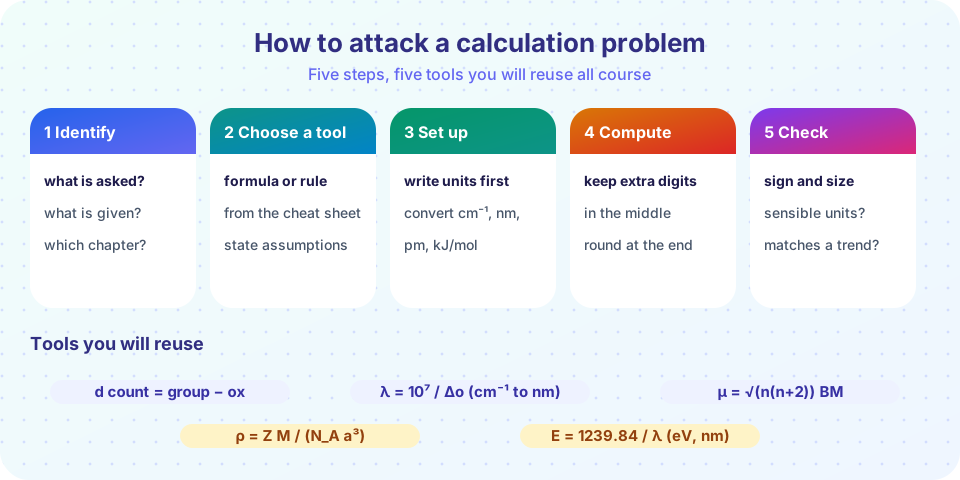
What you will learn
- Choose the right formula for a mixed problem and set it up with units.
- Check numerical answers against a simple sanity test.
- Use code to verify hand calculations.
Key terms
Sanity check: a quick test, such as sign, size or trend, that shows whether an answer could be right.
Spectator ion: an ion that does not take part in the reaction; ignore it in setup.
Significant figures: the digits that carry real information; keep extras until the last step.
The problems
Problem 1 (halogens). Chlorine is bubbled into a bromide solution: Cl₂ + 2 Br⁻ → 2 Cl⁻ + Br₂. Using E°(Cl₂/Cl⁻) = +1.36 V and E°(Br₂/Br⁻) = +1.07 V, find E°cell and log K.
Problem 2 (Latimer). Given MnO₄⁻ —0.56→ MnO₄²⁻ —2.26→ MnO₂, find E°(MnO₄⁻/MnO₂).
Problem 3 (Nernst). What is E for MnO₄⁻/Mn²⁺ at pH 4, with all other species at 1 M, if E° = 1.51 V?
Problem 4 (CFT). [Ni(H₂O)₆]²⁺ has Δo ≈ 8,500 cm⁻¹. State the d count, unpaired electrons, spin-only moment and CFSE in kJ/mol.
Problem 5 (spin). Compare the spin-only magnetic moments of [Fe(CN)₆]³⁻ (low spin) and [Fe(H₂O)₆]³⁺ (high spin).
Problem 6 (solids). NaCl has a = 564 pm, Z = 4 and M = 58.44 g/mol. Calculate its density.
Problem 7 (lattice energy). For KCl: ΔHf = −437, sublimation of K = +89, IE₁(K) = +419, ½D(Cl₂) = +122, EA(Cl) = −349, all in kJ/mol. Find the lattice energy.
Problem 8 (hemoglobin). Using the Hill equation with P50 = 26 mmHg and n = 2.8, find the saturation at p(O₂) = 60 mmHg.
Worked solutions
- Tool: cell potential and equilibrium.
E°cell = 1.36 − 1.07 = +0.29 V, and with n = 2,log K = nE° / 0.0592 = 2 × 0.29 / 0.0592 ≈ 9.8, so K ≈ 6 × 10⁹. Sanity check: positive E° means K ≫ 1. - Tool: weighted average of nE°.
E° = (1 × 0.56 + 2 × 2.26) / 3 = 5.08 / 3 ≈ 1.69 V. Remember that the second step moves two electrons (manganate to MnO₂). - Tool: Nernst with H⁺.
E = 1.51 − 0.0592 × (8/5) × pH = 1.51 − 0.0947 × 4 ≈ 1.13 V. - Tools: d count, CFSE, spin-only formula. Ni²⁺ is group 10 minus 2, so d⁸, with t₂g⁶ eg²: 2 unpaired, μ = √8 ≈ 2.83 BM. CFSE = −1.2 Δo = −1.2 × 8,500 = −10,200 cm⁻¹, and
× 0.011963 kJ/mol per cm⁻¹ ≈ −122 kJ/mol. - Tool: spin-only formula.
[Fe(CN)₆]³⁻: d⁵ low spin, 1 unpaired, μ = √3 ≈ 1.73 BM.[Fe(H₂O)₆]³⁺: d⁵ high spin, 5 unpaired, μ = √35 ≈ 5.92 BM. - Tool: density from the unit cell. Convert 564 pm to 5.64 × 10⁻⁸ cm.
ρ = 4 × 58.44 / (6.022 × 10²³ × (5.64 × 10⁻⁸)³) ≈ 2.16 g/cm³. - Tool: Born–Haber. Sum of steps = 89 + 419 + 122 − 349 = +281 kJ/mol, so
U = ΔHf − 281 = −437 − 281 = −718 kJ/mol. - Tool: Hill equation.
Y = 60²·⁸ / (26²·⁸ + 60²·⁸). Since (60/26)²·⁸ ≈ 10.4, Y ≈ 10.4 / 11.4 ≈ 0.91.
Common misconceptions
"I can add voltages directly." Add nE° (free energy), not E°, when combining half-reactions with different electron counts.
"The units will sort themselves out." Write them down; most errors come from mixing cm⁻¹ with nm, pm with cm or J with kJ.
"A calculator answer is right if it looks reasonable." Always compare with a known trend or known data point.
Try it
Run all eight answers in one script and compare them with your hand calculation. The numbers are derived from the formulas in the text.
Press Run (or Ctrl + Enter) to see the result here.
Program input · what you'd type while the program runs
Type the answers before you press Run, one per line. Each time the program reads a line (with input()), it gets the next line from this box.
Finally, a practice generator. It uses a fixed seed so the questions are the same each run; change the seed to get a new set, work them out, and compare with the printed answers.
Press Run (or Ctrl + Enter) to see the console output here.
No output.
Check your understanding
Quick check · 5 questions
of 5 answered You scored / 5 · perfect!
-
1. In problem 2, why is the second step weighted by 2?
Free energy adds as nE°, and the manganate to MnO₂ step transfers two electrons. -
2. What is log K when E°cell = 0.50 V and n = 2?
log K = 2 × 0.50 / 0.0592 ≈ 16.9. -
3. A d⁸ octahedral complex has how many unpaired electrons?
t₂g⁶ eg²: the two eg electrons are unpaired. -
4. Which unit conversion is needed to turn Δo in cm⁻¹ into a wavelength in nm?
λ (nm) = 10⁷ / Δo (cm⁻¹). -
5. For KCl, the Born–Haber lattice energy is about...
U = ΔHf − (sum of the steps) = −437 − 281 = −718 kJ/mol.
Summary
- Use the five-step method: identify, choose a tool, set up with units, compute, check.
- Reuse a small set of tools: nE° averages, Nernst, d count, CFSE, spin-only moment, unit-cell density, Born–Haber and the Hill equation.
- Always sanity-check sign, size and trend.
Track your progress
Create a free account to tick off lessons and pick up where you left off on any device.
of Inorganic Chemistry lessons completed