


















Lesson 9 of 45 · Atomic Structure and Periodicity
Periodic trends
Explain periodic trends in atomic radius, ionization energy, electron affinity and electronegativity using effective nuclear charge, shielding and penetration, with real data.
The periodic table earns its name from periodicity: properties repeat as atomic number increases. The most useful repeating properties are atomic size, how hard it is to remove an electron, how much an atom wants another electron, and how strongly it attracts electrons in a bond. All four can be explained by one idea, the effective nuclear charge, the net pull an outer electron actually feels.
What you will learn
- What effective nuclear charge (Zeff) is and how to estimate it
- The trends in atomic radius, ionization energy, electron affinity and electronegativity
- The reasons for the exceptions (B, O, Be, N)
- How electronegativity difference predicts bond type
Key terms
- Effective nuclear charge (Zeff): the nuclear charge Z minus the shielding S from other electrons,
Zeff = Z − S. - First ionization energy (IE₁): energy needed to remove one electron from a gaseous atom,
X(g) → X⁺(g) + e⁻. - Electron affinity (EA): energy released when a gaseous atom gains an electron (more negative enthalpy means more favorable).
- Electronegativity (χ): how strongly an atom in a molecule attracts the shared electrons; Pauling's scale runs from about 0.7 to 3.98.
- Isoelectronic: having the same number of electrons, such as O²⁻, F⁻, Ne, Na⁺ and Mg²⁺.
Effective nuclear charge
An outer electron is attracted by the nucleus (Z protons) and repelled by the other electrons. Inner electrons shield it almost completely. Electrons in the same shell shield each other only partially.
Slater's rules give a handy estimate. For an outer s or p electron:
- Each other electron in the same shell contributes 0.35.
- Each electron in the shell one level in contributes 0.85.
- Each electron in shells further in contributes 1.00.
For sodium (Z = 11, [Ne] 3s¹): the ten inner electrons contribute 8 × 0.85 + 2 × 1.00 = 8.8, so Zeff = 11 − 8.8 = 2.2. For chlorine (Z = 17), the six other n = 3 electrons contribute 6 × 0.35 = 2.1 plus 8.8 from the inner shells: Zeff = 17 − 10.9 = 6.1.
Across period 3, Z increases by one for each element while the shielding barely changes, so Zeff climbs steadily from 2.2 for sodium to 6.75 for argon. That is the engine of nearly every trend across a period.
Atomic radius
- Across a period: radius decreases. Higher Zeff pulls the same shell inwards.
- Down a group: radius increases. A new, larger shell is added, and the shielding from inner shells outweighs the extra charge.
Periodic table sizes depend on how you measure them (covalent radius, metallic radius, van der Waals radius), so compare within one scale.
Ions follow clear rules too. A cation is smaller than its atom (fewer electrons, less repulsion, often a whole shell lost). An anion is larger than its atom (more electrons repel each other). Among isoelectronic ions, the one with more protons is smaller: O²⁻ > F⁻ > Ne > Na⁺ > Mg²⁺.
Ionization energy
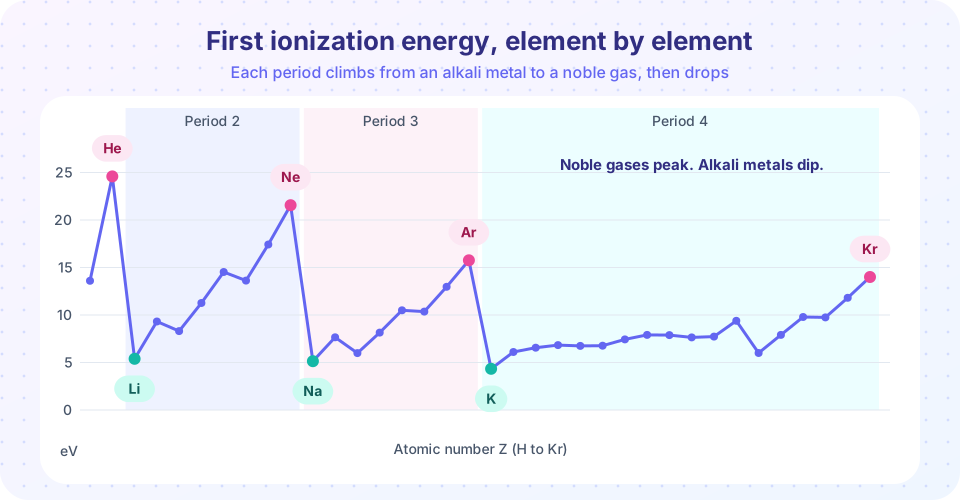
IE₁ rises across a period (higher Zeff, smaller atoms) and falls down a group (outer electron farther away and better shielded). There are two famous dips in each period:
- Be to B: boron's outer electron is in a 2p orbital, which is slightly higher in energy and better shielded than 2s, so it is removed more easily despite the extra proton.
- N to O: oxygen's fourth 2p electron is paired in an orbital and is repelled by its partner, so it leaves more easily than a nitrogen electron from a half-filled subshell.
Successive ionization energies show shell structure beautifully: for magnesium, IE₃ is enormous compared with IE₂, because the third electron must come from the inner 2p shell.
Electron affinity
Halogens have the most negative electron affinities (chlorine is the largest in magnitude, about −349 kJ/mol), because the added electron completes a subshell and feels a high Zeff. Noble gases and group 2 have effectively zero or positive values, since the extra electron would start a new subshell. Fluorine is slightly lower than chlorine because its small 2p orbitals make electron repulsion strong.
Electronegativity
Linus Pauling defined electronegativity using bond energies. Values increase across a period and decrease down a group, with fluorine the highest (3.98) and cesium and francium the lowest. The usual rule of thumb for a bond between atoms A and B uses the difference Δχ:
| Δχ | Typical bond |
|---|---|
| below about 0.4 | nonpolar covalent |
| about 0.4 to 1.7 | polar covalent |
| above about 1.7 | ionic |
It is a guide only: the boundary is fuzzy, and the bonding triangle in chapter 3 gives a better picture.
Common misconceptions
- "Atoms get bigger across a period because they have more electrons." Electrons go into the same shell while the nuclear charge increases, so the atom shrinks.
- "Ionization energy and electronegativity are the same thing." IE is a property of a gaseous atom losing an electron; electronegativity is about an atom bonded to another.
- "Noble gases have no electron affinity because they are unreactive." They do not bind an extra electron because it would have to go into a new shell.
Try it
First, the real data behind the chart at the top: first ionization energies from hydrogen to krypton. Notice the exceptions at B and O.
Press Run (or Ctrl + Enter) to see the result here.
Program input · what you'd type while the program runs
Type the answers before you press Run, one per line. Each time the program reads a line (with input()), it gets the next line from this box.
Next, compute Slater's effective nuclear charge for period 3 and compare it to the covalent radius. A higher Zeff goes with a smaller atom.
Press Run (or Ctrl + Enter) to see the result here.
Program input · what you'd type while the program runs
Type the answers before you press Run, one per line. Each time the program reads a line (with input()), it gets the next line from this box.
Finally, use electronegativity differences to guess bond types.
Press Run (or Ctrl + Enter) to see the result here.
Program input · what you'd type while the program runs
Type the answers before you press Run, one per line. Each time the program reads a line (with input()), it gets the next line from this box.
Check your understanding
Quick check · 6 questions
of 6 answered You scored / 6 · perfect!
-
1. Which atom is largest?
K has an extra shell compared with Na, Mg and Cl, which outweighs the change in nuclear charge. -
2. Why does first ionization energy generally increase across a period?
Across a period the nuclear charge rises while the shielding is roughly constant, so the outer electron is held more tightly. -
3. Why is the first ionization energy of oxygen lower than that of nitrogen?
In oxygen the fourth 2p electron shares an orbital with another electron, and repulsion makes it easier to remove. Nitrogen's 2p subshell is half-filled. -
4. Which has the larger radius, Mg or Mg²⁺?
Removing the two outer electrons removes the whole n = 3 shell, so the cation is much smaller. -
5. Which bond in the list is most polar?
H–F has the largest electronegativity difference among covalently bonded pairs here (3.98 − 2.20 = 1.78). -
6. Arrange the isoelectronic ions O²⁻, F⁻ and Na⁺ in order of decreasing radius.
With the same number of electrons, the ion with more protons pulls them in more strongly, so Na⁺ is smallest.
Summary
- Effective nuclear charge,
Zeff = Z − S, drives most periodic trends: it rises across a period and changes little down a group. - Radius decreases across a period and increases down a group; cations shrink and anions grow.
- Ionization energy and electronegativity increase across and decrease down; exceptions at B and O come from subshell energies and pairing.
- Electronegativity differences give a first guess at bond type.
Next: Chapter 2 review
Track your progress
Create a free account to tick off lessons and pick up where you left off on any device.
of Inorganic Chemistry lessons completed