


















Lesson 31 of 45 · Coordination Chemistry
Chapter 7 Overview: Coordination Chemistry
Meet coordination compounds: metal ions surrounded by ligands, Werner's discovery, coordination numbers and geometries, and a map of this chapter.
Dissolve copper sulfate in water and you get pale blue. Add ammonia and the solution flashes to deep royal blue. Nothing about the copper changed, yet its color, solubility and reactivity all did. What happened is that water molecules around the copper were swapped for ammonia, and the coordination compound [Cu(NH₃)₄(H₂O)₂]²⁺ formed. Coordination chemistry is the study of such species: a metal ion surrounded by ligands, held by bonds in which the ligand donates both electrons.
What you will learn
- Define central metal, ligand, coordination sphere and coordination number.
- Explain Werner's evidence for coordination compounds.
- Predict common geometries from coordination number.
- Calculate the oxidation state of the metal in a complex.
Key terms
Complex (coordination compound): a central metal atom or ion bonded to surrounding ligands.
Ligand: an ion or molecule that donates an electron pair to the metal.
Coordination number (CN): the number of donor atoms bonded to the metal.
Coordination sphere: the metal plus its bonded ligands, written in square brackets.
Counter ion: an ion outside the brackets that balances the charge.
Werner's insight
By the 1890s chemists knew many salts like CoCl₃·6NH₃, CoCl₃·5NH₃ and CoCl₃·4NH₃ with different colors, and they could not explain them using simple valence. Alfred Werner proposed that cobalt keeps a fixed coordination number of six, and that ammonia and chloride can both occupy those six positions. Chloride ions bonded to cobalt would not precipitate with silver nitrate; free chloride would. Werner (Nobel Prize, 1913) tested this with silver nitrate and conductivity, and the numbers matched his formulas. The second TryIt reproduces his counting.
The metal as a Lewis acid
A ligand is a Lewis base: it has a lone pair. The metal ion is a Lewis acid: it has empty orbitals that can accept pairs. The bond is a coordinate covalent bond. This is why coordination compounds can be seen as an extension of acid–base chemistry, and why the same ideas apply to hemoglobin as to a beaker of copper sulfate.
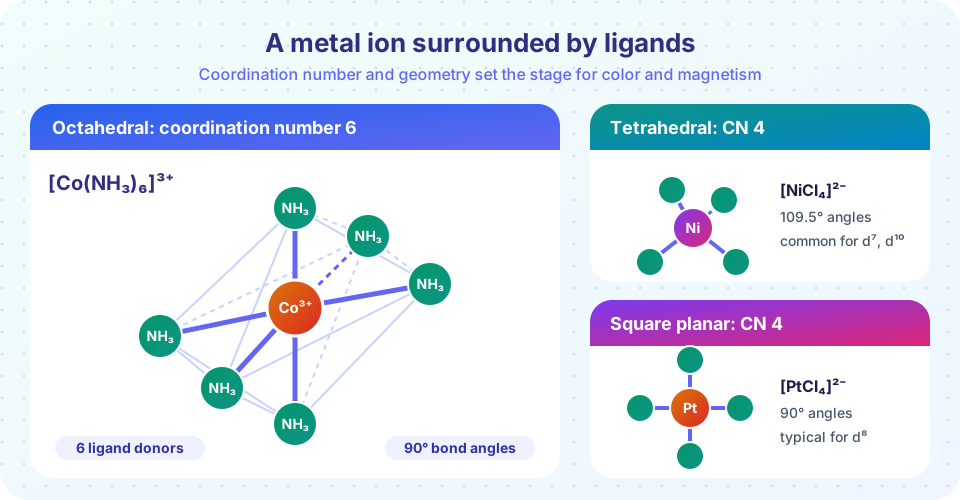
Coordination numbers and geometries
| CN | Common geometry | Example |
|---|---|---|
| 2 | linear | [Ag(NH₃)₂]⁺ |
| 4 | tetrahedral | [NiCl₄]²⁻, [Zn(OH)₄]²⁻ |
| 4 | square planar | [PtCl₄]²⁻, cisplatin |
| 5 | trigonal bipyramid or square pyramid | [Fe(CO)₅] |
| 6 | octahedral | [Co(NH₃)₆]³⁺, [Fe(CN)₆]⁴⁻ |
Six is by far the most common for the 3d metals. Four-coordinate geometry depends on the electron count and the ligand size: small metal ions with large ligands like Cl⁻ prefer tetrahedral, while d⁸ metals such as Pt²⁺ and Pd²⁺ favor square planar.
Why complexes matter
Complexes are everywhere. Hemoglobin and chlorophyll are metal complexes of porphyrin-like ligands. Cisplatin, cis-[PtCl₂(NH₃)₂], is a cancer drug. EDTA complexes iron and calcium in water treatment and food. Prussian blue is an iron cyanide pigment. Catalysts for polymer and pharmaceutical synthesis are organized around metal complexes. You will also see in this chapter that the color and magnetism of the 3d ions are explained by how ligands split the d orbitals.
Anatomy of a complex
Geometry follows CN
In this chapter
Oxidation state in a complex
The oxidation state of the metal is the charge of the complex minus the sum of the ligand charges. In [Fe(CN)₆]⁴⁻, six CN⁻ contribute −6 and the complex is −4, so iron is +2. In [Co(NH₃)₆]³⁺ ammonia is neutral, so cobalt is +3. The first TryIt automates this and reports the d count.
What is in this chapter
| Lesson | Focus |
|---|---|
| Ligands and Nomenclature | Denticity, chelate effect, IUPAC names, isomerism |
| Crystal Field Theory | d-orbital splitting, CFSE, high and low spin |
| Color and Magnetism | Spectrochemical series, d–d transitions, spin-only moments |
| Chapter Review | One-picture summary and quiz |
Common misconceptions
"The counter ions are bonded to the metal." Ions outside the brackets are just balancing charge; only the species inside the brackets is the complex.
"Coordination number equals oxidation state." They are different: Fe²⁺ in [Fe(CN)₆]⁴⁻ has CN 6 and oxidation state +2.
Try it
Enter a complex, and the tool returns the metal's oxidation state, coordination number and d count. The ligand table is hand-written, and the geometry is a simple guess from CN.
Press Run (or Ctrl + Enter) to see the console output here.
No output.
Now reproduce Werner's silver nitrate argument. Each formula has three chlorides in total; those bonded to cobalt stay in solution, and the free ones precipitate as AgCl.
Press Run (or Ctrl + Enter) to see the result here.
Program input · what you'd type while the program runs
Type the answers before you press Run, one per line. Each time the program reads a line (with input()), it gets the next line from this box.
Check your understanding
Quick check · 5 questions
of 5 answered You scored / 5 · perfect!
-
1. In [Fe(CN)₆]⁴⁻, what are the oxidation state and coordination number of iron?
Six CN⁻ give −6; the complex is −4, so Fe is +2. Six donor atoms give CN 6. -
2. Which describes a ligand?
Ligands are Lewis bases and donate electron pairs. -
3. How many chloride ions precipitate as AgCl from [Co(NH₃)₅Cl]Cl₂?
Only the two free chloride ions precipitate; the coordinated one stays on cobalt. -
4. Which geometry is typical for Pt²⁺ (d⁸) with four ligands?
d⁸ ions like Pt²⁺ and Pd²⁺ prefer square planar. -
5. Who proposed the coordination theory and won the 1913 Nobel Prize?
Alfred Werner proposed fixed coordination numbers and won the 1913 Nobel Prize in Chemistry.
Summary
- A complex is a central metal bonded to ligands; ligands are Lewis bases, the metal is a Lewis acid.
- Coordination number and geometry go together: six is octahedral; four is tetrahedral or square planar.
- Werner's silver-nitrate counting showed that coordinated chloride does not precipitate.
- The metal's oxidation state is the complex charge minus the ligand charges.
Next: Ligands and Nomenclature
Track your progress
Create a free account to tick off lessons and pick up where you left off on any device.
of Inorganic Chemistry lessons completed