


















Lesson 44 of 45 · Projects and Practice
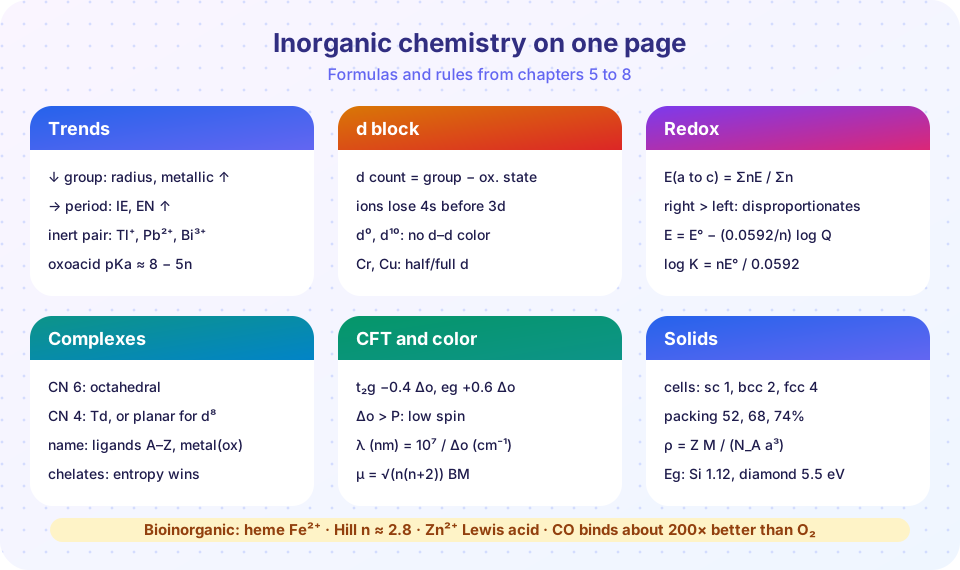
Cheat Sheet: Inorganic Chemistry Formulas and Rules
A one-page recap of the key rules, formulas, constants and unit conversions from main-group, transition metal, coordination and solid-state chemistry.
Keep this page open while you solve problems. It collects the rules and numbers you will use over and over, organized by chapter, together with a conversion table for the energy units that inorganic chemists mix constantly: wavenumbers, nanometers, electronvolts and kilojoules per mole.
What you will learn
- Find any key formula or rule in seconds.
- Convert between energy and wavelength units without mistakes.
- Recall the typical values used in the worked problems.
Chapter 5: main group
| Idea | Rule |
|---|---|
| Down a group | radius, metallic character increase; IE and EN decrease |
| Across a period | IE and EN increase; radius decreases |
| First-row anomaly | period 2 forms strong π bonds, no hypervalence |
| Inert pair effect | heavy p-block prefer oxidation state two lower: Tl⁺, Pb²⁺, Bi³⁺ |
| Oxoacid strength | pKa ≈ 8 − 5n (n = non-hydroxyl oxygens) |
| Halogens | E°(X₂/X⁻): F₂ +2.87, Cl₂ +1.36, Br₂ +1.07, I₂ +0.54 V |
| Haber / Ostwald / contact | N₂ + 3H₂ ⇌ 2NH₃ (Fe); NH₃ → HNO₃ (Pt–Rh); SO₂ → SO₃ (V₂O₅) |
Chapter 6: transition metals
| Idea | Rule |
|---|---|
| d count | group number − oxidation state |
| Ions | 4s electrons are removed before 3d |
| Anomalies | Cr [Ar]3d⁵4s¹, Cu [Ar]3d¹⁰4s¹ |
| Latimer | E(a→c) = ΣnE / Σn; disproportionation if right > left |
| Frost | low point stable; point above chord disproportionates |
| Nernst (25 °C) | E = E° − (0.0592/n) log Q; MnO₄⁻/Mn²⁺: E = 1.51 − 0.0947 pH |
| Equilibrium | ΔG° = −nFE°; log K = nE°/0.0592 |
Chapter 7: coordination
| Idea | Rule |
|---|---|
| Oxidation state | charge of complex − sum of ligand charges |
| Geometry | CN 6 octahedral; CN 4 tetrahedral, or square planar for d⁸ |
| Naming | ligands alphabetical; Roman numeral; anionic complex ends in -ate |
| Octahedral splitting | t₂g −0.4 Δo; eg +0.6 Δo |
| Spin state | Δo > P: low spin; Δo < P: high spin (d⁴ to d⁷ only) |
| CFSE | (−0.4 n(t₂g) + 0.6 n(eg)) Δo + pairing corrections |
| Tetrahedral | Δt ≈ 4/9 Δo, almost always high spin |
| Color | λ (nm) = 10⁷ / Δo (cm⁻¹) for d¹ and d³ |
| Magnetism | μ = √(n(n+2)) Bohr magnetons |
Chapter 8: solids and bioinorganic
| Idea | Rule |
|---|---|
| Atoms per cubic cell | sc 1, bcc 2, fcc 4 |
| Packing efficiency | 52%, 68%, 74% |
| Density | ρ = Z M / (N_A a³) |
| Touching | fcc: 4r = a√2; bcc: 4r = a√3 |
| Radius ratio | 0.225–0.414 CN 4; 0.414–0.732 CN 6; 0.732–1.0 CN 8 |
| Born–Haber (NaCl, kJ/mol) | 107 + 122 + 496 − 349 + U = −411, so U = −787 |
| Bands | metal: partly filled; semiconductor: Eg about 0.5–3 eV; insulator: larger |
| LED | λ (nm) = 1239.84 / Eg (eV) |
| Hemoglobin | Hill n ≈ 2.8, P50 ≈ 26 mmHg; myoglobin P50 ≈ 2.8 mmHg |
Constants and conversions
| Quantity | Value |
|---|---|
| Avogadro constant | 6.02214 × 10²³ mol⁻¹ |
| Faraday constant | 96,485 C/mol |
| 0.0592 V | (RT ln 10)/F at 25 °C |
| 1 eV | 96.485 kJ/mol = 8,065.5 cm⁻¹ |
| 1 cm⁻¹ | 0.011963 kJ/mol |
| hc | 1239.84 eV·nm |
| kT at 300 K | 0.02585 eV |
| Bohr magneton | μB = 9.274 × 10⁻²⁴ J/T |
Common misconceptions
"A cheat sheet replaces understanding." The formulas only help if you know when each applies; use the practice lesson to build that judgment.
"The units in a formula are optional." Wavenumbers, nanometers, electronvolts and kJ/mol are different measures; convert deliberately.
Try it
First, a unit converter for wavelength, wavenumber, energy in eV and energy in kJ/mol. Start from any one of them.
Press Run (or Ctrl + Enter) to see the console output here.
No output.
Second, check the constants against each other: the relation between 0.0592 V, RT/F and the energy conversions.
Press Run (or Ctrl + Enter) to see the result here.
Program input · what you'd type while the program runs
Type the answers before you press Run, one per line. Each time the program reads a line (with input()), it gets the next line from this box.
Check your understanding
Quick check · 4 questions
of 4 answered You scored / 4 · perfect!
-
1. A band at 500 nm corresponds to what wavenumber?
10⁷ / 500 = 20,000 cm⁻¹. -
2. Roughly how many kJ/mol is 1 eV?
1 eV per particle is 96.485 kJ/mol. -
3. What does the 0.0592 in the Nernst equation represent?
It equals (RT/F) × ln 10 at 298 K, about 0.0592 V. -
4. What is the density formula for a cubic metal?
Mass of Z atoms divided by cell volume.
Summary
- Rules and formulas for each chapter fit on a page; knowing when to use each is the real skill.
- Convert units deliberately: λ = 10⁷/ν̃, E = 1239.84/λ, 1 eV = 96.485 kJ/mol.
- The constants table links electrochemistry (0.0592), spectroscopy and thermal energy (kT).
Next: Further Study
Track your progress
Create a free account to tick off lessons and pick up where you left off on any device.
of Inorganic Chemistry lessons completed