


















Lesson 4 of 45 · Getting Started
Oxidation states
Learn the rules for assigning oxidation numbers, how to spot oxidation and reduction, and why oxidation state explains color, stability and reactivity of inorganic compounds.
Chemists keep two kinds of books on electrons. The first book tracks where electrons really are, which is hard. The second is a bookkeeping convention called the oxidation state: you pretend every bond is fully ionic and give all the shared electrons to the more electronegative atom. The convention is artificial, yet it predicts an astonishing amount: which compounds are colored, which metals dissolve in acid, and which reactions release energy.
What you will learn
- The rules for assigning oxidation numbers
- How to find the oxidation state of an element in a compound or ion
- How to recognize oxidation, reduction and the oxidizing agent
- How oxidation state connects to color and stability
Key terms
- Oxidation state (number): the hypothetical charge an atom would have if every bond were ionic.
- Oxidation: loss of electrons, an increase in oxidation number.
- Reduction: gain of electrons, a decrease in oxidation number.
- Oxidizing agent: the species that is reduced, taking electrons from another.
- Disproportionation: one species is both oxidized and reduced in the same reaction.
The rules, in priority order
Apply these top to bottom. A higher rule wins when two conflict.
- An atom in an uncombined element has oxidation state 0 (Na, O₂, S₈, P₄).
- For a monatomic ion, the oxidation state equals the charge (Fe³⁺ is +3, Cl⁻ is −1).
- The sum of oxidation states equals the overall charge: 0 for a neutral compound, the ion's charge for an ion.
- Fluorine is always −1 in compounds.
- Group 1 metals are +1 and group 2 metals are +2.
- Hydrogen is +1 with nonmetals and −1 in metal hydrides (NaH, CaH₂).
- Oxygen is usually −2. Exceptions are peroxides such as H₂O₂ (−1), superoxides (−½) and OF₂ (+2).
- Other halogens are −1, unless combined with oxygen or a more electronegative halogen.
Everything left over is found by solving the sum rule.
Worked examples
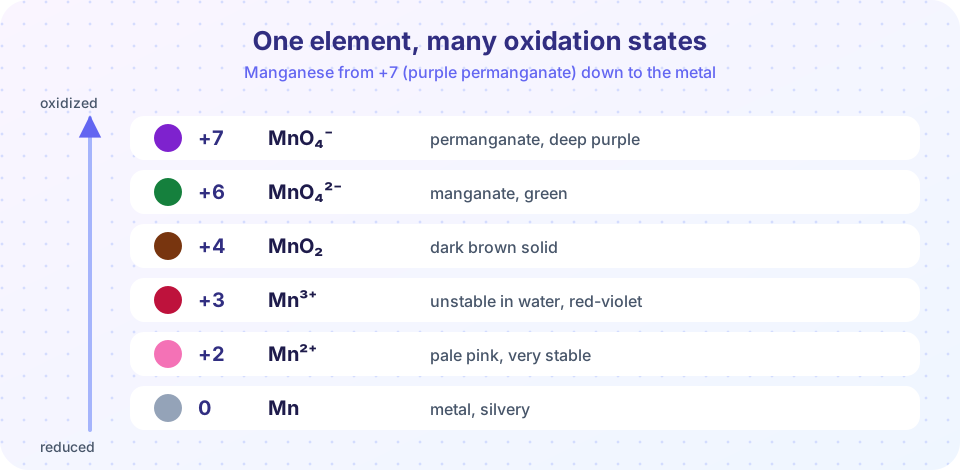
Example 1: Mn in KMnO₄. K is +1 and O is −2 four times, giving −8. The compound is neutral, so +1 + x + (−8) = 0, hence x = +7. This is why permanganate is such a powerful oxidizing agent: manganese is in its highest oxidation state.
Example 2: Cr in the dichromate ion Cr₂O₇²⁻. Seven oxygens give −14. The sum must be −2, so 2x − 14 = −2, giving 2x = 12 and x = +6 per chromium.
Example 3: S in the sulfate ion SO₄²⁻. x + 4(−2) = −2 gives x = +6.
Example 4: Fe in Fe₃O₄ (magnetite). Four oxygens give −8, so three iron atoms total +8. The average is +8/3, about +2.67. The real structure has Fe²⁺ and Fe³⁺ in a 1 : 2 ratio, so the fractional average hides two different ions: 1(+2) + 2(+3) = +8.
Example 5: N in NH₄⁺ and NO₃⁻. In ammonium, hydrogens are +1: x + 4 = +1, so x = −3. In nitrate, x − 6 = −1, so x = +5. Nitrogen spans eight oxidation states in common compounds, from −3 to +5.
An oxidation number is not a real charge. In SO₄²⁻ sulfur is not really S⁶⁺: the S–O bonds are strongly covalent. The number is a tool for counting electrons.
Oxidation, reduction and electron bookkeeping
A redox reaction is one where oxidation numbers change. Take the reaction of zinc with copper(II) sulfate:
Zn(s) + Cu²⁺(aq) → Zn²⁺(aq) + Cu(s)
Zinc goes from 0 to +2: it is oxidized and is the reducing agent. Copper goes from +2 to 0: it is reduced, and Cu²⁺ is the oxidizing agent. Two electrons move.
An easy way to remember: OIL RIG (Oxidation Is Loss, Reduction Is Gain) of electrons.
Disproportionation occurs when an intermediate state is unstable relative to both higher and lower states. Chlorine in water is a classic: Cl₂ + H₂O ⇌ HCl + HOCl takes Cl from 0 to −1 and +1. In basic solution Mn(VI) manganate disproportionates into Mn(VII) permanganate and Mn(IV) MnO₂.
Why oxidation state matters to inorganic chemists
- Color. Manganese(VII) is deep purple, Mn(VI) green, Mn(II) pale pink. The color arises from electron transitions, which depend on the oxidation state. (Chapter 7 explains this in detail.)
- Stability. In the first transition series, +2 and +3 are the common states. Higher states, such as chromium(VI) or manganese(VII), occur mainly in oxo compounds with oxygen, where they act as strong oxidizers.
- Group trends. Heavier p-block elements often prefer a state two lower than the group maximum (Tl⁺ over Tl³⁺, Pb²⁺ over Pb⁴⁺). This is the inert pair effect, which you will meet again in chapter 5.
- Reactivity. A species in a high oxidation state tends to be an oxidizing agent, and one in a low state a reducing agent.
Common misconceptions
- "Oxidation always means adding oxygen." That is where the name came from, but oxidation is defined by electron loss. Iron rusts in oxygen, and also loses electrons to chlorine with no oxygen present.
- "The oxidation number is the charge on the ion." Only for simple ions. In covalent species it is a counting convention.
- "Oxidation states must be integers." The average in Fe₃O₄ is 8/3. Fractions are common in average states and in S₄O₆²⁻ (tetrathionate, average +2.5).
Try it
The first program computes an unknown oxidation state from the sum rule. It prints a small report for ions and compounds that you can extend.
Press Run (or Ctrl + Enter) to see the result here.
Program input · what you'd type while the program runs
Type the answers before you press Run, one per line. Each time the program reads a line (with input()), it gets the next line from this box.
The second plot shows common oxidation states of the first-row transition metals. The filled dot marks the state that is usually most stable in water.
Press Run (or Ctrl + Enter) to see the result here.
Program input · what you'd type while the program runs
Type the answers before you press Run, one per line. Each time the program reads a line (with input()), it gets the next line from this box.
Check your understanding
Quick check · 5 questions
of 5 answered You scored / 5 · perfect!
-
1. What is the oxidation state of chromium in K₂Cr₂O₇?
Two K give +2 and seven O give −14, so 2x + 2 − 14 = 0 and x = +6. -
2. In Zn + Cu²⁺ → Zn²⁺ + Cu, which species is the oxidizing agent?
Cu²⁺ is reduced (its oxidation state falls from +2 to 0) and therefore oxidizes zinc. -
3. What is the oxidation state of oxygen in hydrogen peroxide, H₂O₂?
Each H is +1, so the two oxygens total −2, giving −1 each. Peroxides are the main exception to oxygen being −2. -
4. Which statement about oxidation numbers is correct?
Oxidation numbers assign shared electrons to the more electronegative atom. Averages can be fractions, and nonmetals have them too. -
5. Which species is most likely to be a strong oxidizing agent?
Mn in permanganate is +7, its highest state, so it readily accepts electrons.
Summary
- Oxidation states are a bookkeeping device: assign shared electrons to the more electronegative atom.
- Apply the rules in order and use the sum rule for the unknown element.
- Oxidation is an increase in oxidation number, reduction a decrease.
- Oxidation state predicts color, stability, and whether a compound oxidizes or reduces.
Next: Chapter 1 review
Track your progress
Create a free account to tick off lessons and pick up where you left off on any device.
of Inorganic Chemistry lessons completed