


















Lesson 32 of 45 · Coordination Chemistry
Ligands, the Chelate Effect and Naming Complexes
Classify ligands by denticity, explain why chelates are extra stable, name coordination compounds with IUPAC rules and recognize cis, trans and optical isomers.
Every complex has a name that tells you exactly what is inside: which ligands, how many, and what oxidation state the metal has. Learning to read and write these names is a little like learning a grammar, but once you know the rules you can decode K₄[Fe(CN)₆] as "potassium hexacyanidoferrate(II)" at a glance. Before the grammar comes the vocabulary: ligands, classified by how many bonds they make, and the surprising extra stability of ligands that bite the metal in more than one place.
What you will learn
- Classify ligands by charge and denticity, including ambidentate ligands.
- Explain the chelate effect in terms of entropy.
- Apply IUPAC rules to name and write formulas for complexes.
- Distinguish geometric (cis/trans, fac/mer) and optical isomers.
Key terms
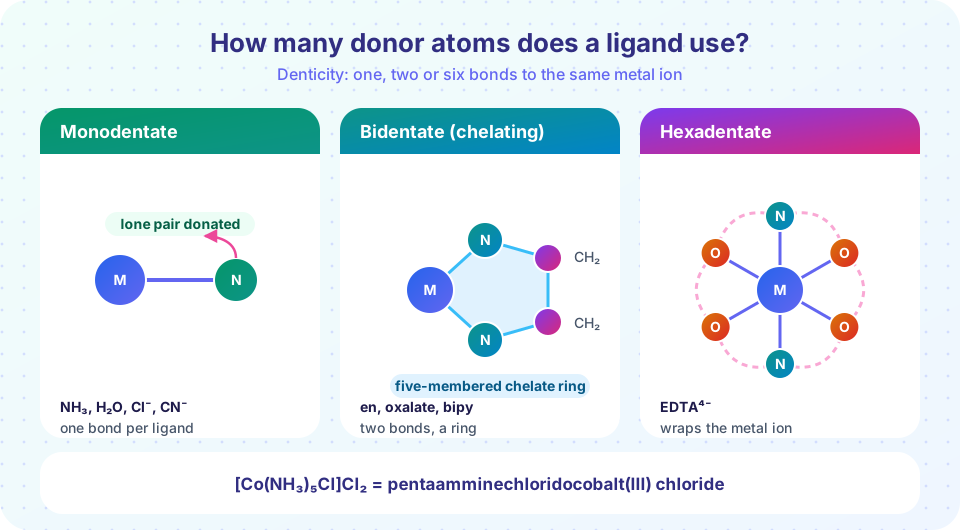
Denticity: the number of donor atoms through which a ligand binds one metal ion.
Chelate: a complex with a polydentate ligand forming a ring that includes the metal.
Ambidentate ligand: one that can bind through different atoms, such as NO₂⁻ (N or O) and SCN⁻ (S or N).
Isomers: compounds with the same formula but different arrangements.
Enantiomers: non-superimposable mirror-image isomers that rotate plane-polarized light in opposite directions.
Ligand types
| Ligand | Name in a complex | Charge | Denticity |
|---|---|---|---|
| H₂O | aqua | 0 | 1 |
| NH₃ | ammine | 0 | 1 |
| CO | carbonyl | 0 | 1 |
| Cl⁻ | chlorido | −1 | 1 |
| CN⁻ | cyanido | −1 | 1 |
| OH⁻ | hydroxido | −1 | 1 |
| en (H₂NCH₂CH₂NH₂) | ethane-1,2-diamine | 0 | 2 |
| C₂O₄²⁻ (ox) | oxalato | −2 | 2 |
| EDTA⁴⁻ | ethylenediaminetetraacetato | −4 | 6 |
Ambidentate ligands give linkage isomers: [Co(NH₃)₅(NO₂)]²⁺ (N-bonded, nitro) and [Co(NH₃)₅(ONO)]²⁺ (O-bonded, nitrito) are different compounds with different colors.
The chelate effect
Compare two reactions in water for nickel(II). Six ammonia molecules give [Ni(NH₃)₆]²⁺ with overall stability constant log β₆ ≈ 8.6. Three ethylenediamine (en) molecules, which also supply six donor atoms, give [Ni(en)₃]²⁺ with log β₃ ≈ 18.3. EDTA gives about 18.5. The chelates are about ten orders of magnitude more stable, even though the bonds are similar Ni–N bonds.
The reason is mostly entropy. In the displacement [Ni(NH₃)₆]²⁺ + 3 en → [Ni(en)₃]²⁺ + 6 NH₃, four particles on the left become seven on the right, so disorder rises (ΔS > 0) and ΔG = ΔH − TΔS becomes more negative. There is also a kinetic reason: if one end of a chelating ligand comes off, the other end holds on and the free end is likely to re-attach, so dissociation is slow. EDTA uses this effect in water softening, food preservation (binding trace metals) and treating heavy-metal poisoning.
Naming coordination compounds
Follow these steps:
- Cation first, anion second, whether or not the complex is the cation, as in any salt.
- Inside the complex, ligands come first in alphabetical order (ignoring prefixes like di, tri), then the metal.
- Anionic ligands end in "-o" (chlorido, cyanido, hydroxido, oxalato). Neutral ligands keep their name, with special names for H₂O (aqua), NH₃ (ammine) and CO (carbonyl).
- Count with di, tri, tetra, penta, hexa; for ligands whose own names contain prefixes or are complicated, use bis, tris, tetrakis with parentheses.
- The metal's oxidation state follows in Roman numerals in parentheses.
- If the complex is an anion, the metal name ends in "-ate" and often uses the Latin root: ferrate (Fe), cuprate (Cu), argentate (Ag), aurate (Au), stannate (Sn), plumbate (Pb).
| Formula | Name |
|---|---|
| [Co(NH₃)₆]Cl₃ | hexaamminecobalt(III) chloride |
| [Co(NH₃)₅Cl]Cl₂ | pentaamminechloridocobalt(III) chloride |
| [Pt(NH₃)₂Cl₂] | diamminedichloridoplatinum(II) |
| K₄[Fe(CN)₆] | potassium hexacyanidoferrate(II) |
| K₃[Fe(CN)₆] | potassium hexacyanidoferrate(III) |
| [Co(en)₃]Cl₃ | tris(ethane-1,2-diamine)cobalt(III) chloride |
| Na₂[Zn(OH)₄] | sodium tetrahydroxidozincate(II) |
To write the formula from a name, put the metal symbol first inside the brackets, then ligands alphabetically by their symbols; the charge of the metal and the ligands tells you the number of counter ions.
Isomerism
- Geometric isomers. In square planar
[Pt(NH₃)₂Cl₂]the two Cl can be adjacent (cis) or opposite (trans). Cisplatin is the cis isomer and is an anticancer drug; trans is not active. In octahedral[Co(NH₃)₄Cl₂]⁺there are cis (violet) and trans (green) forms. ForMA₃B₃the fac (three on one face) and mer (three in a meridian) forms exist. - Optical isomers.
[Co(en)₃]³⁺has no mirror plane: it looks like a three-bladed propeller and exists as left- and right-handed forms (Δ and Λ). Tetrahedral complexes of four different ligands and octahedralcis-[M(AA)₂X₂]are also chiral. - Ionization and hydrate isomers.
[Co(NH₃)₅Br]SO₄and[Co(NH₃)₅(SO₄)]Brgive different precipitates with BaCl₂ and AgNO₃.
Common misconceptions
"Ligands are listed in the order of the formula." In names, ligands are alphabetical by name, not by charge or number.
"The prefix counts as part of the ligand name for alphabetizing." It does not: tetraammine still sorts under "a".
"Chelates are stable because their bonds are stronger." The M–N bonds are similar; the gain is mostly entropy.
Try it
First, a naming tool. It builds the IUPAC name for simple complexes from a metal, a list of ligands and a charge. It handles only the ligands and metals stored in its table.
Press Run (or Ctrl + Enter) to see the console output here.
No output.
Second, compare stability constants to see the chelate effect. The log K values are rounded textbook values for nickel(II) at room temperature.
Press Run (or Ctrl + Enter) to see the result here.
Program input · what you'd type while the program runs
Type the answers before you press Run, one per line. Each time the program reads a line (with input()), it gets the next line from this box.
Check your understanding
Quick check · 5 questions
of 5 answered You scored / 5 · perfect!
-
1. What is the name of [Co(NH₃)₅Cl]Cl₂?
Ligands are alphabetical (ammine before chlorido), oxidation state is Co(III), and the counter ion comes last. -
2. How many donor atoms does EDTA⁴⁻ use?
EDTA is hexadentate: two nitrogens and four carboxylate oxygens. -
3. Which is the formula of potassium hexacyanidoferrate(III)?
Six CN⁻ give −6; Fe(III) gives +3, so the complex is 3−, requiring three K⁺. -
4. The main reason chelates are more stable than comparable monodentate complexes is...
Displacing several monodentate ligands by one chelate increases the number of free particles. -
5. Which complex can exist as optical isomers?
[Co(en)₃]³⁺ has a propeller shape without a mirror plane, so it is chiral.
Summary
- Ligands are classified by charge and denticity; ambidentate ligands give linkage isomers.
- Chelates are extra stable chiefly because of entropy.
- IUPAC names list ligands alphabetically, give oxidation state in Roman numerals, and use "-ate" for anionic complexes.
- Cis/trans, fac/mer and optical isomerism arise from different arrangements of the same ligands.
Next: Crystal Field Theory
Track your progress
Create a free account to tick off lessons and pick up where you left off on any device.
of Inorganic Chemistry lessons completed