


















Lesson 17 of 45 · Acids, Bases and Solvents
Brønsted acids and pKa
Use Ka, pKa and conjugate pairs to compare acid strength, calculate pH and buffer behavior, and see why water levels the strength of strong acids.
When hydrogen fluoride dissolves in water, a proton moves from HF to a water molecule. When hydrogen chloride does the same, the transfer is nearly complete. The difference between those two outcomes, small and large, is what we mean by "weak" and "strong" acids. This lesson turns that idea into numbers you can calculate with: Ka, pKa and pH, and into rules you can use to predict whether a proton transfer will happen.
What you will learn
- How to use Ka, pKa and conjugate pairs
- How to predict the direction of a proton-transfer reaction
- How buffers work and how to use the Henderson-Hasselbalch equation
- What the leveling effect is
Key terms
- Conjugate pair: an acid HA and the base A⁻ left after it donates a proton.
- Ka: the acid dissociation constant,
Ka = [H⁺][A⁻]/[HA]. - pKa:
−log₁₀ Ka; smaller means a stronger acid. - Buffer: a solution of a weak acid and its conjugate base that resists changes in pH.
- Amphoteric (amphiprotic): a species that can act as both an acid and a base, such as H₂O and HCO₃⁻.
Conjugate pairs
In HA + H₂O ⇌ H₃O⁺ + A⁻, HA is the acid and A⁻ is its conjugate base; H₂O is the base and H₃O⁺ is its conjugate acid. Every acid has a conjugate base and vice versa. The stronger the acid, the weaker its conjugate base: chloride, the conjugate base of the strong acid HCl, is a very weak base, while acetate is a modest base because acetic acid is weak.
For a conjugate pair in water: Ka × Kb = Kw = 1.0 × 10⁻¹⁴ at 25 °C, so pKa + pKb = 14. Acetic acid has pKa 4.76, so acetate has pKb 9.24.
Predicting the direction of a proton transfer
A proton transfer favors the weaker acid and weaker base. Compare pKa values: the equilibrium lies on the side of the species with the higher pKa as the acid.
Example: CH₃COOH + F⁻ ⇌ CH₃COO⁻ + HF. HF has pKa 3.17 and acetic acid 4.76. HF is the stronger acid, so the equilibrium lies on the left (acetic acid and fluoride). The difference of 1.6 pKa units gives an equilibrium constant of 10^(3.17 − 4.76) ≈ 0.026.
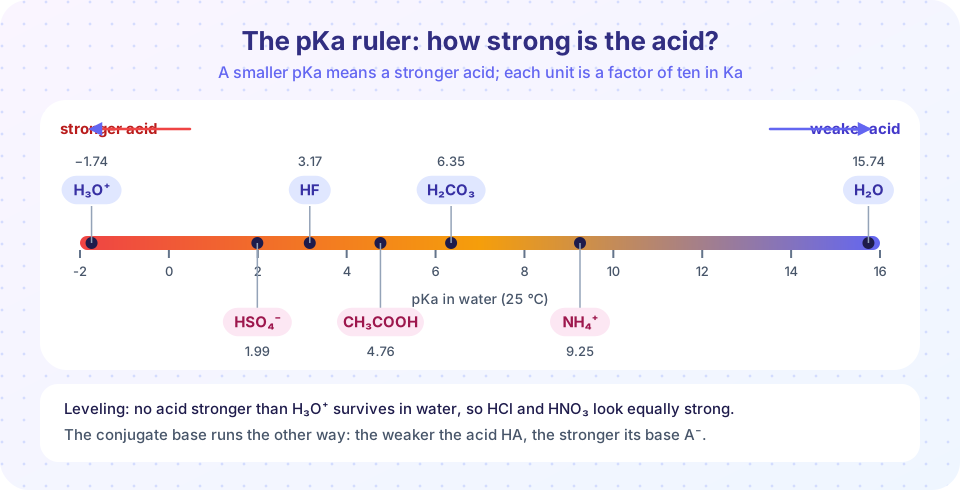
Typical aqueous pKa values: H₃O⁺ −1.74 (by convention for the 55.5 M water scale), HSO₄⁻ 1.99, H₃PO₄ 2.15, HF 3.17, CH₃COOH 4.76, H₂CO₃ 6.35, H₂S 7.0, NH₄⁺ 9.25, HCN 9.21, H₂O 15.74.
Why oxoacids differ: Pauling's rules
For an oxoacid (HO)ₘXOₙ, the number of terminal oxygens n predicts pKa remarkably well: n = 0 gives pKa about 7 or more (Cl(OH) hypochlorous acid, 7.5), n = 1 about 2 (H₃PO₄, 2.15), n = 2 about −3 (H₂SO₄ first step), and n = 3 about −8 (HClO₄). More terminal oxygen atoms pull electrons away from the O–H bond and stabilize the anion by delocalizing its charge.
Buffers and the Henderson-Hasselbalch equation
Take the equilibrium expression for a weak acid, rearrange, and take logarithms:
pH = pKa + log₁₀([A⁻]/[HA])
A buffer works because both HA and A⁻ are present. Added acid is consumed by A⁻, and added base by HA, so the ratio changes only slightly. A buffer is best within about one pH unit of its pKa, where the ratio is between 1:10 and 10:1, and it is most effective at pH = pKa where the ratio is exactly 1. Blood is buffered at about pH 7.4 mainly by the carbonic acid-bicarbonate system.
The leveling effect
In water, the strongest acid that can exist is H₃O⁺. HCl, HBr, HI and HNO₃ all transfer their proton completely, so in water they look equally strong. The solvent levels them. To tell them apart you must change to a less basic solvent such as glacial acetic acid, where HClO₄ is stronger than H₂SO₄, which is stronger than HCl. The same argument applies to bases: in water the strongest base is OH⁻, which is why sodium amide NaNH₂ reacts violently with water rather than dissolving as a super-strong base. The next lesson but one explores nonaqueous solvents.
Common misconceptions
- "A pKa of 4.76 means the solution has pH 4.76." pKa is a property of the acid. The pH depends on concentration or on the ratio of acid to base.
- "A weak acid has a strong conjugate base." Only up to a point: the conjugate base of a weak acid is a weak-to-moderate base. Only the conjugate bases of very weak acids (like NH₃ or H₂O's OH⁻) are strong.
- "Buffers keep pH exactly constant." They resist change, within their capacity. Add enough acid and the buffer is used up.
Try it
The fraction of an acid in each form depends on pH. This plot shows acetic acid (pKa 4.76): below the pKa it exists mostly as HA, above it mostly as acetate.
Press Run (or Ctrl + Enter) to see the result here.
Program input · what you'd type while the program runs
Type the answers before you press Run, one per line. Each time the program reads a line (with input()), it gets the next line from this box.
A titration curve is a speciation plot in motion. This code solves the exact charge balance for 25.0 mL of 0.100 M acetic acid titrated with 0.100 M NaOH, with no approximations.
Press Run (or Ctrl + Enter) to see the result here.
Program input · what you'd type while the program runs
Type the answers before you press Run, one per line. Each time the program reads a line (with input()), it gets the next line from this box.
Check your understanding
Quick check · 5 questions
of 5 answered You scored / 5 · perfect!
-
1. Acid A has pKa 3 and acid B has pKa 5. Which statement is true?
A smaller pKa means a stronger acid; two pKa units mean a factor of 100 in Ka. -
2. A buffer contains 0.20 M acetic acid and 0.20 M acetate. What is its pH (pKa = 4.76)?
When [A⁻] = [HA] the log term is zero, so pH = pKa. -
3. Why do HCl and HNO₃ seem equally strong in water?
H₃O⁺ is the strongest acid that can exist in water, so any stronger acid is converted completely into it. -
4. Which equilibrium lies mainly to the right? HF + CH₃COO⁻ ⇌ F⁻ + CH₃COOH (pKa HF 3.17, acetic acid 4.76)
HF is the stronger acid and acetate the stronger base, so the proton moves from HF to acetate. -
5. For a pair of conjugates in water, pKa + pKb equals:
Ka × Kb = Kw = 1.0 × 10⁻¹⁴ at 25 °C, so the pK values add to 14.
Summary
- Acids and bases come in conjugate pairs; stronger acid means weaker conjugate base, and
pKa + pKb = 14in water. - A proton transfer goes toward the weaker acid; compare pKa values to predict the direction.
- Buffers follow
pH = pKa + log([A⁻]/[HA])and work best within a unit of pKa. - Water levels strong acids to H₃O⁺; other solvents can distinguish them.
Next: Lewis acids and HSAB
Track your progress
Create a free account to tick off lessons and pick up where you left off on any device.
of Inorganic Chemistry lessons completed