


















Lesson 45 of 45 · Projects and Practice
Further Study: Where to Go Next
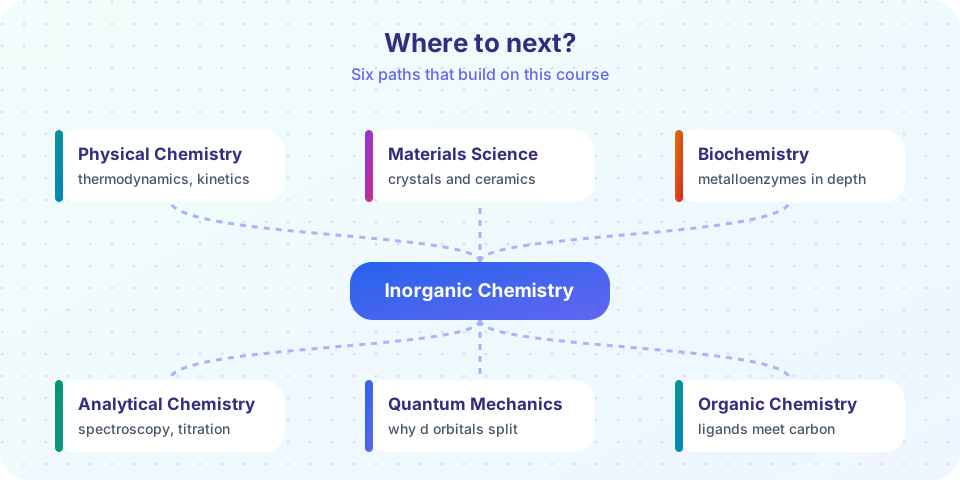
Plan your next steps after inorganic chemistry: advanced topics such as organometallics and MO theory, and related tracks on physical, analytical and materials chemistry.
You now have a working toolkit: periodic trends, d-electron counting, redox diagrams, crystal field theory, lattices and bands. The natural question is what to do with it. This final lesson sketches advanced topics inside inorganic chemistry and points to neighboring subjects on this site, so you can choose a direction that matches your interests.
What you will learn
- Name the main advanced topics beyond this course.
- Choose a related track that fits your goals.
- Assess which chapters deserve another pass before moving on.
Key terms
Ligand field theory: crystal field theory improved with covalent bonding through molecular orbitals.
Organometallic chemistry: the chemistry of compounds with metal–carbon bonds.
Homogeneous catalysis: catalysis in which catalyst and reactants are in the same phase.
Metal–organic framework (MOF): a crystalline porous solid made of metal nodes joined by organic linkers.
Advanced topics inside inorganic chemistry
- Molecular orbital treatment of complexes. Ligand field theory explains why CO and CN⁻ are strong-field ligands (π-backbonding) and why some ligands are weak despite negative charge. Group theory classifies orbitals by symmetry and lets you predict which are allowed to mix.
- Tanabe–Sugano diagrams. They extend crystal field theory to the electronic spectra of d², d⁴ to d⁸ complexes, where the absorptions are not simply Δo.
- Organometallic chemistry and catalysis. Metals bound to carbon (Fe(CO)₅, ferrocene, Grubbs and Wilkinson catalysts) follow the 18-electron rule and a handful of elementary steps: oxidative addition, reductive elimination, migratory insertion and β-hydride elimination. This is the chemistry behind cross-coupling reactions in medicine and plastics.
- Solid-state and materials chemistry. Perovskites, superconductors, battery electrodes (layered oxides, phosphates), zeolites and MOFs extend the lattices and bands of chapter 8.
- Main-group frontiers. Frustrated Lewis pairs, low-valent main-group compounds and new boron and silicon materials challenge old textbook rules.
- Bioinorganic medicine and imaging. Metal-based drugs (cisplatin and successors), contrast agents for MRI and radiopharmaceuticals build on the coordination chemistry you have learned.
Related tracks on this site
| Track | Why it helps | Link |
|---|---|---|
| Physical Chemistry | thermodynamics and kinetics behind Born–Haber cycles, Nernst and catalysis | Physical Chemistry |
| Quantum Mechanics | the origin of orbitals, splitting and band theory | Quantum Mechanics |
| Materials Science | structure and properties of crystals, ceramics and semiconductors | Materials Science |
| Condensed Matter Physics | band theory and solids with more physics | Condensed Matter Physics |
| Analytical Chemistry | spectroscopy, titrations and instruments used to study complexes | Analytical Chemistry |
| Biochemistry | metalloenzymes and electron transport in context | Biochemistry |
| Organic Chemistry Basics | the carbon side of organometallic chemistry | Organic Chemistry Basics |
How to study from here
- Return to weak spots first. A shaky grasp of d counts or of Latimer diagrams will make organometallic chemistry painful.
- Practice with data. Pick a few complexes, find measured Δo, spectra and magnetic moments in a reference, and test the models against them.
- Build more tools. Extend the complex analyzer from the project lesson with mixed ligands, naming and CFSE.
- Read primary sources slowly. Review articles in journals of inorganic chemistry become approachable once the vocabulary is familiar.
Common misconceptions
"Advanced chemistry is all new facts." Mostly it is the same core ideas (electron counting, symmetry, energetics) applied to harder systems.
"I must finish every topic before specializing." Depth in one area, such as catalysis or solid-state materials, is a fine way to begin.
Try it
Pick your interests and let the helper suggest tracks. It is a simple lookup, not an assessment, so treat the output as a starting point.
Press Run (or Ctrl + Enter) to see the console output here.
No output.
Finally, score your confidence on each chapter from 1 to 5. The helper prints which chapters to revisit first.
Press Run (or Ctrl + Enter) to see the console output here.
No output.
Check your understanding
Quick check · 4 questions
of 4 answered You scored / 4 · perfect!
-
1. Which theory adds covalent bonding to crystal field theory?
Ligand field theory uses molecular orbitals and explains π-backbonding and strong-field ligands. -
2. Which topic studies compounds with metal–carbon bonds?
Organometallic chemistry deals with metal–carbon bonds. -
3. Which track would deepen your understanding of band theory most directly?
Condensed matter physics treats electronic bands and solids in more depth. -
4. What is the best first step if your confidence in coordination chemistry is low?
Organometallic chemistry builds directly on d counts and ligand field ideas.
Summary
- Advanced inorganic topics include ligand field theory, Tanabe–Sugano diagrams, organometallic catalysis, materials and main-group frontiers.
- Related tracks on the site cover physical, analytical and materials chemistry, quantum mechanics, condensed matter and biochemistry.
- Revisit weak chapters, practice with data, and build more tools.
Back to the course: Inorganic Chemistry
Track your progress
Create a free account to tick off lessons and pick up where you left off on any device.
of Inorganic Chemistry lessons completed