


















Lesson 2 of 45 · Getting Started
Elements and the periodic table
Tour the periodic table as an inorganic chemist: blocks, groups, periods, metals, metalloids and nonmetals, with the family names and the properties that define them.
Dmitri Mendeleev published his periodic table in 1869, and the reason it worked is still the reason it is useful: elements arranged by increasing atomic number fall into columns of similar chemistry. Sodium and potassium are both soft metals that react fiercely with water. Chlorine and bromine are both colored, reactive nonmetals that form singly charged anions. If you know one member of a column, you can guess the rest.
This lesson is a guided tour. You will meet the vocabulary of the table, the three broad kinds of element, and the families that inorganic chemists talk about every day.
What you will learn
- The difference between groups, periods and blocks
- How to classify an element as a metal, metalloid or nonmetal
- The names and key traits of the main families
- Why elements in a group behave alike
Key terms
- Group: a vertical column, numbered 1 to 18. Elements in a group have the same number of valence electrons (with a few caveats in the d block).
- Period: a horizontal row, numbered 1 to 7. The period number is the outermost shell, n.
- Block: a region named for the type of orbital being filled: s, p, d or f.
- Valence electrons: the outer-shell electrons that take part in bonding.
- Metalloid: an element with properties in between metals and nonmetals, such as silicon.
Groups, periods and blocks
Every element sits at a unique address. Iron is in period 4, group 8, d-block. Chlorine is in period 3, group 17, p-block. The address says a lot:
- The period tells you how many shells hold electrons.
- The group of a main-group element tells you its valence-electron count: group 1 has one, group 2 has two, and groups 13 to 18 have three to eight.
- The block says which subshell is being filled last, which fixes whether the element is a reactive main-group metal, a transition metal or an inner transition metal.
Chapter 2 explains why the table has this shape. For now, treat the layout as a map.
Metals, metalloids and nonmetals
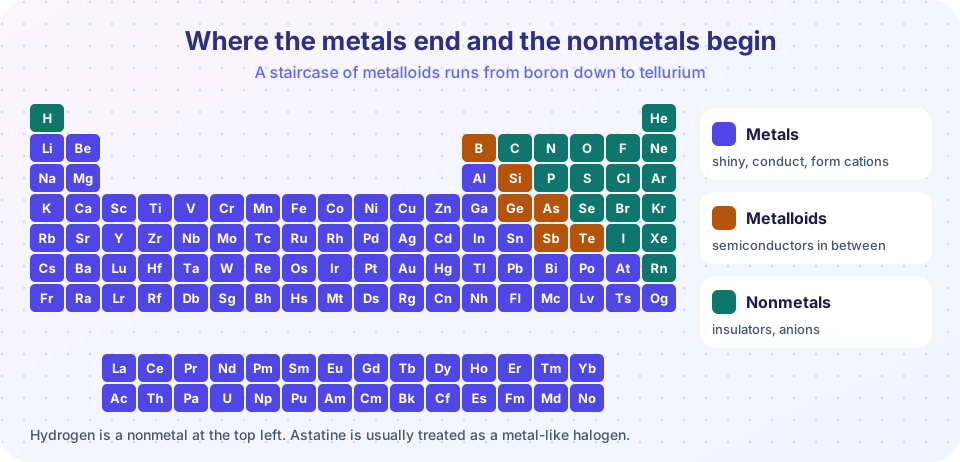
Roughly 80 percent of the known elements are metals. A metal is typically shiny, malleable, ductile, a good conductor of heat and electricity, and forms positive ions (cations) in compounds. Metals lie to the left and in the middle of the table.
A nonmetal is typically a poor conductor, brittle if solid, and forms negative ions (anions) or shares electrons. The nonmetals sit in the upper right, with hydrogen as a special case at the top left.
A metalloid shows mixed behavior. Silicon looks metallic and is a semiconductor, but it is brittle and forms covalent compounds. The usual six are boron, silicon, germanium, arsenic, antimony and tellurium. Different books add or remove one or two, so the staircase is a gradient, not a hard border.
The change across a period is the most useful pattern to remember. Period 3 goes from sodium (a reactive metal) through aluminum (a metal with some covalent character) and silicon (a metalloid) to phosphorus, sulfur and chlorine (nonmetals), ending at argon (an inert gas). One row traverses the whole metal-to-nonmetal spectrum.
The families you will meet constantly
| Group | Name | Typical traits |
|---|---|---|
| 1 | Alkali metals (Li, Na, K, Rb, Cs) | Soft, very reactive, form M⁺ |
| 2 | Alkaline earth metals (Be, Mg, Ca, Sr, Ba) | Harder, reactive, form M²⁺ |
| 3 to 12 | Transition metals | Hard, high melting points, variable oxidation states, colored compounds |
| 13 | Boron group | Mixed: B is a metalloid, Al is a metal |
| 14 | Carbon group | Nonmetal to metal as you go down: C, Si, Ge, Sn, Pb |
| 15 | Pnictogens (N, P, As, Sb, Bi) | Oxidation states from −3 to +5 |
| 16 | Chalcogens (O, S, Se, Te, Po) | Form X²⁻, many allotropes |
| 17 | Halogens (F, Cl, Br, I) | Reactive nonmetals, form X⁻ |
| 18 | Noble gases | Very unreactive, monatomic |
Two more regions are worth naming. The lanthanides (La to Lu, or Ce to Lu depending on the convention) and actinides fill the f subshell and are drawn below the main table so that it stays narrow enough to print.
Why a group behaves alike, and why the first member is odd
Elements in a group have the same valence configuration, so they bond in similar ways. The differences arise from size. Going down a group, atoms get larger and valence electrons are held less tightly, so metallic character increases. That is why carbon is a nonmetal, tin and lead are metals, and the group is a nice demonstration of the trend.
The first member of each main group is unusual. Lithium resembles magnesium more than sodium (a "diagonal relationship"), and beryllium forms covalent compounds more readily than its group-mates. The reason is that the period 2 elements are small and have no d orbitals to expand into. You will see this idea again in chapter 5.
Common misconceptions
- "Hydrogen belongs with the alkali metals." It sits above group 1 because it has one valence electron, but it is a nonmetal gas that forms H⁺, H⁻ and covalent bonds. It is its own case.
- "All metals are solid." Mercury is a liquid at room temperature, and cesium and gallium melt at or just above it (cesium at 28.5 °C, gallium at 29.8 °C).
- "Metalloids are half metal, half nonmetal." They are better described as elements whose properties fall in between, such as semiconductors with moderate conductivity that rises with temperature.
Try it
Period 3 shows the metal-to-nonmetal change in a single row. The program below plots the melting points of the eight elements. The rise from sodium to silicon, then the collapse, reflects the change in bonding: metallic (Na, Mg, Al), giant covalent network (Si) and small molecules (P₄, S₈, Cl₂) or single atoms (Ar).
Press Run (or Ctrl + Enter) to see the result here.
Program input · what you'd type while the program runs
Type the answers before you press Run, one per line. Each time the program reads a line (with input()), it gets the next line from this box.
The second demonstration is a small element explorer. Pick an element from period 3 and see its classification, its usual ion and the kind of bonding.
Check your understanding
Quick check · 5 questions
of 5 answered You scored / 5 · perfect!
-
1. An element is in period 4, group 17. Which family is it, and which block?
Group 17 is the halogens (here bromine), and groups 13 to 18 are the p-block. -
2. How many valence electrons does a group 2 element have?
Group 2 elements have ns² valence configurations, so two valence electrons. -
3. Which of these is a metalloid?
Silicon sits on the staircase between metals and nonmetals. Aluminum is a metal and P and S are nonmetals. -
4. Why do metallic character and reactivity change down a group?
Valence electrons are further from the nucleus and shielded by more inner shells, so they are easier to lose. -
5. Which element is a liquid metal at room temperature?
Mercury is the metal that is liquid at room temperature. Bromine is a liquid nonmetal; gallium and cesium melt only slightly above room temperature.
Summary
- The periodic table groups elements by valence configuration: groups are columns, periods are rows, blocks follow the subshell being filled.
- About 80 percent of the elements are metals; nonmetals sit at the upper right; metalloids form a staircase between them.
- Families such as the alkali metals, halogens and noble gases share traits because they share valence configurations.
- Size increases down a group, so metallic character grows, and first members of main groups are often unusual.
Next: Formulas and naming
Track your progress
Create a free account to tick off lessons and pick up where you left off on any device.
of Inorganic Chemistry lessons completed