


















Lesson 9 of 46 · Methods and Theories of Development
Major Theoretical Perspectives on Development
A guide to the major families of developmental theory: psychodynamic, learning, cognitive and contextual, with Erikson's eight stages and an evaluation of what held up.
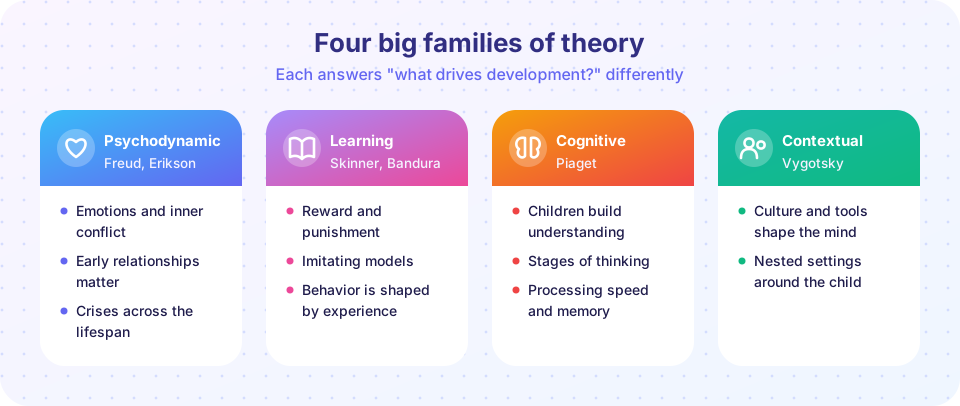
If research methods are the tools of developmental science, theories are the blueprints. A theory organizes facts, explains why they hold and predicts what you should see next. Developmental theories tend to cluster into four families, each giving a different answer to the question: what drives a person to change? None of them is the whole truth, and part of the skill is knowing which pieces have survived testing and which have not.
What you will learn
- describe the four families of developmental theory and their key thinkers
- list Erikson's eight psychosocial stages and the idea of a psychosocial crisis
- explain classical conditioning, operant conditioning and Bandura's social learning
- apply criteria (testability, evidence, scope) to evaluate a theory
Key terms
Psychosocial crisis: in Erikson's theory, a turning point in which a person faces a challenge between two poles (for example, trust versus mistrust).
Reinforcement: a consequence that makes a behavior more likely. Punishment: a consequence that makes it less likely.
Observational learning: learning by watching others' behavior and its consequences.
Self-efficacy: a person's belief in their ability to succeed at a task (Bandura).
What makes a good theory?
Philosophers of science give several criteria. A good theory is testable (it forbids some outcomes), consistent with evidence, parsimonious (no more complicated than needed), broad in scope, and fruitful in generating new research and applications. As you read, notice which theories score high on testability and which score low.
Family 1: psychodynamic theories
Psychodynamic theories stress emotions, inner conflicts and early relationships.
Sigmund Freud (1856–1939) proposed that children pass through psychosexual stages (oral, anal, phallic, latency, genital) in which pleasure centers on different body areas, and that unresolved conflicts shape later personality. Most of his specific claims were hard to test and have not held up well. His lasting influence lies in drawing attention to early experience, to unconscious processes and to the emotional side of development.
Erik Erikson (1902–1994) replaced sexual stages with psychosocial ones, spanning the entire lifespan. At each stage a person faces a crisis, and a healthy resolution builds a strength (a "virtue").
| Stage and approximate age | Crisis | Virtue |
|---|---|---|
| Infancy (0–1) | Trust vs mistrust | Hope |
| Toddlerhood (1–3) | Autonomy vs shame and doubt | Will |
| Preschool (3–6) | Initiative vs guilt | Purpose |
| School age (6–12) | Industry vs inferiority | Competence |
| Adolescence (12–18) | Identity vs role confusion | Fidelity |
| Young adulthood (18–40) | Intimacy vs isolation | Love |
| Middle adulthood (40–65) | Generativity vs stagnation | Care |
| Late adulthood (65+) | Integrity vs despair | Wisdom |
Erikson's ideas, especially "identity", have been very productive. Critics note that the stages are broad, lack precise ways to measure resolution, and were formed mostly from Western observations. James Marcia later turned the identity idea into measurable "identity statuses", and research on adolescent identity continues (see the later chapters).
Family 2: learning theories
Learning theories argue that behavior is shaped by experience.
- Classical conditioning. Ivan Pavlov found (around 1900) that dogs learned to salivate to a neutral signal, such as a bell, that regularly came before food. John B. Watson applied this to children and argued that psychology should study observable behavior only (behaviorism).
- Operant conditioning. B. F. Skinner (1904–1990) showed that behavior is shaped by its consequences. Reinforcement (a reward, or removal of something unpleasant) makes a behavior more likely, punishment makes it less likely, and withholding reinforcement leads to extinction. Skinner stressed that development is gradual and driven by experience; there are no inner stages.
- Social learning. Albert Bandura (1925–2021) argued that people also learn by watching. In the Bobo doll studies (Bandura, Ross and Ross, 1961), children who saw an adult hit an inflatable doll were more likely to hit it afterwards. Bandura later expanded this into social cognitive theory: people interpret what they see, set goals and form beliefs about their own efficacy, and they influence their own environments (reciprocal determinism).
Learning theories predict well in many applied settings (classroom behavior, early intervention programs, fear learning). Critics say they overlook the child's own thinking and biological readiness; Bandura's theory partly answered this. Researchers have also pointed out that the Bobo doll setting was artificial and that children might have imitated because it seemed expected, but observational learning in general is well supported.
Family 3: cognitive theories
Cognitive theories focus on how thinking changes. Jean Piaget proposed that children actively construct understanding in four stages (you will study this in Piaget's Stages). Information-processing theories compare the mind to a system that takes in, stores and transforms information, and they track gradual gains in attention, speed, memory and strategies. Neo-Piagetian and cognitive neuroscience approaches connect cognitive change to brain growth.
Family 4: contextual and evolutionary theories
Contextual theories insist that development cannot be understood apart from its setting.
- Lev Vygotsky (1896–1934) argued that thinking is built in social interaction with the help of cultural tools such as language (Vygotsky and Scaffolding).
- Urie Bronfenbrenner (1917–2005) described layers of environment from family to culture (Ecological Systems).
- Evolutionary and ethological theories (Darwin's baby diaries, Konrad Lorenz, John Bowlby) ask what behaviors help survival and reproduction. Bowlby's attachment theory is explored in later chapters.
- Dynamic systems theory (Esther Thelen) treats development as self-organizing patterns arising from the interaction of body, brain and environment; you will meet it in the lesson on motor development.
Comparing the families
Where theories disagree, data decide. The table shows how each family answers the standing questions.
| Question | Psychodynamic | Learning | Cognitive | Contextual |
|---|---|---|---|---|
| Engine of change | Emotions, conflicts | Reinforcement, imitation | Thinking, maturation | Culture, social partners |
| Stages? | Yes | No (gradual) | Piaget: yes; processing: no | Not as such |
| Active or passive child? | Driven by drives | Mostly passive | Active builder | Active within context |
| Strongest evidence | Importance of early relationships | Fear learning, classroom behavior | Many cognitive milestones | Cultural variation, schooling effects |
You do not have to choose a favorite. Modern researchers often use pieces of several theories, and they hold hypotheses lightly.
Common misconceptions
"Freud's theory is the foundation of developmental science." It had historic influence, but most of its detailed claims were not supported. Later research on attachment and emotion draws on a different, more testable tradition.
"Behaviorism means children are blank slates." Skinner emphasized experience, but modern learning theory recognizes biological constraints and the role of thought.
"Erikson's stages are fixed deadlines." They are broad themes, which many people revisit at different ages.
Try it
Press Run (or Ctrl + Enter) to see the result here.
Program input · what you'd type while the program runs
Type the answers before you press Run, one per line. Each time the program reads a line (with input()), it gets the next line from this box.
Press Run (or Ctrl + Enter) to see the result here.
Program input · what you'd type while the program runs
Type the answers before you press Run, one per line. Each time the program reads a line (with input()), it gets the next line from this box.
Check your understanding
Quick check · 5 questions
of 5 answered You scored / 5 · perfect!
-
1. Which theorist described eight psychosocial crises across the whole lifespan?
Erikson's psychosocial theory spans infancy to late adulthood. -
2. A teacher praises a student each time she raises her hand, and hand-raising becomes more frequent. This is an example of...
A consequence that makes a behavior more likely is reinforcement. -
3. What did Bandura's Bobo doll studies mainly demonstrate?
They showed observational learning: imitation of a model without direct reinforcement. -
4. Which is the best criticism of Freud's psychosexual stages?
Freud's theory was influential but its specific claims were largely untestable or unsupported. -
5. Which theory family emphasizes culture, tools and social partners as the engine of development?
Vygotsky and Bronfenbrenner are contextual theorists.
Summary
- Four families of theory: psychodynamic, learning, cognitive and contextual.
- Freud was historically influential but his claims were largely untestable; Erikson's lifespan crises have been more productive.
- Learning theories: classical and operant conditioning (Pavlov, Skinner) and social learning (Bandura).
- Cognitive theories describe thinking, and contextual theories stress culture and setting.
- Judge theories by testability, evidence, breadth and fruitfulness.
Next: Ecological Systems
Track your progress
Create a free account to tick off lessons and pick up where you left off on any device.
of Developmental Psychology lessons completed