


















Lesson 18 of 46 · Cognitive Development
Cognitive Development: Overview
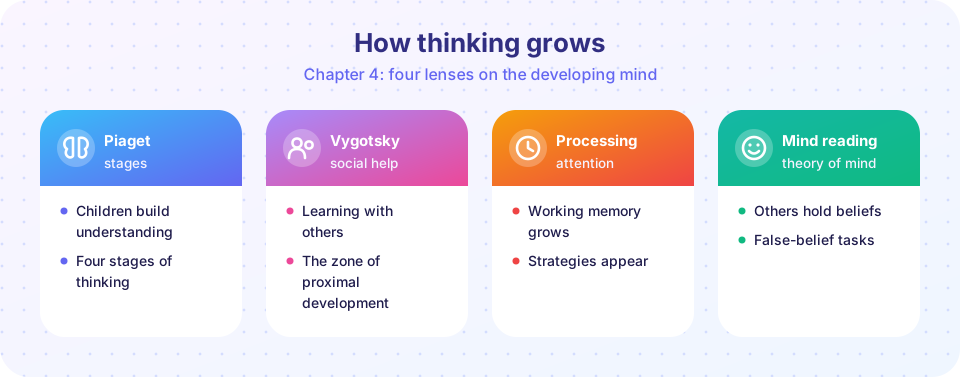
Chapter 4 overview: four lenses on how children's thinking grows, from Piaget's stages and Vygotsky's social learning to memory strategies and understanding other minds.
A four-year-old tells you, completely seriously, that the moon follows the car. A seven-year-old can sort her toys by size and color at once. A fifteen-year-old can argue about a hypothetical world with different laws of physics. How do children get from one kind of thinking to the next? Cognitive development is the study of how perception, attention, memory, reasoning and understanding grow with age. This chapter introduces four major lenses, each of which highlights something the others miss.
What you will learn
- see how the four lenses of the chapter relate
- preview Piaget's stages, Vygotsky's zone of proximal development, information-processing accounts and theory of mind
- understand why no single theory explains all of cognitive growth
Key terms
Cognition: mental processes such as perceiving, attending, remembering, reasoning and problem solving.
Construct: to build. Piaget said children construct knowledge by acting on the world.
Information processing: an approach that studies how the mind takes in, stores and uses information.
Theory of mind: understanding that other people have beliefs, desires and knowledge that may differ from your own.
Four questions, four lenses
- Piaget: What kinds of thinking do children have at different ages? He described four stages in which children construct understanding through action and reflection.
- Vygotsky: How do other people and culture shape thinking? Learning happens first between people, then inside the child.
- Information processing: What are the mental mechanics? How fast, how much and with which strategies does a child process information?
- Theory of mind: How do children understand other minds? When do they realize that others can hold false beliefs?
Piaget: stages of thinking
Vygotsky: learning together
Information processing
Theory of mind
What each lesson covers
- Piaget's Stages: schemas, assimilation, accommodation and the four stages, with famous tasks.
- Evaluating Piaget: what held up, what was revised, and the debate over infant core knowledge.
- Vygotsky and Scaffolding: the zone of proximal development, scaffolding, private speech and a simulation of fading help.
- Memory and Attention: working memory, strategies, metacognition, executive function and the marshmallow test replication.
- Theory of Mind: false-belief tasks, joint attention, culture and language, and debates about infant mind reading.
- Chapter 4 Review: the chapter in one picture and a ten-question quiz.
How the lenses fit together
The lenses are not rivals so much as zoom levels. Piaget describes broad shifts in how children reason. Information processing zooms in to the mechanisms (more working memory lets a child hold two dimensions of a problem in mind at once). Vygotsky zooms out to show how interaction with caregivers and teachers delivers the tools. And theory of mind picks one highly important ability, understanding other people, and tracks it in detail. A fully developed account needs all four.
As you read each lesson, ask: what does this lens explain well, and what does it leave out?
Common misconceptions
"Children think like small adults who know less." Their reasoning often differs in kind: young children treat appearance as reality, and rely on single features of a problem.
"Cognitive development is only about school skills." It includes perception, attention, memory, play and social understanding.
"One theory has been proven right." Each has parts that held up and parts that were revised, as the lessons show.
Try it
Press Run (or Ctrl + Enter) to see the result here.
Program input · what you'd type while the program runs
Type the answers before you press Run, one per line. Each time the program reads a line (with input()), it gets the next line from this box.
Check your understanding
Quick check · 3 questions
of 3 answered You scored / 3 · perfect!
-
1. Which lens emphasizes that learning first happens between people?
Vygotsky argued that higher mental functions appear first in social interaction and are then internalized. -
2. What is theory of mind?
It concerns understanding other people's mental states. -
3. Why does the chapter use four lenses instead of one theory?
The lenses work at different levels (stages, mechanisms, social context, social understanding) and complement each other.
Summary
- Cognitive development covers perception, attention, memory, reasoning and understanding of other minds.
- The chapter's four lenses ask different questions: stages (Piaget), social learning (Vygotsky), mechanics (information processing) and understanding minds (theory of mind).
- The lenses complement one another, and each has strengths and limits.
Next: Piaget's Stages
Track your progress
Create a free account to tick off lessons and pick up where you left off on any device.
of Developmental Psychology lessons completed