


















Lesson 35 of 46 · Adolescence and Adulthood
Brain, risk and identity: the teenage years in depth
Understand how the teenage brain changes, the dual-systems model and its critics, why peers raise risk-taking, and how Erikson and Marcia describe identity formation.
A teenager who gets top marks in a calm exam can also make a rash choice with friends watching. Parents and teachers often find this puzzling. Part of the explanation lies in how the brain changes during adolescence and how social situations alter decisions. Another part lies in a central task of the age: working out who you are.
This lesson covers two big topics. The first is the adolescent brain and risk-taking, including a popular model, its limits and the headline claim that the brain "finishes at 25". The second is identity, using Erik Erikson's idea and James Marcia's four identity statuses. We also touch briefly on mental health and social media.
What you will learn
- The main brain changes of adolescence: pruning, myelination and uneven maturation.
- The dual-systems (imbalance) model, the evidence for it and its criticisms.
- Why the presence of peers can increase risk-taking, and what that does not mean.
- Erikson's identity versus role confusion and Marcia's four statuses.
Key terms
- Synaptic pruning: removal of little-used connections between neurons, making circuits more efficient.
- Myelination: growth of a fatty sheath on neuron fibers that speeds up signals.
- Prefrontal cortex: the front region of the brain involved in planning, attention and self-control.
- Dual-systems model: the idea that reward-seeking brain systems mature earlier than self-control systems.
- Identity statuses: Marcia's four categories based on exploration and commitment.
What changes in the brain
From childhood into the twenties, the brain is reorganized. Two big processes stand out. In synaptic pruning, connections that are not used are trimmed, so networks become more efficient. In myelination, nerve fibers gain insulation, which speeds communication between regions, including between the prefrontal cortex and deeper emotional and reward systems.
Different regions mature at different speeds. Studies using MRI scans of the same people over many years, such as those by Jay Giedd and colleagues, show that the cortex thins and white matter increases through adolescence, with frontal areas among the last to reach adult-like structure. Reward-related regions such as the ventral striatum respond strongly to potential gains in mid-adolescence.
The dual-systems model
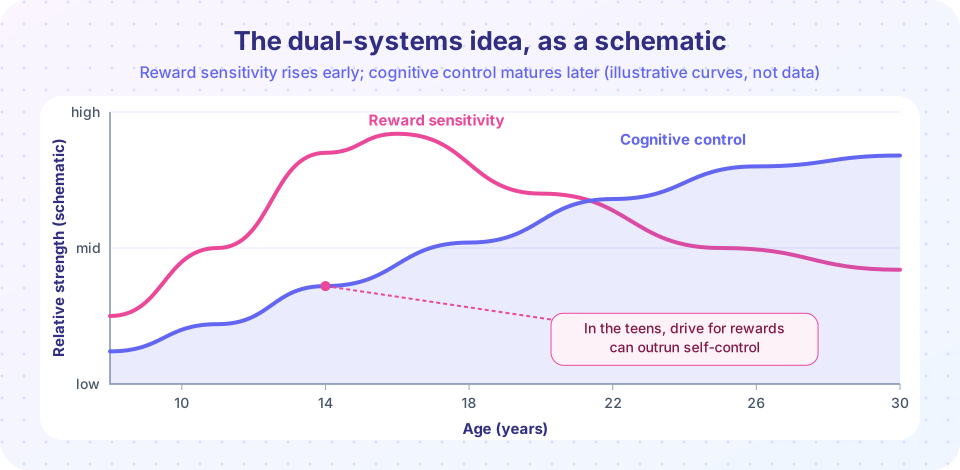
Laurence Steinberg, B. J. Casey and others proposed that two systems develop on different timetables:
- A socioemotional (reward) system becomes highly sensitive around puberty.
- A cognitive control system, centered on the prefrontal cortex, strengthens more slowly into the mid-twenties.
In the mid-teens, then, the drive to seek rewards, especially social rewards, can be strong while the brakes are still developing. This would help to explain why adolescents show a peak in risky behaviors such as reckless driving and experimentation, even when they understand the risks in a calm test.
Evidence about peers
In a 2005 study, Margo Gardner and Laurence Steinberg had participants aged 13 to 16, 18 to 22, and 24 and older play a computer driving game with a yellow light, where waiting for a longer time risked crashing into a wall. They played alone or with two friends watching. Risk-taking rose sharply in the presence of friends for the adolescents and the college-age group, and not for adults. In a 2011 brain-imaging study Jason Chein and colleagues found that reward-related areas were more active in teenagers when peers were present.
Cautions
This model is influential but contested.
- "The brain is not fully developed until 25" is a slogan, not a scientific cutoff. Maturation is gradual, differs by region and person, and never really stops. Adults make mistakes too.
- The simple two-system picture is too tidy. Many researchers stress that reward and control systems interact, that connections between regions matter, and that development continues across the lifespan.
- Context matters. Teens can reason carefully in calm, "cold" conditions and take more risk in emotionally "hot" ones. Their risk-taking is not always poor judgment: sometimes it supports learning, exploration and the building of social ties.
- Individual differences are big. Many teens take few serious risks.
Mental health and social media: a brief note
This section is educational and not medical advice. Adolescence is a common time for anxiety and depression to first appear. A trained professional can help; if you or someone you know is struggling, speak to a doctor, school counselor or another trusted adult or local helpline.
The effects of social media on adolescent wellbeing are a topic of active debate. Large analyses, such as one by Amy Orben and Andrew Przybylski (2019), found very small average associations between digital technology use and wellbeing, while others point to larger effects for some groups or kinds of use. The honest summary is that the evidence is mixed and the details (how, when and for whom) matter.
Identity: who am I?
Erik Erikson proposed that each stage of life has a central psychosocial challenge. In adolescence it is identity versus role confusion: forming a stable sense of self that ties together roles, values, beliefs and goals. This includes career plans, ideas about gender, sexuality, faith, politics and cultural background. For young people from minority or immigrant groups, ethnic and racial identity, studied by Jean Phinney and others, is often a key part of this process.
James Marcia (1966) made Erikson's idea measurable by looking at two dimensions: exploration (actively considering alternatives) and commitment (making a firm choice). Crossing them gives four statuses:
| Status | Exploration | Commitment | What it looks like |
|---|---|---|---|
| Identity diffusion | No | No | Drifting, no clear direction |
| Foreclosure | No | Yes | Adopts parents' or others' plans without exploring |
| Moratorium | Yes | No | Actively trying options, undecided |
| Identity achievement | Yes | Yes | Committed after exploration |
These are not strict stages. People can be in different statuses for different areas, such as career and religion, and can move back and forth. Research tends to find more identity achievement with age through the twenties, and moratorium is common during education and early work. Foreclosure can feel secure but may be fragile when circumstances change.
Parents and schools matter. Warm, supportive relationships that allow independent thinking are associated with healthier identity exploration. Identity is also shaped by context: culture and opportunities can make some options visible and others invisible.
Common misconceptions
- "Teens take risks because they do not understand danger." In calm tests, teens often judge risks about as well as adults. Hot situations and peers change choices.
- "The brain stops changing at 25." It keeps changing throughout life.
- "Moratorium means being lost." Exploring is a normal and often healthy path to commitment.
- "Identity is settled in the teens." It is revised throughout adulthood.
Try it
First, a schematic plot of the dual-systems idea. The curves are drawn to illustrate the proposal, not from data. Change the peak age or the speed of maturation to see the "gap" move.
Press Run (or Ctrl + Enter) to see the result here.
Program input · what you'd type while the program runs
Type the answers before you press Run, one per line. Each time the program reads a line (with input()), it gets the next line from this box.
Second, explore Marcia's statuses. Toggle exploration and commitment to see which status you get.
Third, a toy model of peer influence on risk. It is an invented model, with made-up numbers, built only to show the logic: the presence of peers adds to the reward of a risky choice, and teens have a larger bonus than adults.
Press Run (or Ctrl + Enter) to see the console output here.
No output.
Check your understanding
Quick check · 5 questions
of 5 answered You scored / 5 · perfect!
-
1. Which process makes brain circuits more efficient by trimming little-used connections?
Pruning removes less-used synapses, while myelination speeds up signals. -
2. What did Gardner and Steinberg (2005) find about peers and risk-taking?
Friends watching increased risky choices in the driving game for teenagers and college-age participants, not for adults. -
3. Why is "the brain is fully developed at 25" a poor summary?
There is no sharp cutoff at 25. -
4. In Marcia's scheme, a person who has explored options and made a firm commitment is in which status?
Identity achievement means commitment after exploration. -
5. A teenager follows the family business without considering alternatives. Which status fits?
Commitment without exploration is foreclosure.
Summary
- The adolescent brain is reorganized by pruning and myelination, with regions maturing at different rates.
- The dual-systems model says reward sensitivity peaks before cognitive control matures; it is influential but simplified.
- Peers raise risk-taking in adolescents in experiments; context, not just immaturity, matters.
- Erikson's identity versus role confusion and Marcia's four statuses describe the search for identity.
- Evidence on social media and wellbeing is mixed.
Track your progress
Create a free account to tick off lessons and pick up where you left off on any device.
of Developmental Psychology lessons completed