


















Lesson 1 of 46 · Getting Started
Course Map: How to Study Developmental Psychology
Meet the nine-chapter developmental psychology course: who it is for, what you need, how to study it, and a map from conception to late life.
Why does a three-year-old insist that a flattened ball of clay is "less" than the round one? Why do teenagers take risks that frighten their parents? Why do some people in their eighties stay mentally sharp while others do not? Developmental psychology is the scientific study of how and why people change, and stay the same, from before birth to the end of life. This course walks that whole road, one stretch at a time.
Educational information only. This course explains what research has found about human development. It is not medical, psychological or parenting advice and it cannot diagnose anything. If you are worried about a child's or an adult's health or development, talk to a qualified professional.
What you will learn
- who this course is for and what you need before you start
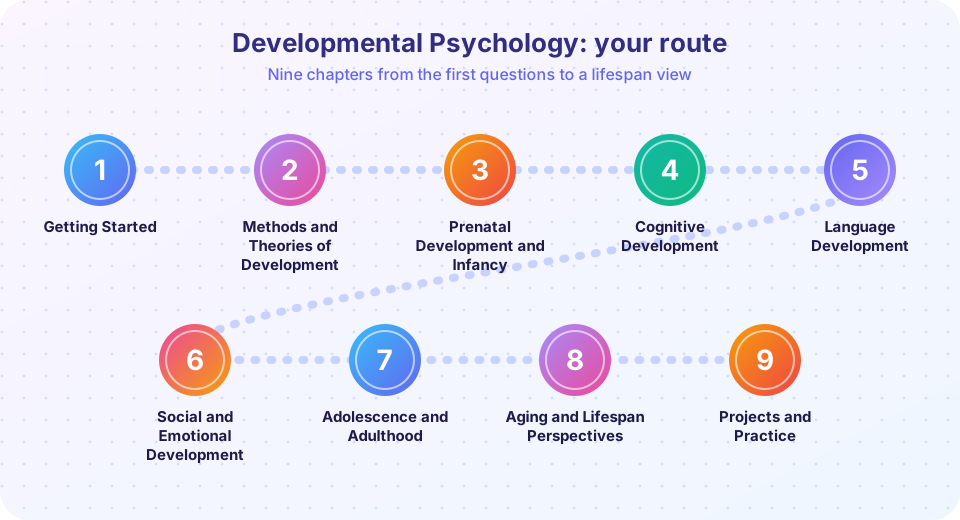
- how the nine chapters fit together
- a study routine that works for a science of change
- how to read claims about children critically, including claims in this course
Key terms
Development: systematic changes and continuities in a person from conception to death.
Domain: one broad area of change: physical, cognitive or socioemotional.
Theory: a connected set of ideas that explains findings and predicts new ones.
Replication: repeating a study to see whether the result holds again.
Who this course is for
The course suits learners of about 11 to 18 who want a first, serious look at the subject, students preparing for school-level psychology courses (it follows the common ground of Cambridge IGCSE and A Level, IB and US AP psychology), and adults who care for, teach or simply wonder about people of any age. You do not need any prior psychology. You do need curiosity and a willingness to look at numbers, because modern developmental science runs on data.
The nine chapters
Think of the course as a journey with three parts.
Part 1: the foundations
- Getting started
- Methods and theories
- Prenatal and infancy
Part 2: growing up
- Cognitive
- Language
- Social and emotional
Part 3: across the lifespan
- Adolescence and adulthood
- Aging
- Projects
This first half of the course covers chapters 1 to 4 (this page, then methods and theories, then prenatal development and infancy, then cognitive development). The chapter lists below link to every lesson of that half. Each chapter opens with an overview, has two to four lessons, and closes with a review quiz.
Chapter 1, Getting Started: What Is Development?, Nature and Nurture, Lifespan Periods and Big Questions, Chapter 1 Review.
Chapter 2, Methods and Theories of Development: Overview, Research Designs, Studying Babies and Research Ethics, Major Theoretical Perspectives, Ecological Systems, Chapter 2 Review.
Chapter 3, Prenatal Development and Infancy: Overview, Prenatal Stages, Teratogens and Risks, The Newborn, Motor Skills and the Infant Brain, Chapter 3 Review.
Chapter 4, Cognitive Development: Overview, Piaget's Stages, Evaluating Piaget, Vygotsky and Scaffolding, Memory and Attention, Theory of Mind, Chapter 4 Review.
How to study this course
- Read actively. After each section, close the page and say the main idea in one sentence.
- Run the demonstrations. Every lesson has small interactive models and simulations. They are labelled as demonstrations, never as tests of a real child or person. Change the numbers and see what happens.
- Quiz yourself on purpose. Retrieving an answer helps memory far more than rereading. Treat the quizzes as practice, not as a judgment.
- Space it out. Two or three short sessions a week beat one long session.
- Ask "how do we know?" Every claim in this course rests on studies. Notice the design, the sample and the size of the effect, and notice when results have failed to replicate.
When a finding sounds too neat ("babies can do arithmetic", "a marshmallow test predicts your life"), slow down. Developmental science has had famous results that shrank or disappeared when other labs repeated them. Part of becoming good at this subject is learning which findings are solid and which are still being argued about. This course flags both.
Common misconceptions
"Developmental psychology is about children only." The field covers the whole lifespan, and some of the most active research today concerns adults and older people.
"It is common sense." Many results contradict intuition: babies are born with surprisingly good hearing, but poor vision; most teenagers do not have a prolonged "storm and stress"; and a great deal of cognitive skill is kept, not lost, in healthy aging.
Try it
Press Run (or Ctrl + Enter) to see the result here.
Program input · what you'd type while the program runs
Type the answers before you press Run, one per line. Each time the program reads a line (with input()), it gets the next line from this box.
Check your understanding
Quick check · 4 questions
of 4 answered You scored / 4 · perfect!
-
1. Which statement best describes developmental psychology?
The field covers the whole lifespan and all domains of change, not just childhood or one topic. -
2. Why does this course keep reminding you to ask 'how do we know?'
Evidence quality matters: designs, samples, effect sizes and replications all affect how much a finding should be trusted. -
3. Which is the best way to use the interactive demonstrations?
They are small models and simulations for learning. They are never diagnostic and are not real data. -
4. Which of these is NOT one of the three domains of development?
The three standard domains are physical, cognitive and socioemotional.
Summary
- Developmental psychology studies change and stability across the whole lifespan.
- The course has nine chapters, from foundations to aging and applied projects.
- Study by retrieving, spacing and asking how we know what we know.
- Demonstrations are teaching models, not tests or real data.
Next: What Is Development?
Track your progress
Create a free account to tick off lessons and pick up where you left off on any device.
of Developmental Psychology lessons completed