


















Lesson 8 of 46 · Methods and Theories of Development
Studying Babies and Research Ethics
Learn how scientists study infants who cannot talk, from habituation and preferential looking to violation of expectation, plus the ethics that protect child participants.
How do you ask a three-month-old what she knows? You cannot hand her a test. You can, however, watch what she looks at, how long she looks, how hard she sucks, how fast her heart beats, or what her brain waves do. Over the last sixty years, developmental scientists have turned these tiny signals into one of the field's greatest sources of discovery. They have also learned, sometimes painfully, that research with children carries special duties.
What you will learn
- explain habituation, preferential looking and violation-of-expectation methods
- describe other infant measures: sucking, heart rate, EEG/ERP and eye tracking
- explain why interpreting looking time is harder than it seems
- state the ethical principles of research with children and why they exist
Key terms
Habituation: a decrease in response to a stimulus that is repeated. Dishabituation: the recovery of response when something new appears.
Preferential looking: showing two stimuli at once and measuring which one the infant looks at longer.
Violation of expectation (VoE): comparing looking at an event that is physically possible with a similar event that is impossible.
Informed consent: agreement to take part after understanding what is involved. With children, parents give consent and the child gives assent when able.
The infant's main response: looking
Newborns can't reach and young infants can't talk, but even newborns can turn their eyes and heads. Because infants tend to look longer at things that are new, interesting or surprising, researchers can use looking time as a window onto what infants notice and expect. Methods differ in how they use it.
Habituation and dishabituation
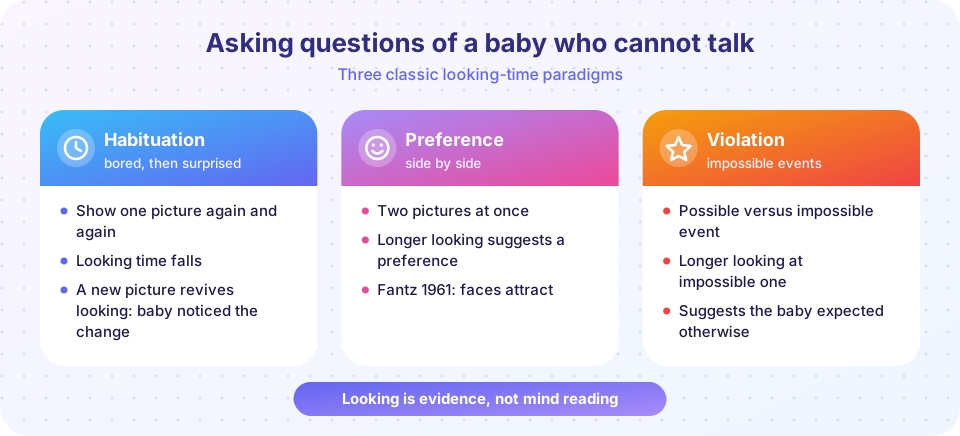
You show an infant the same picture repeatedly. At first she looks for a long time. As she gets used to it, looking time falls. The researcher defines a habituation criterion, for example, when looking time over three consecutive trials falls to half of the starting level. Then comes the test: show either a new picture or the same one again. If the infant looks longer at the new picture, she must have noticed that it differs. This method tests whether infants can discriminate two things, such as two sounds in a language or two faces. It has revealed, for example, that newborns detect differences between speech sounds.
Preferential looking
Robert Fantz (1961) showed infants pairs of patterns, such as a face-like arrangement and a scrambled version, and recorded which they fixated. Infants as young as a few days looked more at face-like patterns, among other preferences such as for patterns over plain discs. Fantz's work showed that infants are not blank slates and that simple methods can test what they can see. A modern variant, the intermodal preferential looking paradigm, plays a sentence ("Where is the dog?") while two pictures are shown and measures which the child looks at, to test word understanding long before the child speaks.
Violation of expectation
Renée Baillargeon's well-known drawbridge study (1985) showed five-month-old infants a screen that rotated like a drawbridge through 180 degrees. In one condition a box sat behind the screen and the screen stopped when it reached the box (possible); in the other, the screen seemed to pass right through the box (impossible). Infants looked longer at the impossible event, and Baillargeon and others interpreted this as evidence that very young infants understand something about objects continuing to exist and not passing through each other. Elizabeth Spelke and others have used similar designs to argue that infants have early "core knowledge" about objects and numbers. We evaluate these claims in Evaluating Piaget.
Other measures
- High-amplitude sucking: infants suck on a pacifier connected to a computer; sucking rates indicate interest.
- Heart rate: a slowing heart rate can signal attention, while changes in rate signal arousal.
- EEG and event-related potentials (ERPs): electrodes on the scalp record brain responses to stimuli, such as to a changed syllable.
- Eye tracking: cameras record exactly where eyes go, with millisecond resolution. It is also used to see whether the infant anticipates where an event will occur.
- fNIRS: a light-based, silent method for measuring blood oxygen changes in the cortex.
- Parent report: checklists such as vocabulary inventories, useful but reliant on parents' observations.
What does looking time mean?
Looking longer might mean the infant is surprised, finds the display more interesting, or simply finds it more complex. A familiar object can attract more looking than a new one, depending on the age and on what was shown before. Critics of violation-of-expectation studies argue that some results could be explained by low-level perceptual differences (for example, one display moves more) rather than by knowledge of physical laws. Defenders reply that well-designed studies control for these. The debate is unresolved.
Replication matters too. The ManyBabies consortium, a collaboration of dozens of labs, tested whether infants prefer infant-directed speech ("baby talk") over adult speech. The 2020 report (ManyBabies 1) found a robust preference on average, with effects varying across labs, ages and methods. Large collaborative projects like this help distinguish solid findings from fragile ones.
Think of looking time as a clue, like a footprint. It tells you something happened. It does not tell you exactly what the infant was thinking.
Ethics of research with children
Children cannot protect themselves, so the rules are stricter than for adults.
- Minimal risk. The risks of the study should be no greater than those of everyday life, and benefits should justify any risk.
- Informed consent and assent. Parents or guardians give permission after learning what the study involves. Older children give their own assent. A child who seems upset or says no can stop at any time, whatever the parent has agreed.
- Voluntary and withdrawable. Participation is never forced, and participants can leave without penalty.
- Confidentiality and data protection. Data are stored securely and reported without identifying children.
- Review. An independent committee (called an institutional review board, or ethics committee) evaluates plans before the study begins.
- Fairness. No group should bear the burdens of research without sharing its benefits.
These principles come from the Nuremberg Code (1947), the Declaration of Helsinki (1964, updated since) and the US Belmont Report (1979), which stress respect for persons, beneficence and justice.
A case that is still taught as a warning is Little Albert (John B. Watson and Rosalie Rayner, 1920). The researchers conditioned a nine-month-old boy to fear a white rat by pairing it with a loud noise, and they did not remove the fear afterward. The experiment would not pass ethical review today, and later historians have also questioned the details of the study.
Common misconceptions
"Longer looking always means preference or surprise." It can mean many things depending on age, familiarity and display, and researchers use controls for this reason.
"Babies can't be studied scientifically because they can't talk." They can, using carefully designed behavioral and physiological measures, although interpretation needs caution.
"Parental consent is enough." Consent is necessary, but researchers must also stop if the child shows distress and must keep risks minimal.
Try it
Press Run (or Ctrl + Enter) to see the result here.
Program input · what you'd type while the program runs
Type the answers before you press Run, one per line. Each time the program reads a line (with input()), it gets the next line from this box.
Press Run (or Ctrl + Enter) to see the result here.
Program input · what you'd type while the program runs
Type the answers before you press Run, one per line. Each time the program reads a line (with input()), it gets the next line from this box.
Check your understanding
Quick check · 5 questions
of 5 answered You scored / 5 · perfect!
-
1. In a habituation study, what shows that an infant noticed the new picture?
Recovery of looking after habituation (dishabituation) suggests the infant detected a difference. -
2. Who used preferential looking in 1961 to show that young infants prefer face-like patterns?
Fantz's preferential-looking studies showed infants' visual preferences. -
3. Why might looking longer at an impossible event NOT prove an infant understands physics?
Alternative perceptual explanations are a main critique of violation-of-expectation research. -
4. Which is a core principle of ethical research with children?
Consent, assent, minimal risk and the right to withdraw protect child participants. -
5. What is the main contribution of the ManyBabies projects?
Large collaborative replications help separate robust effects from fragile ones.
Summary
- Infant research relies on behaviors infants can do: looking, sucking, heart rate and brain responses.
- Habituation tests discrimination, preferential looking tests preference, and violation of expectation probes understanding of events.
- Looking time is evidence, not a mind-reading device; alternative explanations and replications matter.
- Ethics for children: minimal risk, parental consent and child assent, voluntary participation, confidentiality and independent review.
Track your progress
Create a free account to tick off lessons and pick up where you left off on any device.
of Developmental Psychology lessons completed