


















Lesson 3 of 46 · Getting Started
Nature and Nurture
Explore how genes and environments work together in development: heritability, twin studies, gene-environment correlation, epigenetics and common mistakes.
"Is she like that because of her genes or because of how she was raised?" People have asked this about children for centuries. The modern answer is that the question is built wrong. Genes never act alone, and environments never act on a blank slate. This lesson shows how researchers separate and then recombine the two, and why the number called heritability is so often misunderstood.
What you will learn
- define genotype, phenotype and heritability, and say what heritability does not mean
- describe how twin and adoption studies estimate genetic influence
- distinguish passive, evocative and active gene-environment correlation
- explain epigenetics at a basic level, and why some famous gene-by-environment findings failed
- reason about why the same genes can produce different outcomes in different settings
Key terms
Genotype: the genetic information a person inherits. Phenotype: the observable characteristics that result from genotype and environment together.
Heritability: the proportion of the differences between people in a population that is statistically associated with genetic differences. It is not about one person.
Reaction range: the span of outcomes a genotype can produce across different environments.
Epigenetics: chemical tags on DNA and its packaging that change how active genes are, without changing the DNA sequence.
Gene-environment correlation: the tendency for genes to be linked to the environments a person experiences.
Genes and phenotypes
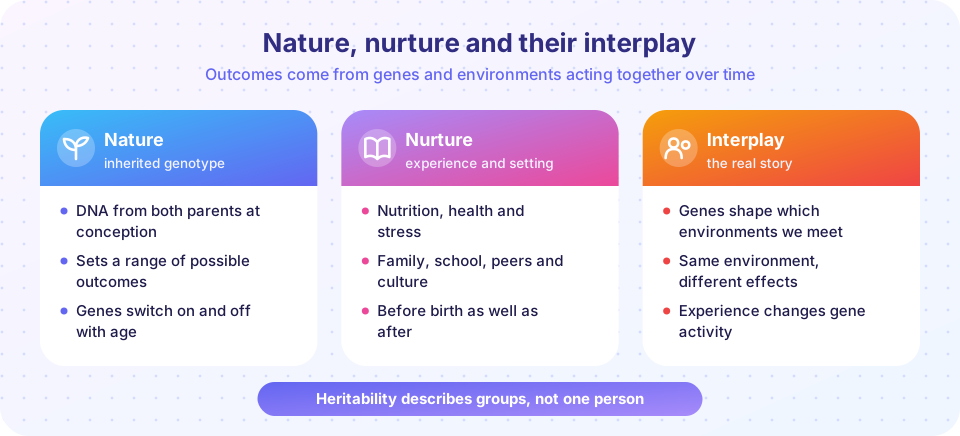
At conception a child receives 23 chromosomes from each parent, a unique combination of DNA (apart from identical twins). That is the genotype. What we see and measure, such as height, vocabulary or shyness, is the phenotype, produced when the genotype meets an environment over time.
A classic example is phenylketonuria (PKU), an inherited condition in which the body cannot process the amino acid phenylalanine. Left untreated, it leads to intellectual disability. But newborns are screened and those with PKU can eat a low-phenylalanine diet, which largely prevents the damage. The same genotype produces very different phenotypes depending on the diet. The idea that a gene "fixes" an outcome is wrong even for a clearly genetic condition.
The range of outcomes a genotype can yield in different environments is its reaction range. Height is a good illustration: genes set a potential, and nutrition and health decide where in the range a person ends up.
How researchers estimate heritability
You cannot randomly assign children to genes, so behavior geneticists use "natural experiments".
- Twin studies. Identical (monozygotic, MZ) twins share essentially all their DNA. Fraternal (dizygotic, DZ) twins share, on average, half of the DNA that varies between people. If MZ twins are more alike than DZ twins on a trait, genes probably matter. A rough formula, Falconer's estimate, says
heritability ≈ 2 × (r_MZ − r_DZ), where r is the correlation between twins. - Adoption studies. Adopted children are compared with both biological relatives (shared genes, different home) and adoptive relatives (shared home, different genes).
- Twins reared apart. The Minnesota Study of Twins Reared Apart (Bouchard and colleagues, begun in 1979) found that separated identical twins were often strikingly similar in some traits, though small samples and partly shared environments limit what it can show.
A major 2015 meta-analysis of about 50 years of twin studies, by Polderman and colleagues, found that across thousands of traits the average heritability was around 50 percent, with similar roles for genes and environment overall. Turkheimer's "three laws" summarize the pattern: every human behavioral trait is partly heritable; the effect of growing up in the same family is usually smaller than the effect of genes; and a large share of variation is not explained by genes or by the shared family environment.
What heritability is not
Heritability is not "how much of you is genetic." A heritability of 0.5 for a trait means that, in a particular population and time, about half of the differences among people go with genetic differences. It says nothing about how much of one individual's trait is "caused" by genes.
Heritability is not fixed. It changes when the environment changes. If everyone has the same diet, differences in height come mostly from genes, so heritability is high; if some children are malnourished, environment explains more and heritability falls. The next demonstration shows this with the same genes in all cases.
High heritability does not mean unchangeable. Poor eyesight is highly heritable and fixed with glasses.
How genes and environments interact
Gene-environment correlation
Sandra Scarr and Kathleen McCartney (1983) proposed that genes and environments are correlated in three ways:
- Passive: parents give both genes and a home that fit those genes. Musical parents pass on genes and also fill the house with instruments.
- Evocative: a child's genetically influenced traits draw out responses. A cheerful baby gets more smiles.
- Active (niche-picking): as children grow, they choose settings that suit them. A child with a talent for sports joins teams and practices more.
Scarr argued that the importance of the active route grows with age, as people gain freedom to choose their surroundings. This helps explain a surprising twin-study result: in many traits the heritability estimate rises through childhood into adulthood.
Gene-environment interaction and the replication lesson
A gene-by-environment interaction (G×E) means a gene's effect depends on the environment. In 2002 Avshalom Caspi and colleagues reported that boys who were maltreated were more likely to become antisocial if they carried a low-activity version of the MAOA gene. A 2003 study reported a similar pattern linking a serotonin transporter gene variant, stressful life events and depression. Both papers were hugely influential.
Later, large reanalyses and meta-analyses, especially for the serotonin transporter finding, failed to confirm it reliably. Today most researchers are cautious about single "candidate gene" findings. The field has moved to genome-wide studies and polygenic scores, which combine the tiny effects of thousands of variants. Even these explain only a modest share of variation in most behaviors (for educational attainment, roughly a tenth), and they can capture family environment as well as direct genetic effects. A 2018 study in Iceland (Kong and colleagues) found that parents' alleles that were not transmitted to the child still predicted the child's education, a "genetic nurture" effect through the home environment.
Epigenetics
Genes can be switched up or down. In rats, Michael Meaney and colleagues found that pups of mothers that groomed and licked them more became calmer adults, with changes in the chemical tagging of a stress-related gene. In humans, people whose mothers were pregnant during the Dutch Hunger Winter of 1944–45 show differences in DNA methylation decades later, and associations with later health. Human epigenetic studies are mostly correlational and hard to interpret, because blood tests may not reflect the brain and many factors vary at once. Epigenetics is best seen as a promising mechanism that shows how experience can leave biological traces, not as proof that every experience rewrites genes.
Common misconceptions
"A gene for X." Almost every psychological trait is influenced by very many genes, each with a tiny effect, plus environment.
"Environment means parenting." Environment includes the womb, nutrition, peers, school, neighborhood, culture and chance events. Studies suggest that, beyond genes, much of the environment that matters is not shared by siblings.
"If it's genetic, nothing can be done." The PKU diet and eyeglasses show otherwise.
Try it
Press Run (or Ctrl + Enter) to see the result here.
Program input · what you'd type while the program runs
Type the answers before you press Run, one per line. Each time the program reads a line (with input()), it gets the next line from this box.
Press Run (or Ctrl + Enter) to see the result here.
Program input · what you'd type while the program runs
Type the answers before you press Run, one per line. Each time the program reads a line (with input()), it gets the next line from this box.
Check your understanding
Quick check · 5 questions
of 5 answered You scored / 5 · perfect!
-
1. A trait has a heritability of 0.6 in a study. What does that mean?
Heritability describes variation in a group at a given time. It does not apportion one person's trait or imply it is unchangeable. -
2. Which finding best shows that a genetic condition is not 'fixed'?
Same genotype, different environment (diet), different outcome: the reaction-range idea. -
3. A cheerful baby receives more smiles and talk from adults, which supports her development. This is...
Evocative: a child's genetically influenced characteristics draw particular responses from others. -
4. Why do researchers now treat the early MAOA and serotonin-transporter G×E findings cautiously?
Candidate-gene findings frequently shrank or disappeared in larger samples, which is one reason the field moved to genome-wide methods. -
5. In the simulation, what happened to heritability when environmental variation increased and genes stayed the same?
Heritability is a share of the total variance. More environmental variance means genes explain a smaller share.
Summary
- Outcomes (phenotypes) come from genotype and environment together; PKU shows that a "genetic" condition can be modified.
- Heritability is a population statistic that changes with the environment and never describes one person.
- Twin and adoption studies estimate genetic influence; the typical trait is moderately heritable.
- Genes and environments are correlated (passive, evocative, active) and interact.
- Famous single-gene G×E findings have replicated poorly; epigenetics shows how experience can leave biological marks, but human evidence is still limited.
Track your progress
Create a free account to tick off lessons and pick up where you left off on any device.
of Developmental Psychology lessons completed