


















Lesson 45 of 46 · Projects and Practice
Cheat sheet: the lifespan on one page
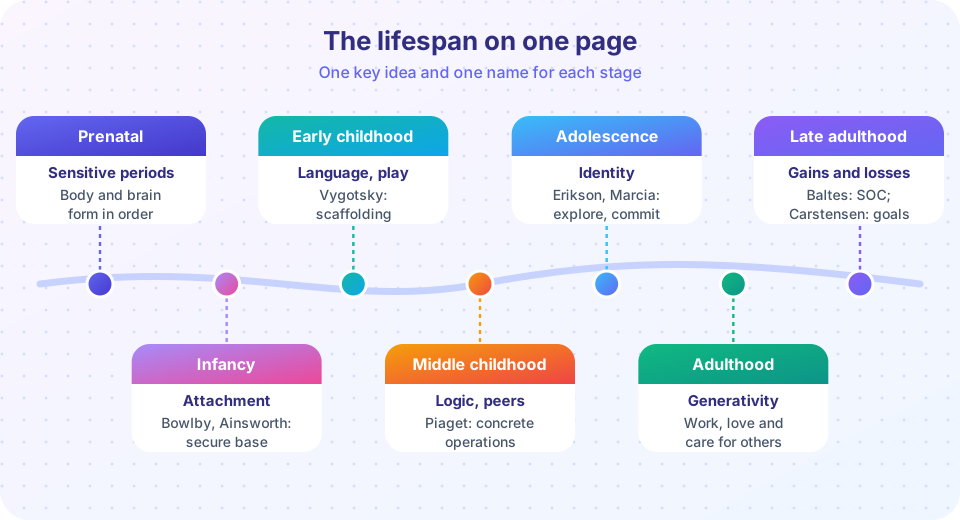
A one-page recap of developmental psychology from the prenatal period to late adulthood: a big lifespan picture, a stage table, key names and ten rules for reading claims.
This page compresses the course into one picture, one table and one list of rules. Print it, use it as a revision guide, or return to it when you meet a new claim about children or aging. Each stage has a short summary: what changes, who to remember and what to be careful about.
What you will learn
- A one-glance summary of the lifespan.
- The key names and findings for each stage.
- Ten rules for reading developmental claims.
Key terms
- Stage: a period with typical features. Stages are guides, and cultures draw them differently.
- Milestone: a skill most children gain within a typical age range.
- Sensitive period: a window of heightened responsiveness to experience.
- Plasticity: capacity to change with experience.
- Cohort: people born in the same era.
The stages in a table
| Stage | Typical ages | Main changes | Key names | Careful note |
|---|---|---|---|---|
| Prenatal | Conception to birth | Body and brain form in order; harmful substances (teratogens) matter most in sensitive windows | Many | Risk depends on timing and dose |
| Infancy | 0-2 | Senses tune in; attachment forms; sensorimotor thinking; babbling and first words | Bowlby, Ainsworth, Piaget | Patterns describe relationships; ages are guides |
| Early childhood | 2-6 | Language explodes; pretend play; temperament and self-regulation | Vygotsky, Chomsky, Tomasello, Thomas and Chess | Theories of language are blended; temperament is not destiny |
| Middle childhood | 6-12 | Logical thinking about concrete things; friendships; rule-based games; moral reasoning | Piaget, Kohlberg, Parten, Baumrind | Correlations in parenting research; culture matters |
| Adolescence | 12-18 | Puberty; abstract thinking; maturing brain; identity exploration; peers | Erikson, Marcia, Steinberg, Elkind | "Storm and stress" is overstated; brain "finishes at 25" is a slogan |
| Adulthood | 18-65 | Emerging adulthood; intimacy, work, parenting, generativity; average maturity of personality | Arnett, Erikson, Gottman, Harvard Study | Not universal; midlife crisis is not typical |
| Late adulthood | 65+ | Fluid abilities slow, knowledge holds; emotion goals shift; life review; grief | Baltes, Schaie, Carstensen, Stroebe and Schut | Large individual differences; wellbeing often good |
Ten rules for reading a claim
- Age is a guide, not a deadline. Ranges are wide.
- Ask who was studied. Many studies use wealthy Western samples.
- Correlation is not cause. Look for random assignment before accepting causal claims.
- Ask about size. Statistical significance is not the same as importance.
- Beware of slogans. "25", "30 million words", "five stages of grief" and "the marshmallow test" are all more complicated than they sound.
- Separate age from cohort. Cross-sectional comparisons mix them.
- Look for replication. One study is a lead, not a conclusion.
- Remember two-way influence. Children shape their parents as well as the reverse.
- Respect culture. The same behavior can mean different things in different places.
- Be kind about ethics. Behind each data point is a person, often a child.
Common misconceptions
- "Stages are rigid ladders." Real development overlaps, with advances and setbacks.
- "Early experience decides everything." Early experience matters, and later experience also changes the path.
- "Older adults are all alike." They are more varied than younger adults.
Try it
First, a stage lookup. Enter an age and see the stage and its key idea. It is a summary tool and not a screening tool.
Second, a self-quiz generator in code: it draws five random questions from a small bank each time. Run it a few times.
Press Run (or Ctrl + Enter) to see the console output here.
No output.
Check your understanding
Quick check · 4 questions
of 4 answered You scored / 4 · perfect!
-
1. Which rule helps you avoid being misled by a famous number such as the 30 million word gap?
Famous numbers often come from one small study and are more complicated than they sound. -
2. Why is a cross-sectional study of different ages tricky?
Older and younger groups also grew up in different times. -
3. Which statement about stages is best?
Stages are useful summaries of typical features, not strict boundaries. -
4. Which pair of name and idea is correct?
Ainsworth designed the Strange Situation; Kohlberg proposed moral stages.
Summary
- Each stage has typical changes, key names and cautions; the ranges are wide.
- Use the ten rules to read claims: ask who, how big, what design, and whether it was replicated.
- Beware slogans, respect culture, and remember that development is lifelong and plastic.
Next: Where to go next
Track your progress
Create a free account to tick off lessons and pick up where you left off on any device.
of Developmental Psychology lessons completed