


















Lesson 22 of 46 · Cognitive Development
Memory, Attention and Executive Function in Childhood
Learn the information-processing view of cognitive growth: working memory, memory strategies, metacognition, executive function, infantile amnesia and the marshmallow test replication.
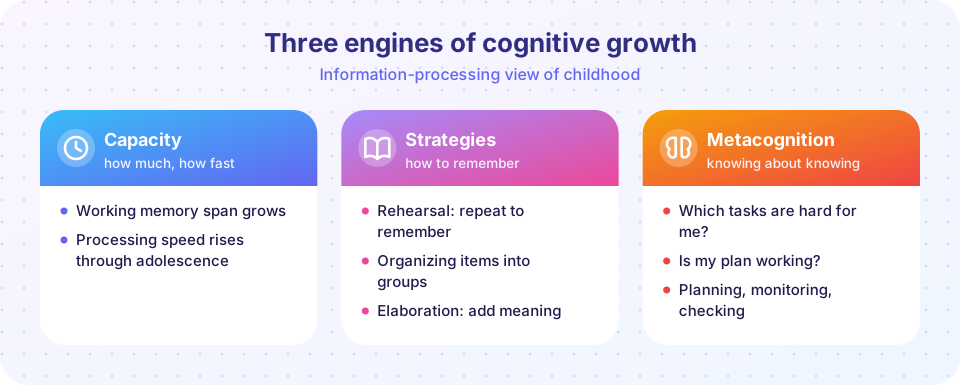
Ask a three-year-old to remember a list of five words and she may recall one or two. Ask a ten-year-old and she will recall more, but notice how: she mutters the words under her breath, groups them by meaning, and checks herself. Piaget described broad stages of thinking, but the information-processing approach asks a more mechanical question: what changes inside the system that takes in, holds and uses information? The answers (more capacity, more speed, better strategies, better self-control and more knowledge about one's own mind) explain a great deal of what we see.
What you will learn
- describe Baddeley's working-memory model and how capacity and speed change with age
- explain memory strategies (rehearsal, organization, elaboration) and when they appear
- define metacognition and executive function and give classic tasks
- explain infantile amnesia and children's suggestibility
- summarize what the marshmallow test replication taught us
Key terms
Working memory: the limited system that holds and manipulates information for a few seconds.
Memory strategy: a deliberate technique that improves remembering, such as rehearsal.
Metacognition: knowledge about, and monitoring of, one's own thinking.
Executive function: control processes such as inhibiting impulses, holding goals in mind and switching rules.
Infantile amnesia: the scarcity of adult memories from the first years of life.
Capacity and speed
In the 1970s Alan Baddeley and Graham Hitch proposed a model of working memory that has been widely used since. It has a phonological loop (holds sounds and words), a visuospatial sketchpad (images and locations), and a central executive that directs attention. A fourth part, the episodic buffer, was added in 2000. Working-memory capacity is often measured as digit span: how many digits a person can repeat back in order. Adults average about seven items (George Miller's famous "seven plus or minus two", 1956), though Nelson Cowan argues that the true limit is nearer four chunks. Span grows steadily through childhood, partly because children speak and rehearse more quickly and partly because they group items into chunks.
Speed of processing also changes: Robert Kail and others found that reaction times shrink rapidly through childhood and more slowly through adolescence, across many kinds of tasks. Faster processing leaves more resources for other operations, a reason why information-processing theorists often describe development as gradual, quantitative change.
Memory strategies
Strategies are the "software" of memory. John Flavell and colleagues (1966) showed pictures to children and watched their lips: five-year-olds rarely rehearsed, while by about ten most did, and rehearsing improved recall of early items in the list. Over middle childhood children add:
- Rehearsal: repeating items.
- Organization: grouping items into categories (animals, tools).
- Elaboration: linking items through an image or sentence.
- Use of external aids: notes and lists.
Children sometimes show a utilization deficiency (Patricia Miller, 1990): they begin using a new strategy before it improves their memory, because carrying it out takes up so much capacity. It starts to help only when practice makes it more automatic.
Metacognition
Metacognition includes knowing which tasks are hard, which strategies help, and whether you have learned something. Young children tend to overestimate their memory. In a study by Flavell, Friedrichs and Hoyt (1970), preschoolers predicted that they could remember all ten pictures, then recalled far fewer. With age, monitoring becomes more accurate, which enables children to study efficiently: spending more time on difficult material and testing themselves.
Attention and executive function
Attention develops from reflexive orienting in infancy to deliberate, sustained and selective attention in childhood. Executive functions are a related set of abilities that include inhibition (resisting an impulse), working memory and cognitive flexibility (switching between rules). They rely on the prefrontal cortex, which matures slowly, and they improve rapidly between ages 3 and 6, then more slowly into early adulthood.
Classic tasks illustrate this:
- Day-night Stroop. In the task by Gerstadt, Hong and Diamond (1994), children must say "day" when shown a picture of the moon and "night" for the sun. Three-and-a-half-year-olds find it very hard (they say what the picture is), whereas six- and seven-year-olds do well.
- Dimensional Change Card Sort (Philip Zelazo and colleagues): children sort cards by color, then are told to sort the same cards by shape. Three-year-olds usually keep sorting by color, even though they can state the new rule; most five-year-olds switch.
The marshmallow test
In 1972, Walter Mischel and colleagues offered preschoolers one treat now or two if they waited. Follow-ups reported that children who waited longer tended to have better outcomes in adolescence, and the finding became enormously famous. In 2018, Tyler Watts, Greg Duncan and Haonan Quan repeated the test with a larger and more diverse sample of about 900 children and found a correlation with later achievement that was about half as large, and that shrank further after accounting for family background and early cognitive ability. Celeste Kidd and colleagues (2013) found that children waited much less after an experimenter had proved unreliable, which suggests that waiting reflects trust and circumstances as well as self-control. The lesson: single dramatic results should be tested with diverse samples and controls.
Memory for personal events
Infantile amnesia, noted by Freud, is the fact that most adults recall almost nothing from before about age three, even though infants can remember. Carolyn Rovee-Collier showed that two- and three-month-olds who learn to kick to make a mobile move will kick again days later, especially with a reminder. Explanations include immature hippocampal and frontal circuits, the lack of a developed self-concept, and the lack of language to organize memories into stories. Parents who talk about the past in rich detail ("elaborative reminiscing") tend to have children with more detailed autobiographical memories.
Children are also suggestible: Stephen Ceci, Maggie Bruck and others reviewed research showing that preschoolers give accurate accounts when asked open, neutral questions, but are more likely to report events that never happened when interviews use leading questions, repeated questioning or social pressure. This is why forensic interviewers use carefully designed protocols.
Common misconceptions
"Children simply have worse memories than adults." They differ in capacity, strategies and knowledge, and children with expert knowledge (young chess experts, studied by Michelene Chi in 1978) can outperform novice adults on memory for chess positions.
"The marshmallow test predicts your whole future." The replication found modest associations, which largely reflected family and cognitive differences.
"Children who forget early childhood never had memories." Early memories exist but become inaccessible.
Try it
Press Run (or Ctrl + Enter) to see the result here.
Program input · what you'd type while the program runs
Type the answers before you press Run, one per line. Each time the program reads a line (with input()), it gets the next line from this box.
Check your understanding
Quick check · 5 questions
of 5 answered You scored / 5 · perfect!
-
1. Which component of Baddeley's model directs attention?
The central executive controls attention and coordinates the other components. -
2. What did Flavell, Beach and Chinsky (1966) find?
Older children rehearsed more, and rehearsal improved recall of early items. -
3. In the Dimensional Change Card Sort, a 3-year-old keeps sorting by color after being told to sort by shape. This illustrates a difficulty with...
Executive function skills, such as switching rules and inhibiting the earlier response, are still developing. -
4. What did the 2018 replication of the marshmallow test conclude?
A larger, more diverse sample found a weaker association, largely explained by background factors. -
5. A preschooler predicts she can remember all ten pictures but recalls only three. This shows limited...
Young children often overestimate their memory because monitoring is still developing.
Summary
- Working memory capacity and processing speed grow through childhood; strategies such as rehearsal, organization and elaboration appear gradually.
- Metacognition (knowing about one's own memory) and executive function (inhibition, working memory, flexibility) improve rapidly in the preschool years and continue to develop.
- Infantile amnesia, suggestibility and the marshmallow test replication show why we need careful, diverse evidence.
- Knowledge matters: children with expertise can remember better than adults without it.
Next: Theory of Mind
Track your progress
Create a free account to tick off lessons and pick up where you left off on any device.
of Developmental Psychology lessons completed