


















Lesson 21 of 46 · Cognitive Development
Vygotsky, the Zone of Proximal Development and Scaffolding
Understand Vygotsky's sociocultural theory: social origins of thought, cultural tools, the zone of proximal development, scaffolding, private speech, and how it compares with Piaget.
Imagine two eight-year-olds who both score the same on a puzzle when working alone. Give each a little help, a hint, a question, a demonstration. One child improves a great deal; the other hardly changes. Do the two children really have the same ability? The Russian psychologist Lev Vygotsky (1896-1934) said no. What a child can do with a good partner reveals abilities that are just emerging. That idea, and the picture of thinking as something that starts between people before it lives inside the head, gave developmental psychology a second great tradition next to Piaget's.
What you will learn
- explain Vygotsky's claim that higher mental functions start in social interaction
- define the zone of proximal development (ZPD) and scaffolding
- describe private speech and its path to inner speech
- compare Vygotsky's and Piaget's views
- evaluate the strengths and limits of sociocultural theory
Key terms
Sociocultural theory: the view that cognitive development is shaped by social interaction and cultural tools.
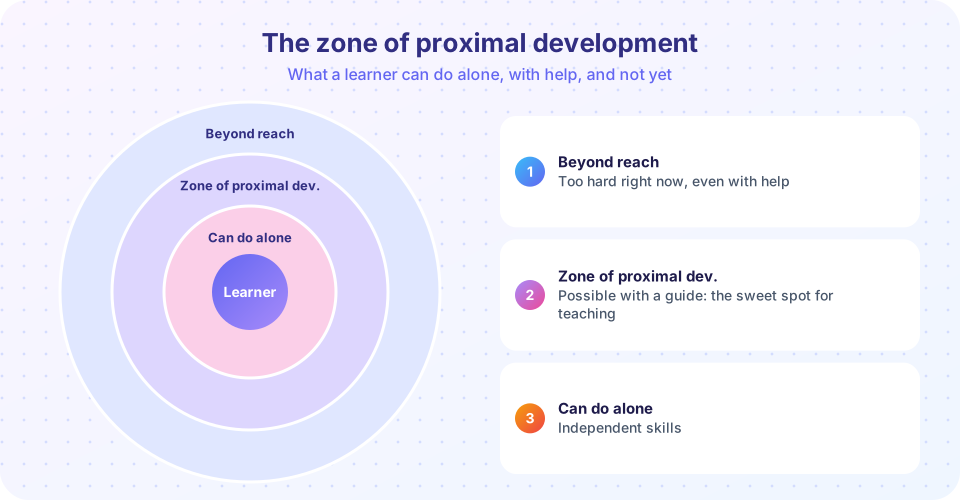
Zone of proximal development (ZPD): the range of tasks a learner cannot yet do alone but can do with help from a more skilled partner.
Scaffolding: temporary, adjustable support that helps a learner work within the ZPD, and that is withdrawn as skill grows.
Private speech: talk children direct to themselves to guide their actions; it becomes silent inner speech.
Cultural tools: the symbol systems and technologies a culture passes on, such as language, counting systems, writing and maps.
Vygotsky's big ideas
Vygotsky worked in the Soviet Union in the 1920s and 1930s and died of tuberculosis at 37. His work was suppressed for a time and reached English-speaking readers only after translations in the 1960s and 1970s (Thought and Language, Mind in Society), but it has since become one of the most influential in education.
- Higher mental functions have social origins. Every function appears twice, first between people, then inside the child. A parent counting with a toddler becomes, later, the child's own counting.
- Culture supplies the tools of thought. Language, number systems, writing and diagrams are tools that extend what minds can do, and different cultures provide different tools. Children do not reinvent these; they appropriate them through interaction.
- Language is central. First it is a means of communicating, and then it becomes a tool for thinking.
The zone of proximal development
Vygotsky distinguished two levels:
- the actual developmental level: what the child can do independently;
- the potential level: what she can do with guidance or in collaboration.
The gap between them is the ZPD. It is not a fixed property of a child; it depends on the task, on the partner and on the relationship. Teaching in the ZPD means aiming just beyond what the learner can do alone: too easy and nothing is learned, too hard and even help is not enough. This also explains why assessing children only on solo performance can hide their potential, and some researchers use dynamic assessment, testing with graduated help, to measure it.
Scaffolding
The term was coined by David Wood, Jerome Bruner and Gail Ross (1976), who watched tutors helping three- to five-year-olds assemble a wooden block pyramid. Good tutors did several things:
- recruited the child's interest;
- simplified the task by reducing the number of steps to manage;
- kept the child on track toward the goal;
- marked critical features of the task;
- managed frustration;
- demonstrated solutions when needed.
The essential point is contingency and fading: the tutor gave more help when the child struggled and less when the child succeeded, and withdrew support as skill grew. Scaffolding is the opposite of both doing the task for the child and leaving her alone. In classrooms, reciprocal teaching (Annemarie Palincsar and Ann Brown, 1984), in which teacher and students take turns leading discussion using summarizing, questioning, clarifying and predicting, is a well-studied scaffolded method.
Private speech
Preschoolers often talk to themselves while playing or solving problems ("Now the blue one... no, it doesn't fit"). Piaget called this egocentric speech, a sign of immature thought that fades. Vygotsky argued the opposite: private speech is thought becoming a tool for self-regulation. Research by Laura Berk and others has found that children use more private speech when tasks are difficult, and that those who use it tend to do better. Over the early school years it goes underground, from loud to whispered to silent inner speech, the voice in our heads when we plan and reason.
Guided participation and culture
Barbara Rogoff extended Vygotsky's ideas through cross-cultural work on guided participation: children learn by taking part in everyday activities with more skilled people, such as cooking, weaving or caring for infants. Communities differ in how much they use verbal explanation compared with observation and gradual involvement. This reminds researchers that teaching styles that look natural in one society may be unusual in another.
Piaget and Vygotsky compared
| Question | Piaget | Vygotsky |
|---|---|---|
| Source of development | Child's own actions and exploration | Social interaction and cultural tools |
| Role of language | Reflects thought | Shapes thought |
| Role of teachers and peers | Create cognitive conflict | Guide within the ZPD |
| Private speech | Egocentric, fades | Self-guidance, becomes inner speech |
| Stages | Universal sequence | Less emphasis; culture varies |
| Educational idea | Discovery, readiness | Guided learning, scaffolding |
Modern views combine them: children construct understanding actively, within social and cultural settings that provide tools and help.
Evidence and limits
Support includes studies showing that children learn more from guided than from unguided practice, evidence for scaffolding in parent-child interaction, and links between private speech and task success. Classroom programs built on Vygotskian ideas, such as the "Tools of the Mind" curriculum, have been evaluated with mixed results: some studies found benefits for self-regulation, while larger evaluations found small or no effects.
Critics note that the theory is more a perspective than a precise, testable model: it does not specify exactly how interaction becomes internal thought. It also gives less weight to biology and individual differences, and "ZPD" can be hard to measure objectively.
Common misconceptions
"Scaffolding means giving children answers." Good scaffolding gives just enough help and then fades.
"The ZPD is a fixed number for each child." It depends on the task, the helper and the context.
"Vygotsky says biology does not matter." He studied both natural and cultural lines of development, though his emphasis was on the cultural.
Try it
Press Run (or Ctrl + Enter) to see the result here.
Program input · what you'd type while the program runs
Type the answers before you press Run, one per line. Each time the program reads a line (with input()), it gets the next line from this box.
Press Run (or Ctrl + Enter) to see the console output here.
No output.
Check your understanding
Quick check · 5 questions
of 5 answered You scored / 5 · perfect!
-
1. What is the zone of proximal development?
The ZPD lies between independent performance and what is still out of reach. -
2. Which tutoring behavior best fits scaffolding?
Contingent support that is withdrawn as skill grows is the defining feature. -
3. How did Vygotsky interpret children's private speech?
He saw it as thought becoming a tool for planning and regulating behavior. -
4. Which pairing correctly contrasts Piaget and Vygotsky?
That is the central contrast, though modern accounts combine the two. -
5. In the toy model, why did fixed heavy help stall short of the task's difficulty?
In the model, learning is fastest when success is uncertain; constant help made success too easy for further growth.
Summary
- Vygotsky argued that thinking starts between people and uses cultural tools, above all language.
- The ZPD is the band of tasks a learner can do with help but not yet alone; teaching works best there.
- Scaffolding is contingent help that fades. Private speech turns into inner speech.
- Piaget emphasized the child's own exploration; Vygotsky emphasized interaction and culture; modern views combine both.
- Sociocultural theory is influential but less precise than one would like, and classroom programs show mixed evidence.
Next: Memory and Attention
Track your progress
Create a free account to tick off lessons and pick up where you left off on any device.
of Developmental Psychology lessons completed