


















Lesson 15 of 46 · Prenatal Development and Infancy
The Newborn: Reflexes, Senses and States
Discover what newborns can do: reflexes, the Apgar score, vision, hearing, taste and smell, sleep and crying, plus which famous infant findings have been debated.
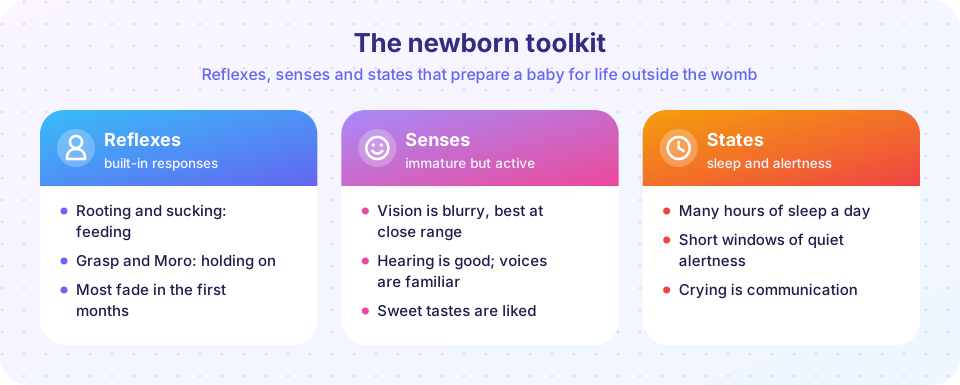
A newborn seems helpless, but she arrives equipped. Within minutes she may turn toward a voice, grip a finger, and search for a nipple. Her vision is blurry and her control of her body is minimal, yet her ears, nose and mouth are already attuned to the people who will care for her. This lesson describes the newborn's toolkit, and it also tells the story of some famous findings that have been challenged, a reminder that studying infants is hard.
Educational information only. This lesson describes typical newborn development. It is not medical advice. A pediatrician or midwife can answer questions about any particular baby.
What you will learn
- list the main newborn reflexes, their purposes and when they usually fade
- explain the Apgar score
- describe the newborn's vision, hearing, taste, smell and touch
- describe the states of arousal, sleep and crying
- evaluate famous findings on imitation and cross-modal matching
Key terms
Neonate: a newborn, from birth to about one month.
Reflex: an automatic, involuntary response to a specific stimulus.
Visual acuity: sharpness of vision.
Intermodal perception: combining information from different senses.
State of arousal: a recognizable level of alertness, from deep sleep to crying.
Reflexes
Reflexes protect the baby and help with early survival. Most are controlled by the brainstem and spinal cord, and they fade as the cortex takes over voluntary control. The ages below are typical, not exact.
| Reflex | What it looks like | Purpose | Typically fades |
|---|---|---|---|
| Rooting | Cheek stroked: turns head and opens mouth | Finding food | About 4 months (becomes voluntary) |
| Sucking | Object touches the mouth: sucks | Feeding | Becomes voluntary |
| Moro (startle) | Sudden drop or noise: arms spread, then pull in | Possibly clinging to the caregiver | About 3 to 6 months |
| Palmar grasp | Finger in the palm: fist closes | Holding on | About 5 to 6 months |
| Babinski | Sole stroked: toes fan out | Neurological sign | About 12 months or later |
| Stepping | Held upright with feet on a surface: alternating stepping | Possible forerunner of walking | About 2 months (see next lesson) |
Pediatricians test reflexes as one sign that the nervous system is working normally.
The Apgar score
In 1952 the American anesthesiologist Virginia Apgar devised a quick check of newborns. At 1 and 5 minutes after birth, a clinician scores five signs from 0 to 2 each: Appearance (skin color), Pulse (heart rate), Grimace (reflex response), Activity (muscle tone) and Respiration. The total, from 0 to 10, guides immediate care. A score of 7 to 10 is generally reassuring; lower scores mean the baby may need help with breathing or warming. The Apgar score is a snapshot of the first minutes, not a predictor of a child's later intelligence.
Senses
Vision
Newborn vision is the weakest sense. Acuity is very roughly one-twentieth of an adult's, and a newborn focuses best on objects about 20 to 30 centimeters (8 to 12 inches) away, which happens to be the distance to a caregiver's face during feeding. Newborns prefer high contrast, patterns and moving objects. Colour vision develops over the first few months, and acuity improves steadily through the first year and beyond.
Face perception has been debated. Mark Johnson and John Morton proposed in 1991 that newborns have a simple built-in preference for face-like arrangements, with experience then refining it. Studies show newborns tracking face-like patterns longer than scrambled patterns, though some researchers argue that the preference reflects general features such as top-heavy patterns instead of "faces" as such.
Hearing
Hearing is well developed at birth. Newborns turn toward sounds and prefer human speech to other sounds. They also prefer their mother's voice, as DeCasper and Fifer showed in 1980. Peter Eimas and colleagues (1971) used high-amplitude sucking to show that one-month-old infants can distinguish speech sounds such as /ba/ and /pa/, and, in the first months, infants can tell apart sounds from many languages, an ability that narrows as they focus on the sounds of their own language (see the later chapter on language).
Taste, smell and touch
Jacob Steiner photographed newborn facial expressions in the 1970s: sweet tastes brought relaxed, sometimes smile-like faces; sour and bitter tastes brought grimaces. Newborns can also recognize familiar smells: in a classic study by Aidan Macfarlane (1975), six-day-old breast-fed babies turned toward a breast pad worn by their own mother more than one worn by another woman. Touch is vital; premature infants who receive gentle touch or skin-to-skin contact tend to gain weight and thrive better.
Sleep, alertness and crying
Peter Wolff described six states of arousal: regular sleep, irregular sleep, drowsiness, quiet alertness, active alertness and crying. Newborns sleep many hours a day, often 14 to 17, in short stretches spread across day and night, and only a small part of the day is spent in quiet alertness, the state in which they are most receptive. Crying is their main way to signal needs. It typically increases until about six weeks and then declines over the following months. Responsive caregiving does not "spoil" babies; it supports attachment and later self-regulation.
Public-health campaigns advising caregivers to place babies on their backs to sleep, starting in the 1990s, were followed by a big drop in sudden infant death syndrome (SIDS) in many countries. Caregivers should follow their local health authority's current advice.
Debated discoveries
Science advances partly by testing claims again. Two famous infant findings illustrate this.
Neonatal imitation. Andrew Meltzoff and M. Keith Moore (1977) reported that infants only days old stuck out their tongues and opened their mouths in response to adult models, suggesting an innate ability to match others' actions. In 2016 Janine Oostenbroek and colleagues tested 106 infants repeatedly across their first two months, with many different gestures, and found no evidence of imitation. The debate continues, and the original result is now treated cautiously.
Intermodal matching. Meltzoff and Richard Borton (1979) reported that 29-day-old infants who had sucked on a pacifier with a particular shape, without seeing it, looked longer at a visual match. A later attempt by Daphne Maurer and colleagues (1999) did not replicate the result. Infants do combine senses (they look toward a sound's source), but the strong claim of early "shape matching" is uncertain.
The visual cliff experiment of Eleanor Gibson and Richard Walk (1960) is a third classic. Babies aged six to 14 months, placed on a glass-covered table that appeared to drop away, mostly would not crawl onto the "deep" side. Later work with heart-rate measures found that younger, non-crawling infants showed interest rather than fear, and that wariness of drops increases with crawling experience, so depth perception comes first and fear comes later.
Common misconceptions
"Newborns see nothing." They see, though with low acuity, best at close range and for bold patterns.
"Newborns can imitate expressions." This was widely taught, but a large later study failed to find it. Treat it as unproven.
"Crying means something is wrong." Crying is normal communication. Caregivers' responses matter, and parents worried about excessive crying or feeding should consult a professional.
Try it
Press Run (or Ctrl + Enter) to see the result here.
Program input · what you'd type while the program runs
Type the answers before you press Run, one per line. Each time the program reads a line (with input()), it gets the next line from this box.
Check your understanding
Quick check · 5 questions
of 5 answered You scored / 5 · perfect!
-
1. What does the Apgar score assess?
It is a quick check of appearance, pulse, grimace, activity and respiration to guide immediate care. -
2. Roughly how far away does a newborn see best?
Roughly the distance to a caregiver's face during feeding. -
3. Which reflex involves turning the head and opening the mouth when the cheek is stroked?
Rooting helps the baby find the nipple. -
4. What did Oostenbroek and colleagues (2016) conclude about neonatal imitation?
Their large study challenged the classic result, so the claim should be treated as unsettled. -
5. In the visual cliff studies, what did later heart-rate work suggest about young, non-crawling infants?
Fear of drops seems to grow with crawling experience, after depth perception is in place.
Summary
- Newborns have protective reflexes that fade as voluntary control grows; Apgar scoring is a quick check of newborn condition.
- Vision is blurry but tuned to faces and contrast at close range; hearing, smell and taste are well developed and favor familiar voices and smells.
- Sleep dominates the day and crying peaks around six weeks; responsive caregiving is supportive.
- Some celebrated findings (neonatal imitation, intermodal matching) are disputed, a lesson in reading infant research critically.
Track your progress
Create a free account to tick off lessons and pick up where you left off on any device.
of Developmental Psychology lessons completed