


















Lesson 38 of 46 · Aging and Lifespan Perspectives
Chapter overview: aging and the lifespan perspective
Meet the lifespan view of development: Baltes's principles, the selection, optimization and compensation model, and how ageism and diversity shape later life.
Humans are living longer than ever. Across the world, average life expectancy has more than doubled since 1900, and in many countries a growing share of the population is over 65. That makes the psychology of later life one of the most important topics of this century. It also raises a basic question: what is aging? Is it only decline, or is it also growth?
This chapter looks at later life through the lifespan perspective, an approach that sees development as a process lasting from conception to death. We examine what happens to thinking and the brain, how emotions and goals change, and how people face the end of life and loss. First, this overview introduces the lifespan perspective and a model of successful aging.
What you will learn
- The main principles of the lifespan perspective (Baltes).
- Why development always includes both gains and losses.
- The SOC model: selection, optimization and compensation.
- How ageism and diversity affect what we think we know about aging.
Key terms
- Lifespan perspective: the view that development continues across the whole of life and has many directions.
- Plasticity: the capacity to change in response to experience, which continues in old age.
- Multidirectionality: some abilities rise while others fall at the same time.
- Ageism: stereotypes or discrimination based on age.
- Young-old, old-old, oldest-old: informal labels for roughly 65 to 74, 75 to 84, and 85 and older; they are used by researchers but are only rough guides.
The lifespan perspective
Paul Baltes (1987) summarized the approach in several principles:
- Development is lifelong. No single age is "the" key period.
- It is multidirectional. Vocabulary may grow for decades while reaction speed slows.
- It involves gains and losses at every age. A child gains reading but gives up some flexible learning of sounds; an older adult may lose speed but gain wisdom and perspective.
- It is plastic. Practice, health and environment change the course, even late in life.
- It is shaped by context. History, culture and personal circumstances matter, and people of the same age (a cohort) share unique experiences.
A useful ratio emerges from the principles: the balance of gains to losses changes across life. In childhood gains far outweigh losses. In very old age losses tend to increase. The mission of aging well is to maximize gains and minimize losses with the resources available.
Selection, optimization and compensation
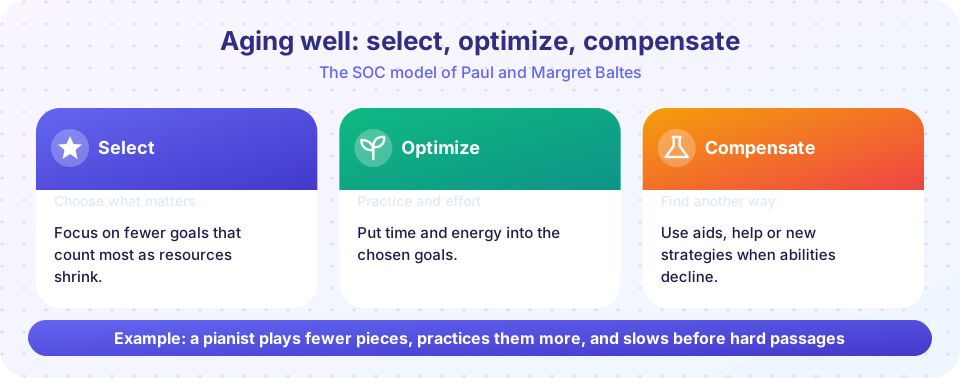
Paul and Margret Baltes proposed the SOC model as a strategy for successful aging at any age, but it becomes especially relevant when resources shrink.
- Selection: choose fewer, more important goals.
- Optimization: invest time and effort in those goals to get better at them.
- Compensation: use aids, help or new methods when an ability declines.
A classic example is the pianist Arthur Rubinstein, who in old age said he played fewer pieces (selection), practiced them more (optimization) and slowed before fast passages so that the faster ones sounded quicker by contrast (compensation). It is a famous illustration, and SOC has since been studied in many ordinary settings, such as work, driving and housekeeping.
Lifespan view
SOC
Not all alike
Older adults differ more from one another than young adults do.
Ageism and diversity
Older adults are a very diverse group. A fit 80-year-old marathon runner and a frail 65-year-old are both "old". Ageism, stereotypes that older people are slow, forgetful or unproductive, can harm people. In experiments, reminding older adults of negative stereotypes about aging has been shown in some studies to worsen their memory performance, and positive images appear to help. Some of these stereotype-threat results have been hard to replicate in every setting, so treat the size of the effect with caution. Attitudes to age also differ among cultures, with some placing more value on elders' status.
Another source of confusion is the cohort. People born in different years had different education, nutrition, health care and technology. When you compare a 70-year-old with a 20-year-old today, you compare both age and cohort. You will see in the next lesson why this matters for studies of aging.
What is in this chapter
- Cognition and the brain: fluid and crystallized abilities, the Seattle Longitudinal Study, and normal aging versus dementia.
- Wellbeing, emotion and death: socioemotional selectivity, the positivity effect, Erikson's final stage, and grief.
- Chapter review: one picture and a mixed quiz.
Common misconceptions
- "Old age is a long decline." Some abilities decline and others hold or improve.
- "Older people are unhappy." Many surveys find stable or higher emotional wellbeing in later life.
- "You cannot learn new things when old." Plasticity continues, although learning may take longer.
Try it
First, a plot of the lifespan idea: the balance of gains and losses changes across life. The curves are a schematic of Baltes's argument and not measured data.
Press Run (or Ctrl + Enter) to see the result here.
Program input · what you'd type while the program runs
Type the answers before you press Run, one per line. Each time the program reads a line (with input()), it gets the next line from this box.
Second, a SOC planner. As the resource level drops, the planner keeps fewer goals but puts more effort into each, which is the idea of selection and optimization. It is an illustration with invented numbers.
Check your understanding
Quick check · 4 questions
of 4 answered You scored / 4 · perfect!
-
1. Which principle of the lifespan perspective says that some abilities rise while others fall at the same time?
Development has many directions, so gains and losses occur together. -
2. In the SOC model, what does compensation mean?
Compensation replaces a lost means of achieving a goal with another. -
3. Why is comparing a 70-year-old today with a 20-year-old today tricky?
Cohort differences in education, health and technology can mix with age differences. -
4. Which of these best describes the lifespan perspective?
That is Baltes's summary.
Summary
- The lifespan perspective sees development as lifelong, multidirectional, plastic and context-dependent.
- Gains and losses coexist at every age, though the balance changes.
- SOC (selection, optimization, compensation) is a strategy for adapting as resources change.
- Ageism, diversity and cohort differences complicate what we think we know about aging.
Track your progress
Create a free account to tick off lessons and pick up where you left off on any device.
of Developmental Psychology lessons completed