


















Lesson 20 of 46 · Cognitive Development
Evaluating Piaget: What Held Up and What Did Not
Weigh Piaget's theory against seventy years of evidence: infant core knowledge, task wording, overlapping waves, décalage, cultural limits of formal thought and Piaget's legacy.
A great theory does two things: it explains a lot, and it invites tests that can show where it is wrong. Piaget's theory has done both. Seventy years of research have confirmed some of his observations and overturned others. Infants know more than he thought; young children are cleverer than his tasks suggest; stages are blurrier than the neat staircase in textbooks. Yet his central picture of the child as an active builder of understanding is now close to a consensus. This lesson sorts the verdict into what held up, what was revised and what is still argued about.
What you will learn
- summarize the strongest evidence for and against Piaget's claims
- explain how task wording and design can change children's performance
- describe the overlapping-waves and décalage criticisms of stages
- describe core knowledge theory and the debate over infant looking-time studies
- explain Piaget's legacy for education
Key terms
Core knowledge: the proposal (Spelke) that infants are born with a few specialized systems for understanding objects, number, space, actions and social partners.
Décalage: unevenness in a child's performance across tasks that should reflect the same stage.
Overlapping waves: Robert Siegler's model in which children use several strategies at once, with the mix changing gradually.
Neo-Piagetian theory: later theories that keep Piaget's emphasis on stages while adding information-processing limits.
What held up
- Children are active learners. The idea that children construct understanding, rather than just absorbing information, is now standard in psychology and education.
- The order of many achievements. Object permanence, symbolic play, conservation and abstract reasoning do generally emerge in the order Piaget described.
- Errors are informative. His clinical interview, asking children to explain their reasoning, remains a tool in education research.
- Qualitative change is real in some domains, such as the shift from reasoning about concrete cases to abstract ones.
What was revised
1. Infants know more than Piaget thought
Piaget inferred young infants' understanding from their reaching. But infants can look before they can reach. In violation-of-expectation studies (see Studying Babies and Research Ethics), Renée Baillargeon and colleagues found that infants of about 3.5 to 5 months looked longer at an impossible event, such as a screen rotating through a hidden box, as though they expected the box to remain. Karen Wynn (1992) reported that five-month-olds looked longer when one doll plus another doll appeared to equal one or three dolls rather than two, suggesting early number sense. Later work also shows that A-not-B errors depend on factors such as delay, posture and how many times the child has reached to A (Esther Thelen, Linda Smith and colleagues, 1999), pointing to many reasons behind the error beyond a lack of permanence.
2. Preschoolers can do more when the task is simpler
- Perspective taking. Martin Hughes (1975) asked children aged about 3.5 to 5 to hide a doll from a toy policeman in a model with intersecting walls. The great majority succeeded, though the same age group failed the three mountains task. Margaret Donaldson (1978) argued that the policeman task makes human sense: children understand hiding and being seen, but a model of mountains is meaningless to them.
- Conservation. James McGarrigle and Donaldson (1974) used a "naughty teddy" who messed up the objects by accident. More children gave the correct answer when the change seemed accidental than when the adult deliberately rearranged items, because the repeated question made children think the first answer had been wrong.
- Number. Rochel Gelman showed that preschoolers conserve small numbers.
The lesson is that performance depends on wording, motivation and familiarity as well as on underlying competence, and that Piaget's tasks sometimes underestimated children.
3. Stages are less sharp than the staircase suggests
Piaget himself noted décalage: a child may conserve number at 6 or 7, mass at 7 or 8, weight at about 9 to 10 and volume at 11 or 12. If thinking changed globally at a stage boundary, all conservation tasks would be mastered together. Robert Siegler's overlapping waves model proposes that children use multiple strategies at any age, with new ones gradually becoming more frequent and old ones fading, making change look gradual and variable. The two TryIt demonstrations below show both ideas.
4. Formal operations are neither universal nor all-purpose
Studies in many societies find that formal operational reasoning is not reached by all adults, and that it depends strongly on schooling and on the domain: a mechanic may reason formally about engines but not about biology. In 1972 Piaget himself acknowledged that formal thinking may appear mainly in areas of one's own expertise.
What remains debated
Core knowledge. Elizabeth Spelke argues that infants are born with core systems for objects, number, space, actions and social partners, which later learning enriches. Critics reply that looking-time results can be explained by low-level perceptual preferences or by rapid learning in the first months, and that some key results (such as infants' arithmetic) have been replicated inconsistently. The question of how much is innate remains open. Linda Smith and Thelen's dynamic-systems approach, for example, argues that behavior emerges from real-time interaction between body, task and context rather than from stored knowledge.
What looking time means. As the previous lesson showed, longer looking can reflect surprise, interest, or perceptual features, so large replication projects are testing these claims.
The role of culture and schooling. Piaget focused on the individual child exploring objects. Vygotsky and cross-cultural researchers stress the role of social partners and cultural tools, the topic of the next lesson. Alison Gopnik and others describe children as intuitive scientists who build "theories" of the world, an idea that revives Piaget's picture with a modern emphasis on probabilistic learning.
Piaget's legacy
Neo-Piagetian theorists such as Robbie Case and Kurt Fischer kept the stage idea but tied it to working memory capacity and to the skills available in each domain. In classrooms, Piaget's influence shows in hands-on science, concrete materials in early mathematics and teaching that pays attention to how children think. A balanced summary: Piaget got the big picture of an active child roughly right, underestimated what babies and preschoolers can do, and overestimated how neat and universal the stages are.
Common misconceptions
"Piaget has been disproved." Many specific claims were revised, but his central insights are widely accepted.
"Infants have been proven to understand physics and arithmetic." The looking-time evidence is suggestive, and its interpretation is disputed.
"If a child fails a task, she lacks the concept." Failure can reflect wording, memory, attention or motivation.
Try it
Press Run (or Ctrl + Enter) to see the result here.
Program input · what you'd type while the program runs
Type the answers before you press Run, one per line. Each time the program reads a line (with input()), it gets the next line from this box.
Press Run (or Ctrl + Enter) to see the result here.
Program input · what you'd type while the program runs
Type the answers before you press Run, one per line. Each time the program reads a line (with input()), it gets the next line from this box.
Check your understanding
Quick check · 5 questions
of 5 answered You scored / 5 · perfect!
-
1. What did Hughes' policeman doll task suggest about the three mountains task?
Most 3.5 to 5-year-olds succeeded in the policeman task, which is more meaningful to children. -
2. What did McGarrigle and Donaldson's 'naughty teddy' study find?
Task context and the pragmatics of being asked twice affect children's answers. -
3. What does 'décalage' describe?
A child can conserve number before volume, so stage-wide jumps are less sharp than the theory suggests. -
4. Which is the core knowledge claim?
Spelke's proposal; critics argue that early learning and perceptual factors explain some results. -
5. Which best summarizes the overall verdict on Piaget?
His central insights endure while specific claims were revised.
Summary
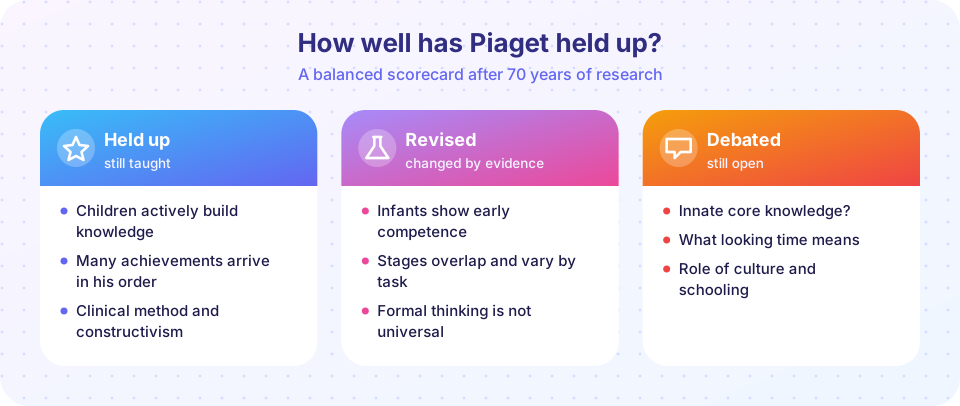
- Held up: active construction of knowledge, many orderings of achievements, the value of children's errors.
- Revised: infants and preschoolers are more capable than Piaget's tasks suggested; stages overlap; formal thought depends on schooling and domain.
- Debated: how much is innate, what looking time means, and the role of culture.
- Legacy: constructivist teaching, neo-Piagetian theories and the child-as-scientist view.
Next: Vygotsky and Scaffolding
Track your progress
Create a free account to tick off lessons and pick up where you left off on any device.
of Developmental Psychology lessons completed