


















Lesson 31 of 46 · Social and Emotional Development
Emotion and temperament: how children feel and learn to self-regulate
Explore Thomas and Chess's temperament types, Kagan's behavioral inhibition, goodness of fit, and how children learn self-control, with the marshmallow and Dunedin studies.
Two babies lie in the same crib with the same caregiver. One sleeps on a schedule, smiles at strangers and shrugs off a loud noise. The other wakes often, reacts strongly to every change and cries for a long time. Parents of more than one child will say that children are different from day one, and research agrees. These early differences in mood, activity and reactivity are called temperament.
Temperament is the raw material. What happens next depends on how children and their environments interact, and on how children learn to manage their feelings, a skill called emotion regulation. This lesson covers the major temperament studies, the idea of goodness of fit, and what research says about self-control, including a famous study that turned out to be more complicated than the headlines.
What you will learn
- The three temperament types described by Thomas and Chess and the idea of goodness of fit.
- What Kagan's behavioral inhibition research found.
- How emotion regulation and self-control develop.
- What the marshmallow and Dunedin studies show, with their limits.
Key terms
- Temperament: biologically based differences in emotional reactivity and self-regulation that appear early.
- Goodness of fit: how well a child's temperament matches the demands of the environment.
- Behavioral inhibition: a tendency to react to new people and situations with caution and distress.
- Effortful control: the ability to focus attention and override an impulse to do something else.
- Delay of gratification: waiting for a bigger reward instead of taking a smaller one now.
Thomas and Chess: easy, difficult and slow to warm up
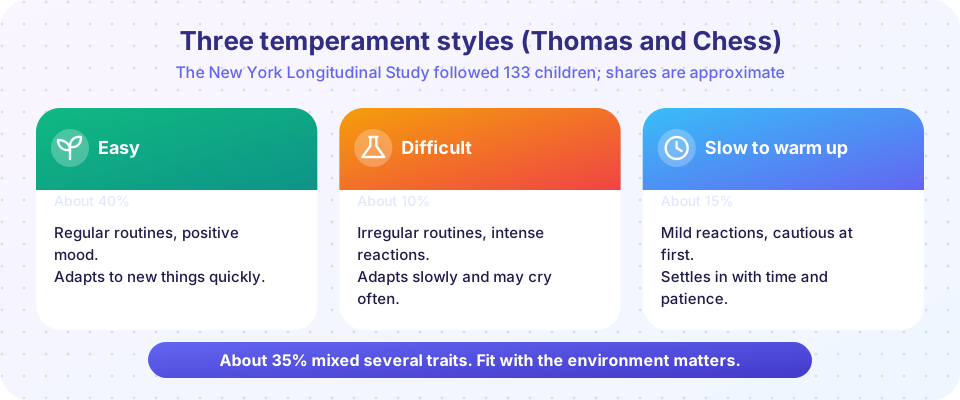
In 1956 psychiatrists Alexander Thomas and Stella Chess began the New York Longitudinal Study, following 133 children from infancy into adulthood. From parent interviews they rated nine dimensions, including activity level, regularity of sleeping and eating, mood, intensity of reactions and how children approached new things.
Combining the ratings gave three common patterns:
- Easy children (about 40 percent): regular routines, positive mood, adapt quickly.
- Difficult children (about 10 percent): irregular routines, intense reactions, slow to adapt, frequent negative mood.
- Slow-to-warm-up children (about 15 percent): mild reactions, cautious at first, adapt gradually with time.
About 35 percent did not fit one pattern neatly. The percentages are approximate and come from a sample of mostly middle-class New York families, so they are not world averages.
The most lasting idea of the study is goodness of fit. No temperament is good or bad in itself. A very active child may thrive on a farm and struggle in a rigidly quiet classroom. A cautious child may do well when adults give time to adjust, and poorly when pushed into new situations quickly. Parents who understand a child's temperament can adjust expectations and routines.
Another way to describe it: Rothbart's dimensions
Mary Rothbart and colleagues suggested three broad dimensions that are easier to measure across ages:
- Surgency or extraversion: activity, enthusiasm, sociability.
- Negative affectivity: frequency of fear, anger and sadness.
- Effortful control: focusing attention and inhibiting impulses, which grows rapidly in the preschool years.
Effortful control is especially interesting because it links temperament to self-regulation and school adjustment.
Kagan and behavioral inhibition
Jerome Kagan and colleagues observed infants at four months as they saw new toys, mobiles and smells. A group of about 20 percent were high-reactive: they thrashed, arched and cried. Followed over the years, many (but not all) of these children grew into cautious, shy toddlers and children, often showing a high level of arousal in the amygdala, a brain region linked to fear. Kagan suggested that some of this temperament has a biological basis.
Importantly, the story is not destiny. Many high-reactive infants did not become shy, and supportive parenting that gently exposes a cautious child to new situations can reduce fearfulness. Temperament sets a tendency, not a script.
Emotion regulation: from caregiver to self
Babies cannot calm themselves. They rely on rocking, feeding, soothing talk and other caregiver actions, called co-regulation. Gradually children take over: toddlers look away from something upsetting, preschoolers distract themselves, and school-age children use thoughts ("it is only a game") to manage disappointment.
Parents play a part. Studies by John Gottman and colleagues suggest that "emotion coaching" is linked to better regulation. This means noticing feelings, naming them and helping a child solve the problem, instead of dismissing the feelings or punishing them. As with most parenting research, such links are correlations, and children also shape their parents' behavior.
Understanding emotions develops too. Three-year-olds can say that someone is happy or sad. Preschoolers begin to understand that people can feel different things about the same event. By middle childhood children understand mixed feelings, such as being nervous and excited at once. Display rules, learned from culture and family, teach children when to show and when to hide feelings, such as smiling politely at an unwanted gift.
The marshmallow test and what happened next
In the late 1960s and early 1970s, Walter Mischel and colleagues offered preschoolers at Stanford a choice: eat one treat now, or wait while the experimenter leaves the room and get two. Children who found ways to distract themselves, such as covering their eyes, singing, or thinking of the treat as a picture, waited longer. Follow-up studies reported that children who waited longer had higher test scores and other advantages as adolescents.
The result became famous, and the popular summary became "wait for the marshmallow and you will succeed". That is far too simple. In 2018 Tyler Watts, Greg Duncan and Haonan Quan studied a much larger and more varied sample. They found that the link between waiting time and later achievement was roughly half as large as in earlier reports and shrank further once family background and early cognitive ability were taken into account. Other studies show that children's choices also depend on whether they trust that the adult will keep a promise. A child whose experience says that promises are broken may sensibly take the treat now.
Self-control and later life: the Dunedin study
A stronger source is the Dunedin Multidisciplinary Health and Development Study in New Zealand, which followed about 1,000 people born in 1972 to 1973. In 2011 Terrie Moffitt, Avshalom Caspi and colleagues reported that childhood self-control, measured from ages three to eleven by parents, teachers and the children themselves, predicted adult physical health, money problems and criminal convictions decades later. The link held even after taking into account intelligence and family social class. Children's self-control also differed within families: siblings with lower self-control did worse as adults than their better self-controlled brothers and sisters.
This is an observational study, so it cannot prove that improving self-control would change outcomes, but it shows that early self-regulation is a strong signal. Programs that teach attention and emotion skills in childhood are being tested.
Common misconceptions
- "A difficult baby is the result of bad parenting." Temperament is partly inborn. Parenting affects how it develops, but did not create it.
- "Shy babies become shy adults." Many do not. Experience can change the path.
- "The marshmallow test proves self-control determines success." The best evidence is more modest, and context and trust affect the results.
- "Temperament is the same as personality." Temperament is the early foundation. Personality includes learned habits and beliefs and develops over a lifetime.
Try it
First, plot the New York Longitudinal Study shares. The numbers are the commonly reported approximate percentages.
Press Run (or Ctrl + Enter) to see the result here.
Program input · what you'd type while the program runs
Type the answers before you press Run, one per line. Each time the program reads a line (with input()), it gets the next line from this box.
Second, a temperament profile demo. Move the sliders to describe an imaginary child and see how the description changes. It is a demonstration of the three Rothbart dimensions, never a test of a real child.
Third, a goodness-of-fit table in code. Change the numbers to see how fit changes.
Press Run (or Ctrl + Enter) to see the console output here.
No output.
Check your understanding
Quick check · 5 questions
of 5 answered You scored / 5 · perfect!
-
1. What does goodness of fit mean?
No temperament is good or bad in itself. What matters is the match with the setting. -
2. About what share of children in the New York Longitudinal Study were classed as difficult?
Roughly 40 percent easy, 10 percent difficult, 15 percent slow to warm up and the rest mixed. -
3. What did Kagan find about high-reactive infants?
Temperament sets tendencies, not destiny. -
4. Why is the marshmallow test now seen as more complicated?
Watts, Duncan and Quan (2018) reported about half the earlier link, much reduced by controls. -
5. Which finding comes from the Dunedin study?
Moffitt and colleagues (2011) found these associations, even after accounting for intelligence and social class.
Summary
- Temperament means early, partly inborn differences in reactivity and regulation.
- Thomas and Chess described easy, difficult and slow-to-warm-up children and stressed goodness of fit.
- Kagan found that high-reactive infants often became cautious, but environment can change this.
- Self-regulation moves from caregiver soothing to self-control; emotion coaching is linked to better regulation.
- The marshmallow test is weaker evidence than popular accounts suggest; the Dunedin study provides stronger support for the importance of childhood self-control.
Track your progress
Create a free account to tick off lessons and pick up where you left off on any device.
of Developmental Psychology lessons completed