


















Lesson 36 of 46 · Adolescence and Adulthood
Emerging adulthood, work and family: development in the adult years
Explore Arnett's emerging adulthood, Erikson's intimacy and generativity, what long studies say about relationships, the midlife crisis myth and how personality changes.
Many people picture development as something that ends when you turn 18 or finish school. In fact, adulthood has its own changes: new jobs, relationships, parenthood, caring for aging parents, shifts in goals and slow changes in personality. Researchers who study adults often follow the same people for decades to see what really changes and what only seems to.
This lesson starts with the stretch between 18 and 29 that some call emerging adulthood, then looks at Erikson's adult challenges, the evidence on close relationships and parenthood, the midlife crisis, and how personality changes with age.
What you will learn
- What emerging adulthood is, and who it describes (and who it does not).
- Erikson's adult stages: intimacy, generativity and what they mean.
- What long-term studies, such as the Harvard Study of Adult Development, say about relationships.
- What research says about the midlife crisis and personality change.
Key terms
- Emerging adulthood: Jeffrey Arnett's term for ages roughly 18 to 29 in societies with long education and delayed family formation.
- Intimacy versus isolation: Erikson's young-adult challenge of forming close, committed relationships.
- Generativity: concern for guiding and contributing to the next generation, through parenting, work or community.
- Social clock: cultural expectations about when life events (marriage, parenthood) should happen.
- Maturity principle: the finding that, on average, people become more responsible and emotionally stable with age.
Emerging adulthood
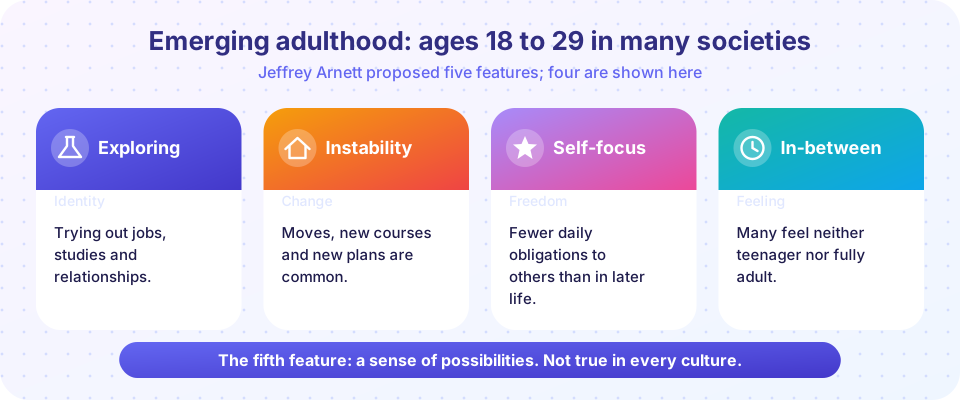
In 2000 Jeffrey Arnett proposed that in wealthy societies where people stay in education longer and marry and have children later, ages 18 to 29 form a distinct phase. He described five features: identity exploration in love and work, instability (many moves and changes), self-focus (fewer daily obligations to others), feeling in between (neither adolescent nor fully adult) and a sense of possibilities.
The idea has been useful but also challenged. Critics say that it describes mostly middle-class young people in industrialized countries. For people who start work early, care for family members, or face poverty, the twenties can be a time of heavy responsibility and little room for exploration. Others say "emerging adulthood" is a period of life, not a universal stage, and that the boundaries depend on economics and culture. Treat it as a helpful description of a common pattern, not a law.
Erikson: intimacy and generativity
Erik Erikson proposed that each phase of life has a central challenge. In young adulthood it is intimacy versus isolation: Can you form close, committed relationships without losing your sense of self? He argued that a secure identity makes real intimacy easier, though research finds the two develop together and not in a strict order.
In middle adulthood it is generativity versus stagnation: caring about the next generation and contributing something lasting, whether through raising children, mentoring, creative work or community service. Dan McAdams and others developed questionnaires and life-story interviews to study generativity. People with higher generativity tend to report greater life satisfaction and civic involvement, though as always, such findings are correlational.
Love, partnership and parenthood
What matters most for a good life? One of the longest studies in psychology, the Harvard Study of Adult Development, began in 1938 with Harvard students and later added men from inner-city Boston, and has followed them and some of their families for over eighty years. A central finding, reported by George Vaillant and later by Robert Waldinger, is that the quality of close relationships at midlife was a strong predictor of later health and happiness, a better predictor than cholesterol levels or social class in some analyses. The sample began with men in a particular era and place, so the results need cautious generalization, but the message is consistent with other work.
John Gottman, who studied hundreds of couples in a laboratory, identified patterns that predicted later relationship trouble. He called four of them "the four horsemen": criticism (attacking character rather than a behavior), contempt, defensiveness and stonewalling. Healthy couples more often began difficult conversations gently and repaired tension with humor or affection. Some of the strongest predictive claims have been questioned for overstating accuracy, so use the patterns as useful warning signs and not as a fortune-telling tool.
Parenthood is a major transition. On average, couples report a dip in relationship satisfaction after the first child, but the size varies, and couples who share childcare and household work fairly and who stay connected tend to fare better. Parenting also brings meaning and growth for many people.
Work
Work shapes identity, income, daily structure and social contacts. Job satisfaction depends on pay but also on autonomy, fairness, good colleagues and a sense of purpose. Job loss is linked to distress and, on average, to a lasting dip in wellbeing for some people. Many adults change careers more than once. Researchers who study "the social clock" (Bernice Neugarten) note that expectations about timing have loosened in many societies, which gives people more freedom and more uncertainty.
The midlife crisis: myth or fact?
The phrase suggests that at around 40 to 50 many adults fall into a crisis of regret and make dramatic changes. Large surveys, such as the MIDUS study in the United States, find that a small minority of people report something they call a midlife crisis, and that many of those report a trigger such as divorce or job loss. Most people do not experience a crisis tied specifically to age. Midlife is, however, a time of reassessment and of heavy responsibilities: many people care for children and aging parents at once.
Does personality change?
The Big Five traits (openness, conscientiousness, extraversion, agreeableness and neuroticism) are fairly stable from person to person, but average levels change. A 2006 meta-analysis by Brent Roberts, Kate Walton and Wolfgang Viechtbauer found that, on average, people become more conscientious, more agreeable and less neurotic from young adulthood into middle age. This is called the maturity principle. Life roles, such as holding a steady job or having a committed partner, appear to encourage these changes. The averages hide big individual differences, and some people change more than others.
Common misconceptions
- "Everyone goes through a midlife crisis." Most people do not.
- "Emerging adulthood is universal." It fits some groups much better than others.
- "Personality is fixed after childhood." The average person changes, though ranking among peers is fairly stable.
- "Marriage always makes people happier." Relationship quality matters more than status.
Try it
First, an Erikson explorer. Click a stage to see its typical age range and central question. The ages are guides, not rigid boundaries.
Second, a Likert scoring demo, using reverse-scored items. The items are our own practice examples about generativity, and this is a demonstration of scoring, not a real psychological test.
Press Run (or Ctrl + Enter) to see the result here.
Program input · what you'd type while the program runs
Type the answers before you press Run, one per line. Each time the program reads a line (with input()), it gets the next line from this box.
Third, a toy sorter for conflict talk. It shows the idea behind Gottman's four horsemen. It uses keywords, so it is crude, and real coding examines tone and context.
Press Run (or Ctrl + Enter) to see the console output here.
No output.
Check your understanding
Quick check · 5 questions
of 5 answered You scored / 5 · perfect!
-
1. Who proposed the idea of emerging adulthood, and for roughly which ages?
Jeffrey Arnett described ages about 18 to 29 in societies with long education and delayed family formation. -
2. What does generativity mean?
It is Erikson's central theme of middle adulthood. -
3. A key finding of the Harvard Study of Adult Development is that...
Close, supportive relationships at midlife were strongly linked to later wellbeing. -
4. What do large surveys such as MIDUS suggest about midlife crises?
Most people do not experience an age-tied crisis. -
5. What is the maturity principle?
Meta-analyses find these average shifts from young adulthood into middle age.
Summary
- Emerging adulthood describes a common, not universal, phase of exploration and instability between about 18 and 29.
- Erikson saw intimacy in young adulthood and generativity in middle adulthood as central challenges.
- Long studies point to the quality of close relationships as a strong influence on health and happiness.
- The midlife crisis is less common than its reputation; personality shows average maturity gains.
Track your progress
Create a free account to tick off lessons and pick up where you left off on any device.
of Developmental Psychology lessons completed