


















Lesson 42 of 46 · Projects and Practice
Case studies in developmental science: Genie, Bucharest, Dunedin and Seattle
Read four landmark developmental studies like a scientist: the question, the design, the findings, the limits and the ethics, then practice with effect sizes.
Textbooks often turn studies into one-line facts: "Harlow showed...", "Dunedin proved...". Real studies are messier. Someone asked a question, chose a design, ran into limits and drew careful (or too bold) conclusions. In this lesson you will read four famous cases the way a scientist does, and you will practice a tool for judging how big a finding really is.
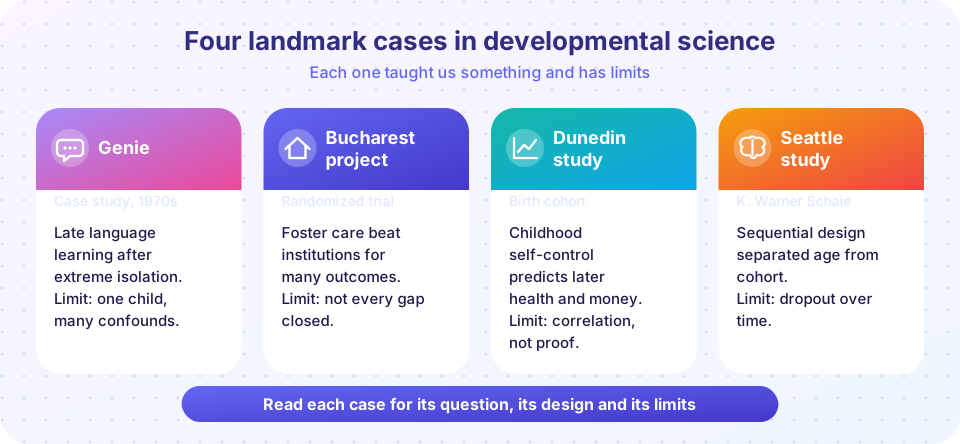
Each case teaches a different lesson about method. Genie shows the power and the limits of a single case. The Bucharest Early Intervention Project shows what a randomized trial can answer when an experiment is ethically possible. The Dunedin study shows what a long-running birth cohort can reveal. The Seattle Longitudinal Study shows how clever design untangles age from generation.
What you will learn
- How to read a study using five questions: question, design, findings, limits, ethics.
- What each of the four cases found and what it cannot show.
- How to judge the size of an effect with Cohen's d.
Key terms
- Case study: an in-depth description of one person or a very small group.
- Randomized controlled trial (RCT): participants are randomly assigned to conditions so that groups are alike except for the treatment.
- Birth cohort study: following everyone born in a place and time across many years.
- Sequential design: combines cross-sectional and longitudinal samples to separate age from cohort.
- Effect size: a measure of how big a difference or relationship is, such as Cohen's d or a correlation.
A reading routine: five questions
For any study, ask:
- Question. What exactly did the researchers want to know?
- Design. Who took part, how were they chosen and how was it measured? Was there a comparison group?
- Findings. What did they find, and how large was the effect?
- Limits. Who might be missing? Could something else explain the results? Has it been replicated?
- Ethics. Were participants protected? Would you allow this study today?
Case 1: Genie
Question. Can a person who missed language in early childhood still learn it later? Design. A single case. Genie (a pseudonym) was discovered in California in 1970 at about age 13, after years of severe isolation and abuse. Researchers, including linguist Susan Curtiss, studied her language for several years. Findings. She learned many words and could communicate, but her grammar stayed limited, for example in forming questions and using small function words. Her case is often cited in discussions of a sensitive period. Limits. She also suffered extreme malnutrition, trauma and neglect, which makes it impossible to say that missing language exposure alone explains her outcome. A single case cannot be generalized. Ethics. Genie was a vulnerable child. Her case has been criticized for mixing research and care, and there were disputes about her treatment and where she lived afterward. It is a lesson in why researchers owe participants protection first and data second.
Case 2: the Bucharest Early Intervention Project
Question. Does moving a child from institutional care to a family improve development? Design. After the fall of the Ceausescu regime in Romania, researchers led by Charles Zeanah, Nathan Fox and Charles Nelson assessed institutionalized children under three. They randomly assigned some to foster families, newly created by the project, and others to continued institutional care ("care as usual"). Children were followed for many years. Random assignment was considered ethical because there were not enough foster families for all, and the project did not hold children back from care they would otherwise have received. Findings. Children placed into foster families did better on many measures, including language, cognition and attachment, with the earliest placements doing best. Not all gaps closed. Limits. Foster families were unusual (created and supported by the project); some children moved after the study; results may not apply to all kinds of care. Lesson. Random assignment supports causal claims better than correlational studies can.
Case 3: the Dunedin study
Question. Does childhood self-control predict adult outcomes? Design. Since 1972 to 1973, researchers have followed about 1,000 people born in Dunedin, New Zealand, with regular assessments in childhood, adolescence and adulthood. Self-control was measured from ages three to eleven by parents, teachers, observers and the children. Findings. In a 2011 paper, Terrie Moffitt, Avshalom Caspi and colleagues reported that lower childhood self-control predicted worse health, lower income and more crime in adulthood, even after allowing for intelligence and social class. Sibling comparisons strengthened the finding. Limits. Observational design, so unmeasured factors might matter; one place and time; participants who dropped out could differ from those who stayed. Lesson. A long birth cohort can reveal developmental pathways but cannot alone prove cause.
Case 4: the Seattle Longitudinal Study
Question. How do adult intellectual abilities really change with age? Design. K. Warner Schaie began the study in 1956 and added new samples every seven years, retesting earlier participants (a sequential design). Findings. For many abilities, true individual decline begins later than cross-sectional comparisons suggest, and more recent cohorts often outperform earlier ones on some tests. Limits. Dropout over time (often of people with poorer health), practice effects on repeated tests, and a sample that was mostly from one region and health plan. Lesson. Clever design can separate age from cohort.
How big is the effect? Cohen's d
Finding that two groups differ is not enough. The key question is by how much. Cohen's d divides the difference between group means by the standard deviation. A common rule of thumb is that d of about 0.2 is small, 0.5 medium and 0.8 large. Another way to see it is the probability of superiority: the chance that a randomly chosen person from the higher group scores above a randomly chosen person from the lower group. When d = 0.5 that chance is roughly 64 percent, so the groups overlap a lot.
This matters when you read headlines. A statistically significant effect can be tiny in size, and a large effect in a small sample can be a fluke.
Common misconceptions
- "One famous study settles a question." Replication and different designs matter.
- "A significant result means an important one." Significance is not size.
- "Case studies are worthless." They generate ideas and show what is possible, but cannot prove general claims.
Try it
First, explore effect sizes. This plot shows two groups with a chosen Cohen's d and reports their overlap and the probability of superiority. The curves are normal distributions.
Press Run (or Ctrl + Enter) to see the result here.
Program input · what you'd type while the program runs
Type the answers before you press Run, one per line. Each time the program reads a line (with input()), it gets the next line from this box.
Second, a case-analysis checklist. Fill in the five questions for a study you have read, then see what is missing.
Check your understanding
Quick check · 5 questions
of 5 answered You scored / 5 · perfect!
-
1. Why can the Genie case not prove that missing language exposure alone caused her limited grammar?
Many factors were confounded in a single case. -
2. What made the Bucharest Early Intervention Project good evidence about foster care?
Random assignment supports causal claims better than correlational comparisons. -
3. What does a sequential design, as in the Seattle Longitudinal Study, help to do?
New cohorts were added at intervals while earlier participants were retested. -
4. A study reports d = 0.5. About how likely is a random person in the higher group to outscore a random person in the lower group?
At d = 0.5 the groups overlap a lot, with a probability of superiority around 64 percent. -
5. Which is a limit of the Dunedin study mentioned above?
Observational designs cannot by themselves prove cause.
Summary
- Read any study with five questions: question, design, findings, limits, ethics.
- Genie shows the value and limits of a single case; Bucharest shows what random assignment can show; Dunedin shows what a birth cohort reveals; Seattle shows how a sequential design separates age from cohort.
- Always ask how big an effect is (Cohen's d, probability of superiority), not only whether it is significant.
Track your progress
Create a free account to tick off lessons and pick up where you left off on any device.
of Developmental Psychology lessons completed