


















Lesson 28 of 46 · Language Development
Chapter review: language development
Review the language development chapter with a one-picture summary, a recap table of studies and terms, flashcards and a ten-question mixed quiz.
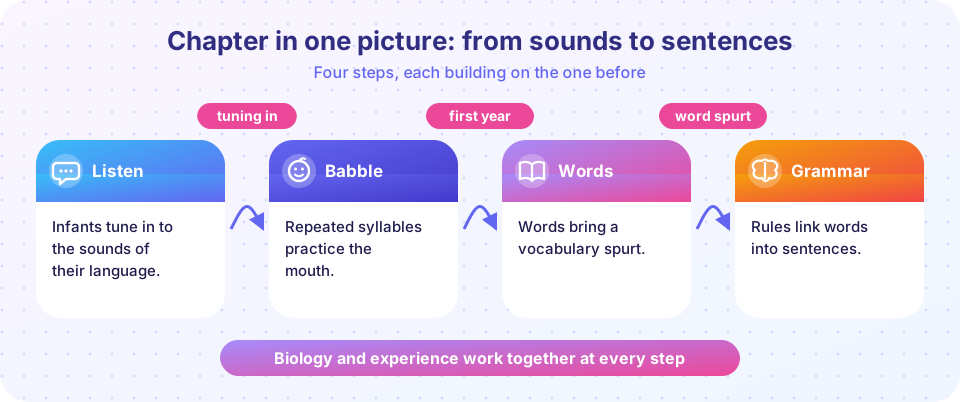
You have now followed a child from the first familiar voice to full sentences, and you have met the theories that try to explain the journey. This review pulls the chapter into one picture, one table and one quiz. Use it to find what you remember and what needs another look.
What you will learn
- A quick recap of the main milestones and the studies behind them.
- How the theories fit together.
- Which ideas still need careful wording, such as the critical period and the bilingual advantage.
Recap table
| Idea | Key names | One-line summary |
|---|---|---|
| Newborn voice preference | DeCasper and Fifer, 1980 | Newborns prefer the voice they heard before birth. |
| Perceptual tuning | Werker and Tees, 1984 | By about 10-12 months, infants favor the sounds of their own language. |
| Statistical learning | Saffran, Aslin and Newport, 1996 | 8-month-olds track which syllables go together. |
| Babbling | Petitto and Marentette, 1991 | Deaf infants babble in sign; babbling is practice for language. |
| Fast mapping | Carey and Bartlett, 1978 | One exposure can give a rough meaning to a new word. |
| Learning theory | Skinner, 1957 | Imitation and reward shape speech; cannot explain novel errors. |
| Nativism | Chomsky, 1959 | Children are born ready for grammar; details debated. |
| Wug test | Berko, 1958 | Children apply plural rules to invented words. |
| Usage-based view | Tomasello | Children find patterns and read intentions. |
| Social interaction | Bruner, Vygotsky | Caregivers scaffold learning. |
| Sensitive period | Lenneberg, 1967; Johnson and Newport, 1989 | Earlier exposure helps; decline is gradual. |
| Bilingualism | many | Normal and not harmful; "advantage" claims contested. |
Common misconceptions
- One theory has won. Researchers usually combine ideas from several theories.
- Children who talk late have a disorder. Many catch up; some do not; only a professional can tell.
- Numbers like the "30 million word gap" are facts. They come from one small study and have been challenged.
Try it
First, flashcards. Click a card to flip between the term and its meaning.
Second, a milestone lookup that lists which typical milestones a child has usually reached by a given age. It is a teaching aid, not a screening tool.
Press Run (or Ctrl + Enter) to see the console output here.
No output.
Check your understanding
Quick check · 10 questions
of 10 answered You scored / 10 · perfect!
-
1. Which finding supports the idea that infants learn from patterns in speech?
After hearing a stream of invented syllables, infants distinguished words from non-words based on transitional probabilities. -
2. What did Werker and Tees (1984) find?
Perception narrows: native contrasts stay easy while non-native contrasts become harder. -
3. A deaf infant exposed to sign language babbles with their hands. What does this suggest?
Petitto and Marentette's finding suggests babbling reflects a general capacity for language structure. -
4. "Daddy go work" is an example of what?
Early sentences keep content words and drop small grammar words. -
5. Why is "goed" evidence against a pure imitation theory?
Adults say "went", so "goed" arises from the child's own rule. -
6. Which pair is matched correctly?
Tomasello is the leading name for usage-based theory. Berko did the wug test, Skinner stressed reinforcement and Chomsky universal grammar. -
7. What does the Johnson and Newport study suggest about age and second-language grammar?
Performance dropped gradually as age of arrival rose, so many scholars say sensitive period. -
8. How does a bilingual child's combined vocabulary compare with a monolingual child's?
Each language may have fewer words, but the total number of concepts is similar or larger. -
9. Which statement about the Genie case is most accurate?
Many abilities were affected by abuse and isolation, so it cannot isolate language alone. -
10. What is joint attention?
Following and sharing attention helps children connect words with the right things.
Summary
- Infants listen before they speak, tune in to native sounds, babble, say first words near 12 months, spurt in vocabulary and learn grammar.
- Theories: learning, nativist, usage-based and social interaction; most researchers blend them.
- Language has a sensitive period with a gradual decline.
- Bilingualism is normal and not harmful.
- Be careful with famous claims: the 30 million word gap and the bilingual advantage are both debated.
Track your progress
Create a free account to tick off lessons and pick up where you left off on any device.
of Developmental Psychology lessons completed