


















Lesson 17 of 46 · Prenatal Development and Infancy
Chapter 3 Review: Prenatal Development and Infancy
Review prenatal stages, teratogens, newborn reflexes and senses, motor milestones and infant brain development with a recap table, a one-picture summary and a ten-question quiz.
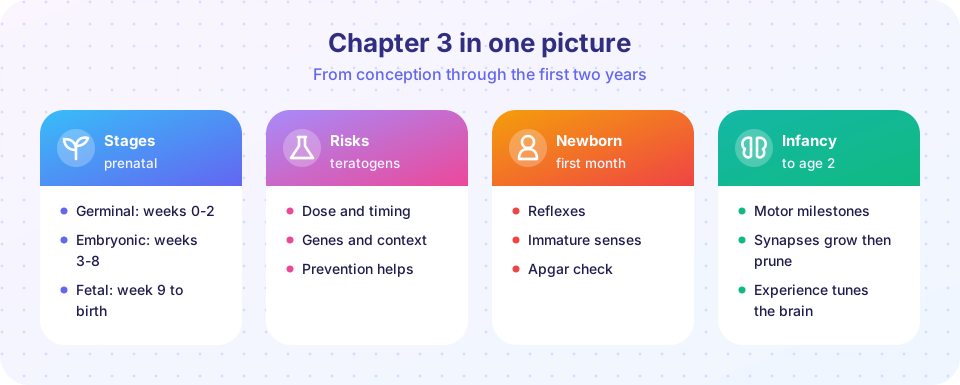
You have followed a human being from one cell to a walking toddler. This review fits the chapter into one picture and one table, then tests it. As you review, keep returning to two themes: timing (when something happens determines what it does) and interplay (biology and experience work together from the start).
Educational information only. The review concerns typical development and research findings. It is not medical advice.
What you will learn
- consolidate stages, risks, newborn abilities and infant growth
- connect timing and interplay across the whole chapter
- practice retrieval with a mixed quiz
Recap table
| Lesson | Key ideas |
|---|---|
| Prenatal Stages | Germinal (weeks 0-2), embryonic (3-8), fetal (9-birth); 46 chromosomes; gestational age is about 2 weeks longer than conception age; fetuses hear and learn simple patterns. |
| Teratogens and Risks | Dose, timing, genes, combination; thalidomide, alcohol (FASD), rubella, Zika; folic acid; "crack baby" overstatement; preterm and low birth weight; resilience. |
| The Newborn | Reflexes (rooting, Moro, grasp), Apgar score, blurry vision, good hearing, states of arousal; disputed findings on imitation and intermodal matching. |
| Motor Skills and the Infant Brain | Cephalocaudal and proximodistal; WHO milestones with wide windows; dynamic systems; synapse overproduction and pruning; myths of "first three years" and Mozart. |
Key terms
Zygote, blastocyst, embryo, fetus: the stages of the developing organism.
Teratogen, sensitive period, FASD: vocabulary of prenatal risk.
Reflex, Apgar, habituation: newborn vocabulary.
Synaptic pruning, myelination, experience-expectant plasticity: the language of brain change.
The two themes
Timing. Organs have sensitive periods, so the same exposure matters more at some times than others. In infancy, sensory and motor circuits have their own sensitive periods (for instance, vision needs patterned light early). When you meet a new risk or benefit, ask when.
Interplay. The fetus responds to its mother's nutrition and voice, and the newborn's reflexes meet caregiving. Babies learn to walk through thousands of practice steps while the brain prunes and strengthens circuits. Neither biology nor experience works alone.
Common misconceptions
"The placenta blocks everything harmful." Many substances and infections cross it.
"Early alarming findings are reliable." The "crack baby" story shows why replication and confounds matter.
"Milestone ages are deadlines." They are medians in wide windows.
"Infants are blank slates." Reflexes, preferences and sensory abilities are present at birth.
Try it
Press Run (or Ctrl + Enter) to see the result here.
Program input · what you'd type while the program runs
Type the answers before you press Run, one per line. Each time the program reads a line (with input()), it gets the next line from this box.
Check your understanding
Quick check · 10 questions
of 10 answered You scored / 10 · perfect!
-
1. During which stage is the organism most vulnerable to structural birth defects?
Organs form during weeks 3 to 8 after conception. -
2. Which pair correctly matches a teratogen with a well-known effect?
Thalidomide taken in early pregnancy caused severe limb defects in thousands of babies. -
3. A baby is born at 39 weeks and has a 1-minute Apgar score of 8. What does this most likely mean?
A score of 7 to 10 is generally reassuring. It is not a prediction of later intelligence. -
4. Which finding supports the dynamic systems view of motor development?
Thelen's water and weight experiments showed that body and environment shape the behavior. -
5. What is experience-expectant plasticity?
Experience-expectant circuits rely on universal experiences; absence of them (as in untreated cataracts) impairs development. -
6. Which claim about early brain development is a myth?
Early experience matters, but the brain stays plastic and many windows stay open. -
7. Why is it risky to treat the early 'crack baby' reports as established fact?
Early claims overstated the effects; confounders were not controlled. -
8. What did the Oostenbroek study (2016) cast doubt on?
It found no evidence of imitation in a large longitudinal sample, challenging the classic result. -
9. A mother reads the same story aloud during late pregnancy and her newborn later prefers it. This is evidence that...
DeCasper and Spence (1986) found a preference for a familiar story, suggesting prenatal auditory learning. -
10. According to the WHO study, which statement about walking alone is accurate?
Medians are central values; the window for healthy infants is wide.
Summary
- Prenatal development runs from germinal through embryonic to fetal stages, with timing determining vulnerability.
- Teratogens act through dose, timing, genetics and combination; protective factors and resilience matter.
- Newborns bring reflexes, preferences and sensory skills; some famous findings are disputed.
- Infant motor skills and brain circuits develop together through maturation and practice, with pruning shaping the wiring.
Track your progress
Create a free account to tick off lessons and pick up where you left off on any device.
of Developmental Psychology lessons completed