


















Lesson 6 of 46 · Methods and Theories of Development
Methods and Theories of Development: Overview
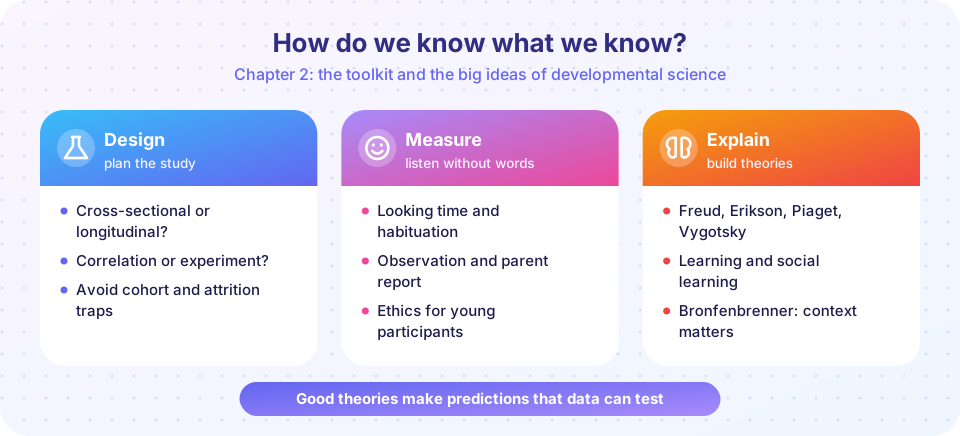
Chapter 2 overview: the research designs, measurement tools, ethics and theories that developmental scientists use to turn questions about change into evidence.
Babies cannot fill in a questionnaire. Children forget, imagine and tell adults what they think adults want to hear. People change while you are studying them, and the most interesting questions (what causes a person to become who they are) cannot be settled by randomly assigning children to different parents. Developmental science has therefore invented clever designs and tools. This chapter shows how they work, and then introduces the theories that organize what the data mean.
What you will learn
- see how chapter 2 connects design, measurement, ethics and theory
- preview the main designs (cross-sectional, longitudinal, sequential)
- preview the tools used with babies and young children
- preview the major theory families and the ecological systems model
Key terms
Research design: the plan for who is studied, when and how often.
Theory: a set of ideas that explains findings and predicts new ones.
Hypothesis: a testable prediction derived from a theory.
Operational definition: a precise description of how a concept will be measured.
The big picture
Every study in this course follows a cycle. Researchers begin with a question ("Do babies expect objects to keep existing?"), derive a hypothesis from a theory, choose a design, define and measure the behavior, analyze the data and then revise the theory. The cycle repeats, and the best theories survive because they make risky predictions that could have failed.
The research cycle
Choosing a design
Tools for little ones
Why ethics matter
What each lesson covers
- Research Designs: cross-sectional, longitudinal and sequential designs, cohort effects, attrition, and famous long-running studies, with two simulations.
- Studying Babies and Research Ethics: habituation, preferential looking, violation of expectation, what looking time can and cannot tell us, and the principles that protect child participants.
- Major Theoretical Perspectives: psychodynamic, learning, cognitive and contextual families of theory, with Erikson's eight stages and a model of conditioning.
- Ecological Systems: Bronfenbrenner's nested layers of context and how to use them to analyze a child's life.
- Chapter 2 Review: the whole chapter in a picture and a ten-question quiz.
How to judge a study (a short checklist)
Whenever you read about a result, ask:
- Who was studied, how many, and from where?
- How were the key terms measured?
- Could something else explain the pattern (a third variable, a cohort difference)?
- Has it been replicated by other teams?
- How big is the effect, not just whether it is "significant"?
Use this checklist on every claim you meet in the news. You will find that "studies show" often means one small study.
Common misconceptions
"A theory is just a guess." In science a theory is a well-developed explanation that has survived tests. Developmental theories vary in how well they have done, and the course will tell you which parts held up.
"Correlation shows cause." Two things that go together may both be caused by a third. Only carefully controlled experiments can support causal claims, and many developmental questions cannot be tested that way.
Try it
Check your understanding
Quick check · 4 questions
of 4 answered You scored / 4 · perfect!
-
1. What is an operational definition?
It turns an abstract idea such as 'attention' into something measurable, like seconds of looking time. -
2. Which sequence best describes the research cycle?
Theories generate hypotheses, which are tested, and the results feed back into the theory. -
3. A newspaper says 'a study shows that X causes Y' based on a survey. What should you ask first?
Surveys show associations. Causal claims need designs that rule out alternative explanations. -
4. Why do good theories make 'risky predictions'?
A prediction that cannot fail teaches nothing; risky predictions let data support or reject the theory.
Summary
- Developmental research moves from question to hypothesis, design, measurement and revision.
- Designs trade speed, cost and clarity; tools are adapted to babies and children.
- Ethics protect participants and are part of good method.
- Theories organize findings, and good ones make testable, risky predictions.
Next: Research Designs
Track your progress
Create a free account to tick off lessons and pick up where you left off on any device.
of Developmental Psychology lessons completed